
Free Safe Operating Procedure (Furniture Steam Clean) Template
Download our free Safe Operating Procedure template for furniture steam cleaning. This customisable DOCX and PDF helps define safe work methods.
Free Safe Operating Procedure (Furniture Steam Clean) Template
DOCX • 126 KB + PDF
Updated Oct 2026
No signup required
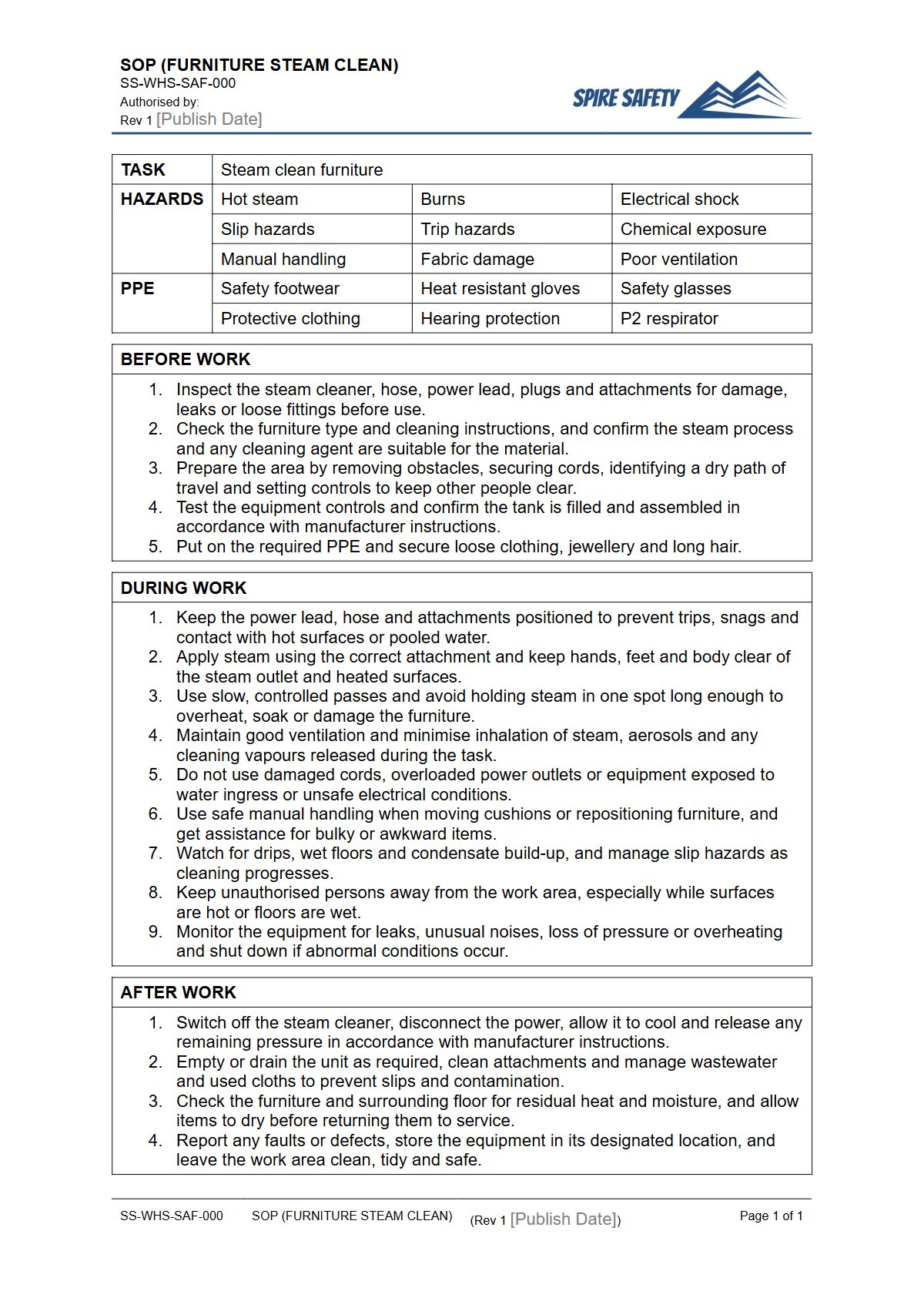
Purpose of the Free Safe Operating Procedure (Furniture Steam Clean) Template
Operating a furniture steam cleaner, while common in many commercial cleaning and facility management settings, involves a range of health and safety risks. This Safe Operating Procedure (SOP) provides a structured framework for documenting the step-by-step process required to perform the task safely.
It is designed to help persons conducting a business or undertaking (PCBUs) meet their primary duty of care by managing hazards such as thermal burns from steam, electrical shock from faulty equipment, exposure to cleaning chemicals, and ergonomic injuries from manual handling.
A well-defined SOP is a critical administrative control measure. It serves as a vital tool for worker training, competency verification, and ongoing supervision.
By implementing a clear procedure, you can standardise safe work practices across your organisation, reduce the likelihood of incidents, and demonstrate a proactive approach to workplace safety. This is a fundamental component of developing robust WHS management systems that protect your workers and your business.
Video walkthrough
How to use the Free Safe Operating Procedure (Furniture Steam Clean) Template
This document is provided as a user-friendly template in both DOCX and PDF formats. To implement it effectively in your workplace, you should follow a systematic process.
Begin by downloading the file and reviewing its contents alongside the manufacturer’s instructions for your specific steam cleaning equipment. The template is a starting point, aligned with Australian WHS principles, but requires site-specific information to be effective.
Engage in consultation with the workers who will be performing the task. Their direct experience is invaluable for identifying practical challenges and effective control measures.
Fill in the sections for site details, required Personal Protective Equipment (PPE), pre-start checks, and the step-by-step procedure. Once complete, the SOP should be formally approved, and all relevant workers must be trained on its contents before undertaking the work.
IMPORTANT: This is a template document. We have drafted it as a guide, but you must customise it to reflect the specific equipment, chemicals, processes, and control measures used in your workplace.
We recommend a consultation process with your team to ensure the SOP is practical and effective.
Key hazards in furniture steam cleaning
A thorough risk assessment should precede the finalisation of your SOP. Key hazards associated with furniture steam cleaning include:
- Thermal Burns: Direct contact with hot steam, water, or heated components of the machine can cause serious burns.
- Electrical Hazards: The combination of water and electricity creates a significant risk of electric shock, particularly if equipment is poorly maintained, cords are frayed, or work is done near live power sources.
- Chemical Exposure: Cleaning agents and pre-treatment sprays can cause skin irritation, respiratory issues, or allergic reactions if not handled correctly. Referencing the Safety Data Sheet (SDS) for each chemical is essential.
- Slips, Trips & Falls: Wet floors, trailing electrical cords, and water hoses create a hazardous environment for both the operator and others in the vicinity. Proper housekeeping and barricading are crucial. For tasks requiring work at height, such as cleaning drapes, a step ladder SOP should also be consulted and followed.
- Ergonomic & Musculoskeletal Injuries: Manual handling of heavy furniture, awkward postures, and repetitive movements can lead to strains and sprains.
When to use this Safe Operating Procedure
The SOP for furniture steam cleaning should be used as a primary reference document in several scenarios. It must be consulted by operators before starting the task for the first time and used as a checklist for pre-operational safety checks.
It forms the basis of initial and refresher training programs for all staff authorised to use the equipment. Supervisors can also use it as a tool for conducting workplace observations and verifying that safe work practices are being followed consistently.
Furthermore, in the event of an emergency or equipment malfunction, the procedure should outline immediate response steps, which might include referencing a defibrillator operation procedure if a serious electrical incident occurs.
Who should use it
This SOP is intended for a broad range of personnel within an organisation. Primarily, it is for the workers who directly operate the steam cleaning equipment.
It is also a critical document for their supervisors and managers, who are responsible for ensuring work is performed safely and for providing adequate training. WHS managers and safety officers will use this document as part of the overall safety management system, integrating it into risk assessments, training needs analyses, and incident investigations.
The effectiveness of any procedure relies on periodic review, which is why regular WHS compliance auditing is recommended to ensure documentation stays current with operational practices and regulatory changes. For other common plant, you might also find our air compressor SOP template a useful addition to your safety library.
Common mistakes
Common mistakes to avoid
- Failing to properly cordon off the work area, creating slip hazards for others.
- Neglecting to test cleaning solutions on an inconspicuous area of the furniture fabric first.
- Using equipment with damaged electrical cords or without a current test-and-tag.
- Inadequate ventilation when using chemical pre-sprays or spot treatments.
Legal references
Legal considerations
The following legal requirements may be relevant to this type of work.
- Work Health and Safety Act (Harmonised) — Provides the primary duties for protecting workers and other people from work health and safety risks.
- Work Health and Safety Regulations (Harmonised) — Sets out requirements supporting the management of workplace hazards and risks.
The following codes may be relevant to this type of work.
- Managing WHS Risks Code of Practice — Provides practical guidance on identifying hazards, assessing risks and applying effective controls.
- Work Health and Safety Consultation, Cooperation and Coordination Code of Practice — Provides practical guidance on consulting workers and coordinating with other duty holders.
- Managing the Work Environment and Facilities Code of Practice — Provides practical guidance on safe work environments, workplace facilities and related controls.
Did you know
Sanitisation Power
Steam heated to over 100°C is highly effective at killing bacteria, mould spores, and dust mites without the need for harsh chemicals, making it a powerful tool for sanitisation and allergen reduction.
FAQ
Frequently asked questions
01What should be included in a Safe Operating Procedure for steam cleaning?
02Is personal protective equipment (PPE) required for furniture steam cleaning?
03How often should a furniture steam cleaning SOP be reviewed?
04Can this template be used for commercial carpet steam cleaners?
Share this resource
Free Safe Operating Procedure (Furniture Steam Clean) Template
Browse Categories
How To Use It
- 1Download and open in Word or PDF.
- 2Replace the placeholders with your business details.
- 3Get it reviewed by a WHS specialist before rollout.
Need it customised?
Our WHS consultants can adapt this template to your site, run a gap analysis, or audit what you already have in place.
Book a Free Consultation WHS consulting servicesor call 1300 156 382
Related templates
- Free Safe Operating Procedure (Fuse Puller) Template
- Free Safe Operating Procedure (Galvanising) Template
- Free Safe Operating Procedure (Gang Saw) Template
- Free Safe Operating Procedure (Gangway Inspection) Template
- Free Safe Operating Procedure (Gangway Use) Template
- Free Safe Operating Procedure (Gantry Crane) Template