
Free Safe Operating Procedure (Gantry Crane) Template
Download our free Safe Operating Procedure (Gantry Crane) template. A customisable DOCX & PDF to help you outline safe work methods for gantry crane operations.
Free Safe Operating Procedure (Gantry Crane) Template
DOCX • 126 KB + PDF
Updated Oct 2026
No signup required
Purpose of the Free Safe Operating Procedure (Gantry Crane) Template
Effectively managing workplace health and safety requires clear, documented processes for high-risk equipment. This free Safe Operating Procedure (Gantry Crane) template provides a structured starting point for your organisation to formalise the steps required for the safe use of gantry cranes.
A well-developed SOP is a critical tool for training personnel, standardising operational conduct, and demonstrating a systematic approach to risk management. It helps ensure every operator understands the required pre-start checks, operational steps, shutdown procedures, and associated hazards before commencing work.
Using this template helps you document control measures identified during your risk assessment process. It forms a key component of a safe system of work, integrating seamlessly into your broader WHS management system. The primary goal is to minimise the risk of incidents, equipment damage, or personal injury by providing unambiguous instructions for a routine, yet potentially hazardous, task.
Documenting these procedures is a fundamental step in fulfilling your duties as a PCBU (Person Conducting a Business or Undertaking).
Video walkthrough
How to use the Free Safe Operating Procedure (Gantry Crane) Template
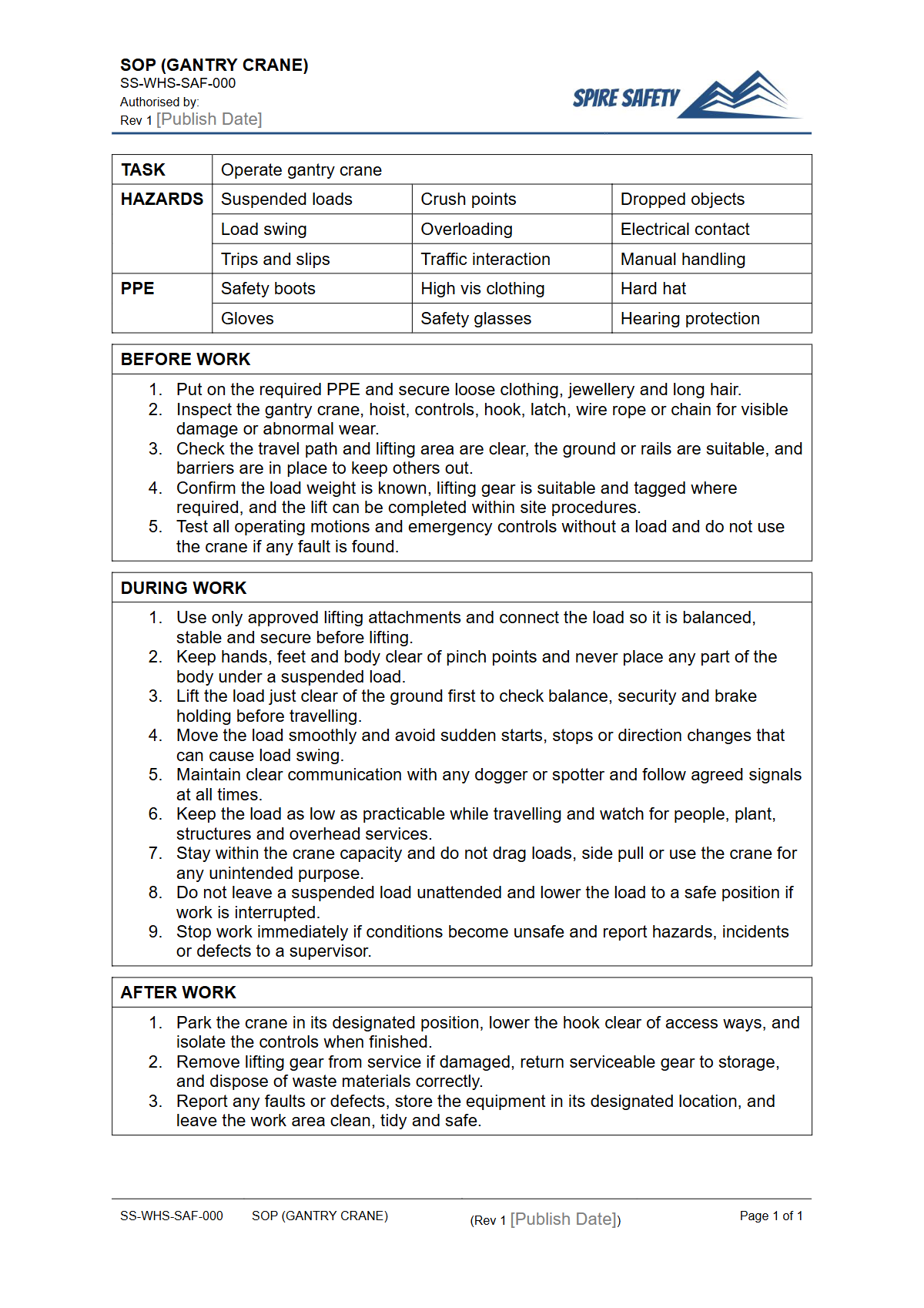
This Safe Operating Procedure for gantry cranes is provided as a fully editable DOCX file, with a PDF version also available for easy printing and distribution. To use it, simply download the file and open it in your word processing software.
The document is logically structured with sections for PPE, pre-operational checks, step-by-step operating instructions, and post-operational tasks.
IMPORTANT: This is a template only. We have provided a structured starting point aligned with Australian WHS practice, but you MUST customise this document with your site-specific details.
This includes the make and model of your gantry crane, specific workplace hazards (like overhead powerlines or pedestrian walkways), emergency procedures, load limitations, and relevant personnel. Generic, uncustomised procedures are not effective and may not adequately control risks in your unique environment.
When to use a Gantry Crane SOP
A Safe Operating Procedure for a gantry crane should be used consistently for all related tasks. It is not a document to be completed once and filed away.
It should be developed before the crane is first used, integrated into the induction and training for all new operators, and be readily available in the work area for easy reference. Supervisors should use the SOP as a benchmark for observing work practices and conducting competency conversations.
The document should also be reviewed and updated following any incident, when new information about hazards becomes available, or when changes are made to the equipment or work environment.
While this SOP covers a specific type of crane, the principles apply to other heavy equipment. For example, the process of documenting safe operation is similar for our free Telehandler SOP template, which also involves lifting and moving loads in a dynamic environment.
Who should use this Safe Operating Procedure
This document is intended for a range of personnel within an organisation. PCBUs and managers are responsible for ensuring that safe systems of work, such as SOPs, are developed, implemented, and maintained.
Safety advisors and WHS officers will often be tasked with drafting, reviewing, and facilitating the customisation of the template. Supervisors must use the SOP to train, monitor, and direct workers.
Finally, crane operators are the primary end-users who must understand and follow the procedure every time they use the equipment to ensure their own safety and the safety of others around them.
The development of an effective SOP often requires input from multiple stakeholders, including the operators who perform the task daily. If your team lacks the internal expertise to adapt this template confidently or to assess the unique risks of your operations, engaging external WHS consulting services can provide the necessary guidance and assurance.
Review and Continuous Improvement
An SOP is a live document. It should be scheduled for regular review—at least annually, or more frequently if risk levels demand it.
Triggers for an unscheduled review include equipment modifications, changes in the work environment, or after an incident or near-miss. These reviews are a vital part of continuous improvement and can be incorporated into your schedule of WHS compliance auditing to verify that documented procedures match actual practice.
Just as procedures for gantry cranes require specific detail, so too does other specialised machinery. A similar structured approach can be seen in our free Boom Pump SOP template, highlighting the importance of tailoring instructions to the unique risks of each piece of plant.
You can explore these and many other templates in our free WHS resources library to build a comprehensive set of workplace procedures.
Common mistakes
Common mistakes to avoid
- Failing to customise the template with site-specific details, crane models, and unique hazards.
- Neglecting to include comprehensive pre-start and post-operation checklists in the procedure.
- Not clearly referencing the crane's load chart and capacity limits within the SOP.
- Using the SOP for one-off training but failing to keep it accessible in the work area for daily reference.
Legal references
Legal considerations
The following legal requirements may be relevant to this type of work.
- Work Health and Safety Act (Harmonised) — Provides the primary duties for protecting workers and other people from work health and safety risks.
- Work Health and Safety Regulations (Harmonised) — Sets out requirements supporting the management of workplace hazards and risks.
The following codes may be relevant to this type of work.
- Managing WHS Risks Code of Practice — Provides practical guidance on identifying hazards, assessing risks and applying effective controls.
- Work Health and Safety Consultation, Cooperation and Coordination Code of Practice — Provides practical guidance on consulting workers and coordinating with other duty holders.
- Managing the Work Environment and Facilities Code of Practice — Provides practical guidance on safe work environments, workplace facilities and related controls.
Did you know
Design Working Period
Cranes are designed for a finite life, known as the Design Working Period (DWP). Australian Standard AS 2550.1 requires major inspections and assessments as cranes approach the end of their DWP to ensure they remain safe to operate.
FAQ
Frequently asked questions
01What's the difference between a SWMS and an SOP for a gantry crane?
02Who needs to be trained on the gantry crane SOP?
03How often should a gantry crane SOP be reviewed?
04Is a gantry crane operator required to hold a High Risk Work Licence?
Share this resource
Free Safe Operating Procedure (Gantry Crane) Template
Browse Categories
How To Use It
- 1Download and open in Word or PDF.
- 2Replace the placeholders with your business details.
- 3Get it reviewed by a WHS specialist before rollout.
Need it customised?
Our WHS consultants can adapt this template to your site, run a gap analysis, or audit what you already have in place.
Book a Free Consultation WHS consulting servicesor call 1300 156 382
Related templates
- Free Safe Operating Procedure (Garage Door Reset) Template
- Free Safe Operating Procedure (Garage Door Service) Template
- Free Safe Operating Procedure (Garden Bed Edging) Template
- Free Safe Operating Procedure (Garden Bed Mulching) Template
- Free Safe Operating Procedure (Garden Bed Weeding) Template
- Free Safe Operating Procedure (Garden Path Cleaning) Template