
Free Safe Operating Procedure (Garden Path Cleaning) Template
Download our free Safe Operating Procedure (Garden Path Cleaning) template. This customisable DOCX and PDF provides a structured framework for WHS.
Free Safe Operating Procedure (Garden Path Cleaning) Template
DOCX • 126 KB + PDF
Updated Oct 2026
No signup required
Purpose of the Free Safe Operating Procedure (Garden Path Cleaning) Template
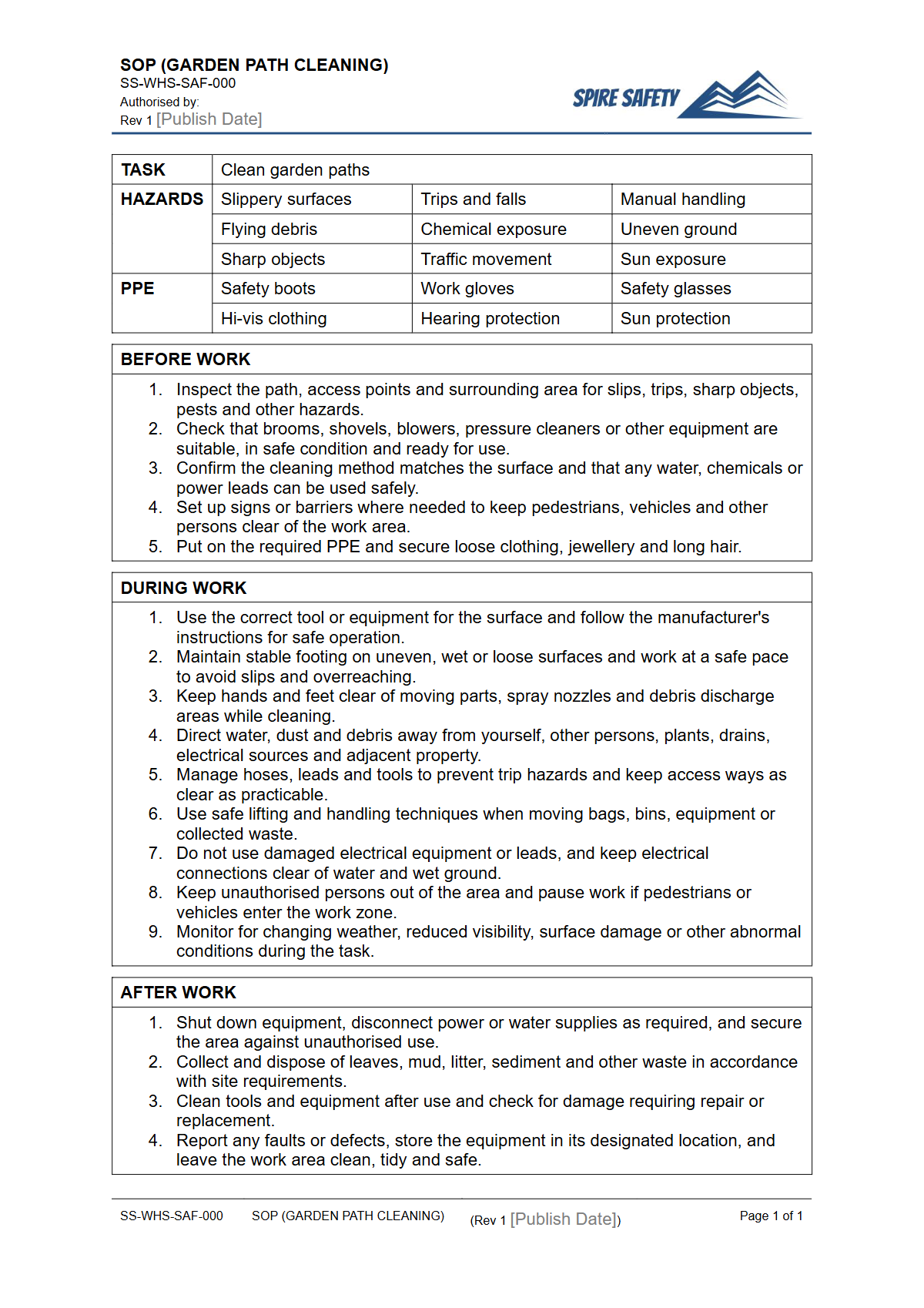
A Safe Operating Procedure (SOP) is a fundamental WHS document that outlines the step-by-step process for completing a task safely. This free Safe Operating Procedure (Garden Path Cleaning) Template provides a structured starting point for organisations to document the hazards and control measures associated with cleaning outdoor pathways.
Garden path cleaning, while seemingly straightforward, involves numerous risks, including slips on wet or mossy surfaces, high-pressure water injuries from pressure washers, manual handling strains from moving equipment, and potential exposure to cleaning chemicals.
This template is designed to help you formalise your approach to managing these risks. By creating a clear, documented procedure, you provide workers with essential instructions, promote consistent and safe work practices, and demonstrate a commitment to workplace health and safety.
Properly implemented, this SOP forms a key part of your overall risk management strategy and contributes to creating a safer working environment for everyone involved in property maintenance and landscaping tasks.
Video walkthrough
How to use the Free Safe Operating Procedure (Garden Path Cleaning) Template
This resource is available for download as a DOCX file, which can be easily edited and customised to fit your organisation's specific needs. To use the template effectively, you should add your company name and logo, and then meticulously review each section.
It is vital to adapt the content to reflect the actual equipment (e.g., specific models of pressure washers), chemicals, and unique environmental conditions of your worksite. Some pressure washers are powered by compressed air, which may require a specific air compressor Safe Operating Procedure to be developed alongside this one.
Important: This document is a template only. It provides a foundation based on Australian WHS principles, but it is not a complete, ready-to-use procedure.
We have provided a framework, but you must conduct a site-specific risk assessment and tailor the document to your operational context to ensure it is effective. If you require assistance, our specialist WHS consulting services can help you develop and implement robust safety documentation.
When to use a Safe Operating Procedure
A Safe Operating Procedure for garden path cleaning should be developed and implemented before any worker undertakes the task for the first time. It serves as a primary training tool during worker induction and for specific task training, ensuring everyone understands the approved, safe method of work from the outset.
The SOP should also be a key reference document during pre-start meetings or toolbox talks to refresh knowledge on hazards and controls.
Furthermore, the SOP is a dynamic document. It should be reviewed regularly as part of your scheduled safety audits, whenever new equipment or chemicals are introduced, or after any incident or near-miss occurs.
This ensures the procedure remains relevant, effective, and continuously improves safety outcomes. Integrating this process into your broader comprehensive WHS management systems ensures safety documentation keeps pace with operational changes.
Who should use this Safe Operating Procedure
This SOP is intended for any Person Conducting a Business or Undertaking (PCBU) whose workers perform garden path cleaning. This includes businesses in landscaping, property maintenance, groundskeeping, strata management, and local councils.
It is also relevant for schools, retirement villages, and any organisation responsible for maintaining safe access to its premises. Supervisors and managers should use the SOP to train and oversee workers, ensuring compliance with the established procedures.
Workers themselves are primary users of the SOP, as it guides their actions and empowers them to work safely. The document should be made easily accessible to them at all times.
This procedure is also a valuable resource for WHS officers and safety committees responsible for developing and reviewing workplace safety protocols. For other common maintenance or landscaping tasks, you can find more templates in our free WHS resources library.
Additional Considerations for Garden Path Cleaning
When customising this template, consider every aspect of the task. For example, if accessing water taps requires working at a height, even a small one, a separate procedure for ladder safety may be needed.
You can use our step ladder SOP as a reference for these situations. While this SOP covers the cleaning task itself, remember to document safety procedures for all related site activities to ensure a holistic approach.
For example, major landscaping projects require safety documentation for every stage, such as our free Trencher SOP template for groundwork.
Common mistakes
Common mistakes to avoid
- Using the template 'as-is' without customising it for specific equipment and site conditions.
- Failing to train all relevant workers on the contents of the finalised SOP.
- Not checking the Safety Data Sheet (SDS) for every cleaning chemical used and incorporating its requirements.
- Forgetting to review and update the SOP after an incident or when procedures change.
Legal references
Legal considerations
The following legal requirements may be relevant to this type of work.
- Work Health and Safety Act (Harmonised) — Provides the primary duties for protecting workers and other people from work health and safety risks.
- Work Health and Safety Regulations (Harmonised) — Sets out requirements supporting the management of workplace hazards and risks.
The following codes may be relevant to this type of work.
- Managing WHS Risks Code of Practice — Provides practical guidance on identifying hazards, assessing risks and applying effective controls.
- Work Health and Safety Consultation, Cooperation and Coordination Code of Practice — Provides practical guidance on consulting workers and coordinating with other duty holders.
- Managing the Work Environment and Facilities Code of Practice — Provides practical guidance on safe work environments, workplace facilities and related controls.
Did you know
Slips, Trips and Falls
According to Safe Work Australia, slips, trips and falls are a leading cause of workplace injury. From 2015-19, they were responsible for 21% of serious claims, with falls on the same level being the most common cause.
FAQ
Frequently asked questions
01What is a Safe Operating Procedure (SOP)?
02Do I legally need an SOP for cleaning garden paths?
03What are the main hazards of garden path cleaning?
04Can I use this template for a commercial pressure washing business?
Share this resource
Free Safe Operating Procedure (Garden Path Cleaning) Template
Browse Categories
How To Use It
- 1Download and open in Word or PDF.
- 2Replace the placeholders with your business details.
- 3Get it reviewed by a WHS specialist before rollout.
Need it customised?
Our WHS consultants can adapt this template to your site, run a gap analysis, or audit what you already have in place.
Book a Free Consultation WHS consulting servicesor call 1300 156 382
Related templates
- Free Safe Operating Procedure (Garden Tool Cleaning) Template
- Free Safe Operating Procedure (Garden Waste Loading) Template
- Free Safe Operating Procedure (Garden Waste Removal) Template
- Free Safe Operating Procedure (Garden Watering) Template
- Free Safe Operating Procedure (Garment Steamer) Template
- Free Safe Operating Procedure (Gas Bottle Storage) Template