
Free Safe Operating Procedure (Garden Tool Cleaning) Template
Download our free Safe Operating Procedure for Garden Tool Cleaning. This editable DOCX and PDF template helps you document safe work methods.
Free Safe Operating Procedure (Garden Tool Cleaning) Template
DOCX • 126 KB + PDF
Updated Oct 2026
No signup required
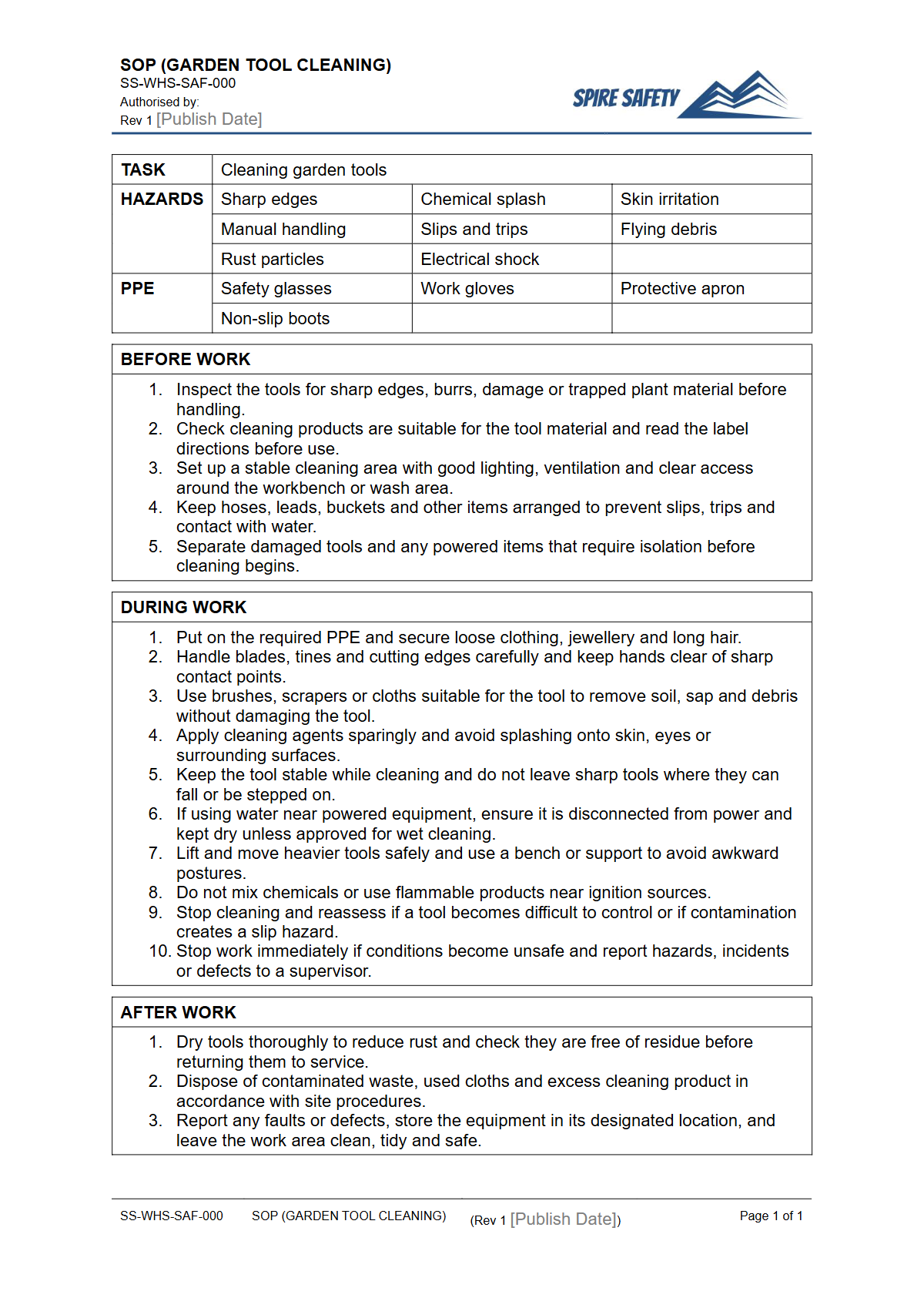
Purpose of the Free Safe Operating Procedure (Garden Tool Cleaning) Template
This Safe Operating Procedure (SOP) template provides a clear, structured framework for cleaning and maintaining garden tools safely. Using this template helps your organisation meet its duty of care by systematically identifying hazards and outlining control measures.
Proper tool cleaning is not just about hygiene; it's a critical safety task that prevents injuries from sharp edges, exposure to harmful chemicals, and infection from biological contaminants. A documented procedure ensures that all workers perform the task to the same safe standard, every time.
Implementing a standardised procedure for tasks like tool cleaning is a cornerstone of effective safety management. It provides evidence of proactive risk management and forms a vital part of more comprehensive WHS management systems. This document helps ensure workers are aware of the risks and the required controls, such as wearing correct PPE and following specific steps for handling cleaning agents.
Video walkthrough
How to use the Free Safe Operating Procedure (Garden Tool Cleaning) Template
Our Free Safe Operating Procedure (Garden Tool Cleaning) Template is provided as a starting point. It is available in both DOCX and PDF formats for your convenience.
The DOCX file is fully editable, allowing you to adapt it to the unique requirements of your workplace. Simply download the file and open it in Microsoft Word or a compatible program to begin customisation.
IMPORTANT: This is a template only. To be effective, you must customise this Safe Operating Procedure to reflect the specific tools (e.g., secateurs, shovels, mowers), chemicals, personal protective equipment (PPE), and processes used in your workplace.
We recommend a competent person reviews and validates the final document before it is implemented. If you require assistance, our team can provide expert WHS consulting to ensure your documents are fit for purpose.
Key Hazards in Garden Tool Cleaning
A thorough SOP must address all foreseeable hazards associated with the task. When cleaning garden tools, workers may be exposed to several risks, including:
- Cuts and Lacerations: Contact with sharp blades on shears, saws, mowers, and secateurs.
- Chemical Exposure: Inhalation or skin contact with solvents, disinfectants, oils, and rust inhibitors. Always refer to the Safety Data Sheet (SDS) for handling requirements.
- Biological Hazards: Contact with soil-borne bacteria (like tetanus), fungi, plant sap, and pest residues that can cause skin irritation or infection.
- Ergonomic Strains: Injuries from repetitive scrubbing motions, awkward postures while cleaning large equipment, or lifting heavy items.
- Slips, Trips, and Falls: Wet floors in cleaning areas, hoses, and general clutter can create slip and trip hazards. This is particularly relevant when working at height, so a procedure for the safe use of a step ladder may also be necessary.
When to use this Safe Operating Procedure
The SOP for cleaning garden tools should be integrated into daily work routines. It should be followed:
- After Each Use: For tools used in diseased plant removal or soil work, to prevent cross-contamination.
- At the End of Each Day/Shift: As a standard practice for all regularly used hand tools.
- Before Storage: For seasonal or long-term storage, ensuring tools are clean, dry, and properly protected to prevent degradation.
- During Scheduled Maintenance: When performing deeper cleaning and servicing on larger equipment.
Integrating this procedure with your maintenance schedule ensures tools remain in safe, good working order and extends their operational lifespan. A similar systematic approach is vital for powered tools, as outlined in our procedure for a circular saw.
Who should use this SOP
This Safe Operating Procedure is intended for any person required to clean garden tools as part of their role. This includes, but is not limited to:
- Landscapers and Gardeners
- Groundskeepers and Maintenance Staff
- Horticulturists
- Nursery Workers
- Apprentices and Trainees
All personnel must be trained in this specific SOP to ensure they understand the steps, hazards, and controls. This training should be documented, and competency should be verified before a worker is permitted to perform the task unsupervised. This principle of training and competency applies to all equipment, from hand tools to machinery, such as when operating heavy equipment like a trencher.
This template is just one of many documents we offer to help improve safety at your organisation. You can browse our extensive library of free WHS resources for more templates, checklists, and guides.
Common mistakes
Common mistakes to avoid
- Using the wrong cleaning agent, which can damage tools or be ineffective.
- Neglecting to wear appropriate PPE, especially chemical-resistant gloves and eye protection.
- Storing tools while still wet or damp, leading to rust, corrosion, and mould growth.
- Failing to inspect tools for damage like cracks or loose handles before and after cleaning.
Legal references
Legal considerations
The following legal requirements may be relevant to this type of work.
- Work Health and Safety Act (Harmonised) — Provides the primary duties for protecting workers and other people from work health and safety risks.
- Work Health and Safety Regulations (Harmonised) — Sets out requirements supporting the management of workplace hazards and risks.
The following codes may be relevant to this type of work.
- Managing WHS Risks Code of Practice — Provides practical guidance on identifying hazards, assessing risks and applying effective controls.
- Work Health and Safety Consultation, Cooperation and Coordination Code of Practice — Provides practical guidance on consulting workers and coordinating with other duty holders.
- Managing the Work Environment and Facilities Code of Practice — Provides practical guidance on safe work environments, workplace facilities and related controls.
Did you know
Biosecurity Risk
Improperly cleaned tools are a major vector for spreading plant diseases, pests, and soil-borne pathogens between sites, posing a significant biosecurity risk to agriculture and local ecosystems.
Tetanus Threat
Tetanus bacteria (Clostridium tetani) are commonly found in soil. A small cut from a dirty garden tool can be enough for a serious infection to occur if a person's vaccinations are not up to date.
FAQ
Frequently asked questions
01What should be included in an SOP for cleaning garden tools?
02Why is cleaning garden tools a WHS issue?
03How often should garden tools be cleaned according to a Safe Operating Procedure?
04Is this garden tool cleaning SOP template compliant in my state?
Share this resource
Free Safe Operating Procedure (Garden Tool Cleaning) Template
Browse Categories
How To Use It
- 1Download and open in Word or PDF.
- 2Replace the placeholders with your business details.
- 3Get it reviewed by a WHS specialist before rollout.
Need it customised?
Our WHS consultants can adapt this template to your site, run a gap analysis, or audit what you already have in place.
Book a Free Consultation WHS consulting servicesor call 1300 156 382
Related templates
- Free Safe Operating Procedure (Garden Waste Loading) Template
- Free Safe Operating Procedure (Garden Waste Removal) Template
- Free Safe Operating Procedure (Garden Watering) Template
- Free Safe Operating Procedure (Garment Steamer) Template
- Free Safe Operating Procedure (Gas Bottle Storage) Template
- Free Safe Operating Procedure (Gas Bottle Trolley) Template