
Free Safe Operating Procedure (Gas Bottle Trolley) Template
Download our free Safe Operating Procedure (Gas Bottle Trolley) template.
Free Safe Operating Procedure (Gas Bottle Trolley) Template
DOCX • 126 KB + PDF
Updated Oct 2026
No signup required
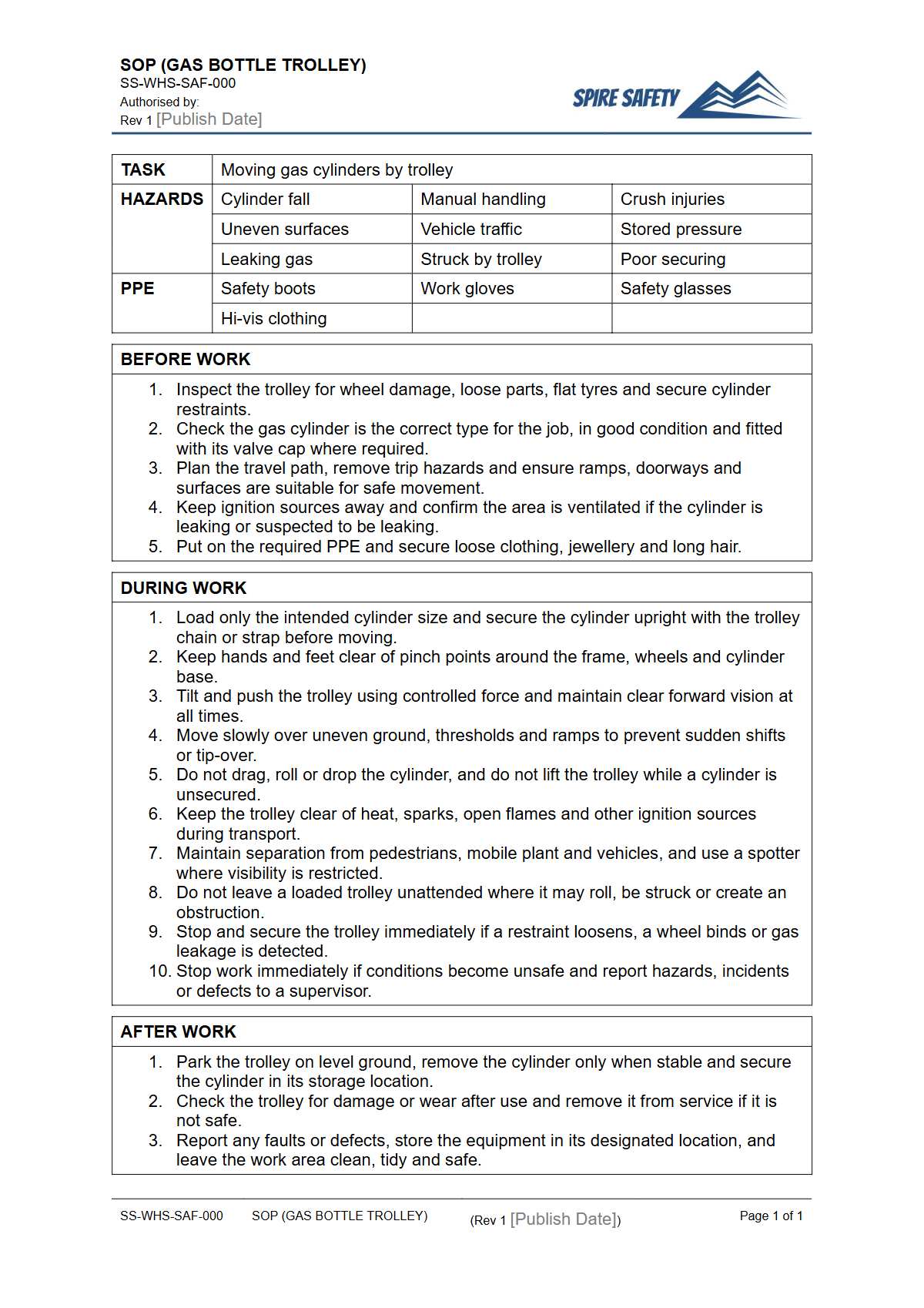
Purpose of the Free Safe Operating Procedure (Gas Bottle Trolley) Template
Effectively managing workplace risks associated with handling compressed gas cylinders is a critical safety requirement. This free Safe Operating Procedure (Gas Bottle Trolley) template provides a structured starting point for your business to document the correct, step-by-step process for moving gas bottles using a trolley.
Using a comprehensive SOP helps to minimise risks such as musculoskeletal injuries from manual handling, impact injuries from dropped cylinders, and uncontrolled gas release. This document serves as a vital tool for training workers and ensuring a consistent, safe approach is followed every time.
Implementing robust SOPs is a fundamental component of a functional safety framework. They provide clear instructions to workers, assist in meeting legislative duties, and form part of your overall WHS management systems. This template helps formalise your processes, creating a safer environment for everyone involved in handling gas cylinders.
Video walkthrough
How to use the Free Safe Operating Procedure (Gas Bottle Trolley) Template
This template is provided in both DOCX and PDF formats for your convenience. To use it, simply download the file and adapt it to the specific conditions of your workplace.
It is designed to be easily customised with your company’s name, logo, and any site-specific details, such as different trolley types, cylinder sizes, or unique environmental hazards.
It is essential to review and customise this document. A generic procedure is not sufficient for compliance.
You must conduct a risk assessment for the task at your site and incorporate the identified controls into the SOP. This includes specifying the personal protective equipment (PPE) required, pre-start inspection checks for the trolley, and emergency procedures.
For example, if the gas bottles are used for welding or cutting, you might also require a FREE Plasma Cutter SOP (Safe Operating Procedure) Template to cover the entire scope of work.
Important Customisation Note:
This is a template, not a finished document. We have developed it as a starting point based on common industry practices.
You are responsible for ensuring it is adapted to reflect the specific equipment, hazards, and control measures relevant to your workplace. A thorough risk assessment should always inform the final content of your Safe Operating Procedure.
When to use a Gas Bottle Trolley SOP
A Safe Operating Procedure for gas bottle trolleys should be used whenever a worker is required to move a gas cylinder using a trolley. This applies to various industries, including workshops, construction sites, manufacturing plants, laboratories, and hospitality venues.
The SOP should be a core part of worker induction and ongoing refresher training. It serves as an on-the-job reference guide to reinforce safe work practices.
The procedure should be formally reviewed on a regular basis, after any incident involving a gas cylinder, or when there is a change in equipment or process. It's good practice to integrate the review of task-specific SOPs, like this one and our FREE Step Ladder SOP Template, into your site's broader safety schedule.
Consistent review ensures your documented procedures remain current and effective at controlling risks.
Who should use this Safe Operating Procedure
This SOP should be used by all personnel tasked with moving gas cylinders, including workshop hands, tradespeople, warehouse staff, and maintenance workers. It is also a critical resource for supervisors and managers responsible for overseeing these tasks.
They can use the document to conduct training, verify competency, and perform workplace inspections to ensure the procedure is being followed correctly.
Safety officers and WHS managers will find the template invaluable for developing and implementing formal safety documentation. Integrating this procedure with SOPs for related equipment, such as an Free Air Compressor SOP (Safe Operating Procedure) Template, helps build a comprehensive library of safe work documents.
Regular checks against these documented procedures are a key part of any internal or external WHS compliance auditing program. Feel free to browse our entire free WHS resources library for other useful templates.
Common mistakes
Common mistakes to avoid
- Using a damaged trolley with faulty wheels, frame, or securing chain.
- Failing to securely fasten the cylinder to the trolley before moving.
- Incorrect manual handling technique, such as pulling the trolley instead of pushing it (which provides better control and visibility).
- Leaving the trolley unattended on an incline without chocking the wheels.
Legal references
Legal considerations
The following legal requirements may be relevant to this type of work.
- Work Health and Safety Act (Harmonised) — Provides the primary duties for protecting workers and other people from work health and safety risks.
- Work Health and Safety Regulations (Harmonised) — Sets out requirements supporting the management of workplace hazards and risks.
The following codes may be relevant to this type of work.
- Managing WHS Risks Code of Practice — Provides practical guidance on identifying hazards, assessing risks and applying effective controls.
- Work Health and Safety Consultation, Cooperation and Coordination Code of Practice — Provides practical guidance on consulting workers and coordinating with other duty holders.
- Managing the Work Environment and Facilities Code of Practice — Provides practical guidance on safe work environments, workplace facilities and related controls.
Did you know
Cylinder Weight
A full 'G' size oxygen cylinder can weigh over 50kg. Using a purpose-built trolley is not just a best practice; it's an essential control measure to prevent serious musculoskeletal injuries.
Valve Protection
The valve assembly is the most fragile part of a gas cylinder. If it's sheared off, the cylinder can release its contents with enough force to propel it through a brick wall, which is why valve caps are so important during transport and storage.
FAQ
Frequently asked questions
01What should be included in a gas bottle trolley SOP?
02Are gas bottle trolleys considered manual handling?
03How often should gas bottle safety procedures be reviewed?
04Why is it important to secure gas cylinders on a trolley?
Share this resource
Free Safe Operating Procedure (Gas Bottle Trolley) Template
Browse Categories
How To Use It
- 1Download and open in Word or PDF.
- 2Replace the placeholders with your business details.
- 3Get it reviewed by a WHS specialist before rollout.
Need it customised?
Our WHS consultants can adapt this template to your site, run a gap analysis, or audit what you already have in place.
Book a Free Consultation WHS consulting servicesor call 1300 156 382
Related templates
- Free Safe Operating Procedure (Gas Cooktop) Template
- Free Safe Operating Procedure (Gas Cutting Torch) Template
- Free Safe Operating Procedure (Gas Cylinder Change) Template
- Free Safe Operating Procedure (Gas Cylinder Handling) Template
- Free Safe Operating Procedure (Gas Detector Bump Test) Template
- Free Safe Operating Procedure (Gas Detector Calibration) Template