
Free Safe Operating Procedure (Gas Cylinder Change) Template
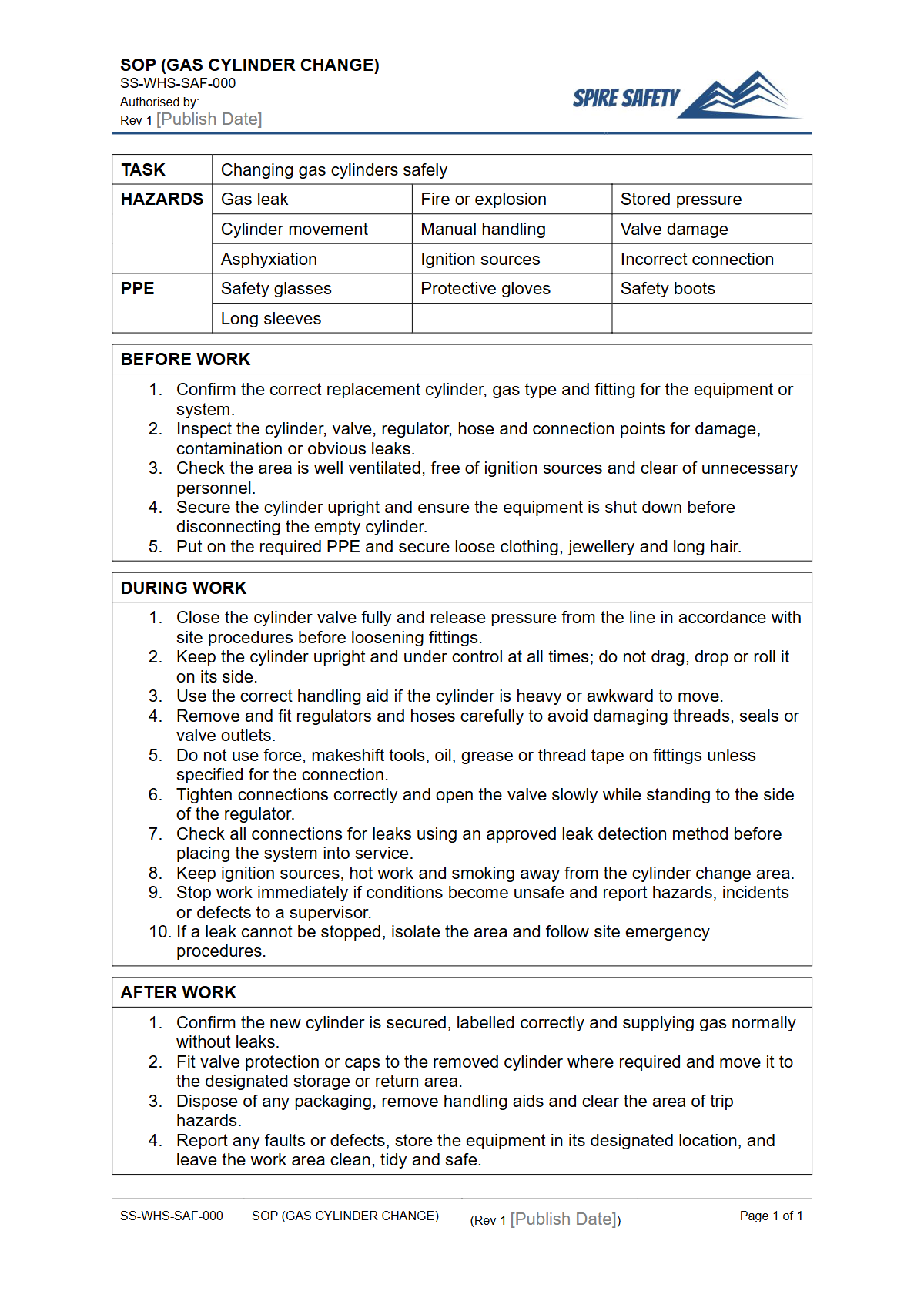
Download our free Safe Operating Procedure (Gas Cylinder Change) Template. This customisable DOCX and PDF resource helps you outline safe work steps.
Free Safe Operating Procedure (Gas Cylinder Change) Template
DOCX • 126 KB + PDF
Updated Oct 2026
No signup required
Purpose of the Free Safe Operating Procedure (Gas Cylinder Change) Template
Handling and changing gas cylinders presents significant risks, from musculoskeletal injuries during manual handling to the catastrophic potential of an uncontrolled gas release. This Free Safe Operating Procedure (Gas Cylinder Change) Template provides a structured framework for documenting the required steps to perform this task safely.
It is designed for Australian workplaces and helps organisations formalise their processes, manage risks, and ensure workers are guided by a consistent, safe method. By implementing a clear SOP, you can reduce the likelihood of incidents associated with compressed and liquefied gases.
A documented SOP serves as a critical control measure, detailing pre-start checks, personal protective equipment (PPE) requirements, the step-by-step changing process, and post-task clean-up. This is particularly important for high-risk activities that use compressed gas, where a failure in procedure could have severe consequences.
For example, a workshop might use this document alongside a safe operating procedure for a plasma cutter to cover all aspects of the equipment's safe use.
Video walkthrough
How to use the Free Safe Operating Procedure (Gas Cylinder Change) Template
This resource is available as a fully editable DOCX file and a print-ready PDF. To use it, simply download the file and adapt the content to suit your operational environment.
Fill in the specific details of your workplace, including the types of gases used (e.g., Acetylene, Oxygen, Argon, CO2), the equipment involved, and the designated storage areas. You should also include site-specific emergency procedures and contact information.
IMPORTANT: This is a template only. We have developed it as a starting point, and you must customise it to reflect the specific gas types, equipment, and unique hazards present in your workplace.
This SOP should form one part of your organisation's broader WHS management systems, integrated with risk assessments and training records.
When to use this Safe Operating Procedure
This Safe Operating Procedure should be used and referenced any time a worker needs to change a gas cylinder. This applies across numerous industries, from manufacturing and construction to hospitality and healthcare.
Common scenarios include swapping out cylinders for welding equipment, replacing CO2 cylinders for beverage systems, or changing oxygen cylinders in a workshop. It forms the basis for training new workers and serves as a vital refresher for experienced personnel.
The SOP should be readily accessible in the work area where cylinders are changed. It should also be a key document reviewed during toolbox talks or safety meetings before the task begins.
In some cases, the task may involve working at height to access valves or regulators, requiring adherence to other procedures, like those for safely using a step ladder.
Who should use this Safe Operating Procedure
This template is designed for use by Persons Conducting a Business or Undertaking (PCBUs), WHS managers, supervisors, and the workers who directly perform the task. WHS managers and supervisors can use the template to develop a workplace-specific procedure in consultation with their teams.
This consultative process is vital for ensuring the SOP is practical, accurate, and reflects how the work is actually done.
Workers must be trained in the final, approved procedure and deemed competent before undertaking the task unsupervised. For businesses that lack the internal expertise to adapt and implement such documents, engaging external WHS consulting professionals can provide the necessary guidance and assurance.
The procedure should also consider the full lifecycle of the cylinder at the workplace, including its safe transport and storage. Depending on the size and weight, moving cylinders may require mechanical aids. If so, workers must be trained on the relevant equipment, such as using a telehandler for moving pallets of cylinders.
Finally, the effectiveness of any SOP relies on regular review and updates. This can be scheduled annually or triggered by an incident, a change in equipment, or findings from a formal WHS compliance auditing process.
You can find more templates and checklists in our free WHS resources library to support your safety management system.
Common mistakes
Common mistakes to avoid
- Using adjustable spanners or incorrect tools that can damage brass fittings and cause leaks.
- Failing to secure cylinders with a chain or strap before, during, and after the change-out.
- Neglecting to perform a leak test with a suitable solution after connecting the new cylinder.
- Incorrectly identifying the gas type, leading to dangerous reactions or incompatible connections.
Legal references
Legal considerations
The following legal requirements may be relevant to this type of work.
- Work Health and Safety Act (Harmonised) — Provides the primary duties for protecting workers and other people from work health and safety risks.
- Work Health and Safety Regulations (Harmonised) — Sets out requirements supporting the management of workplace hazards and risks.
The following codes may be relevant to this type of work.
- Managing WHS Risks Code of Practice — Provides practical guidance on identifying hazards, assessing risks and applying effective controls.
- Work Health and Safety Consultation, Cooperation and Coordination Code of Practice — Provides practical guidance on consulting workers and coordinating with other duty holders.
- Managing the Work Environment and Facilities Code of Practice — Provides practical guidance on safe work environments, workplace facilities and related controls.
Did you know
Pressure Check
A full industrial oxygen cylinder can be pressurised to over 2,200 psi. If the valve is knocked off, the cylinder can become a projectile with enough force to penetrate a brick wall.
Empty Doesn't Mean Empty
An 'empty' gas cylinder is never truly empty. It still contains residual gas and pressure, and must be treated with the same caution as a full cylinder, with the valve closed and cap secured.
FAQ
Frequently asked questions
01What should be included in a gas cylinder change SOP?
02How often should we review our gas cylinder SOP?
03Is specific training required to change gas cylinders?
04What are the main hazards when changing gas cylinders?
Share this resource
Free Safe Operating Procedure (Gas Cylinder Change) Template
Browse Categories
How To Use It
- 1Download and open in Word or PDF.
- 2Replace the placeholders with your business details.
- 3Get it reviewed by a WHS specialist before rollout.
Need it customised?
Our WHS consultants can adapt this template to your site, run a gap analysis, or audit what you already have in place.
Book a Free Consultation WHS consulting servicesor call 1300 156 382
Related templates
- Free Safe Operating Procedure (Gas Cylinder Handling) Template
- Free Safe Operating Procedure (Gas Detector Bump Test) Template
- Free Safe Operating Procedure (Gas Detector Calibration) Template
- Free Safe Operating Procedure (Gas Heater) Template
- Free Safe Operating Procedure (Gas Regulator Change) Template
- Free Safe Operating Procedure (Gate Latch Repair) Template