
Free Safe Operating Procedure (Gas Regulator Change) Template
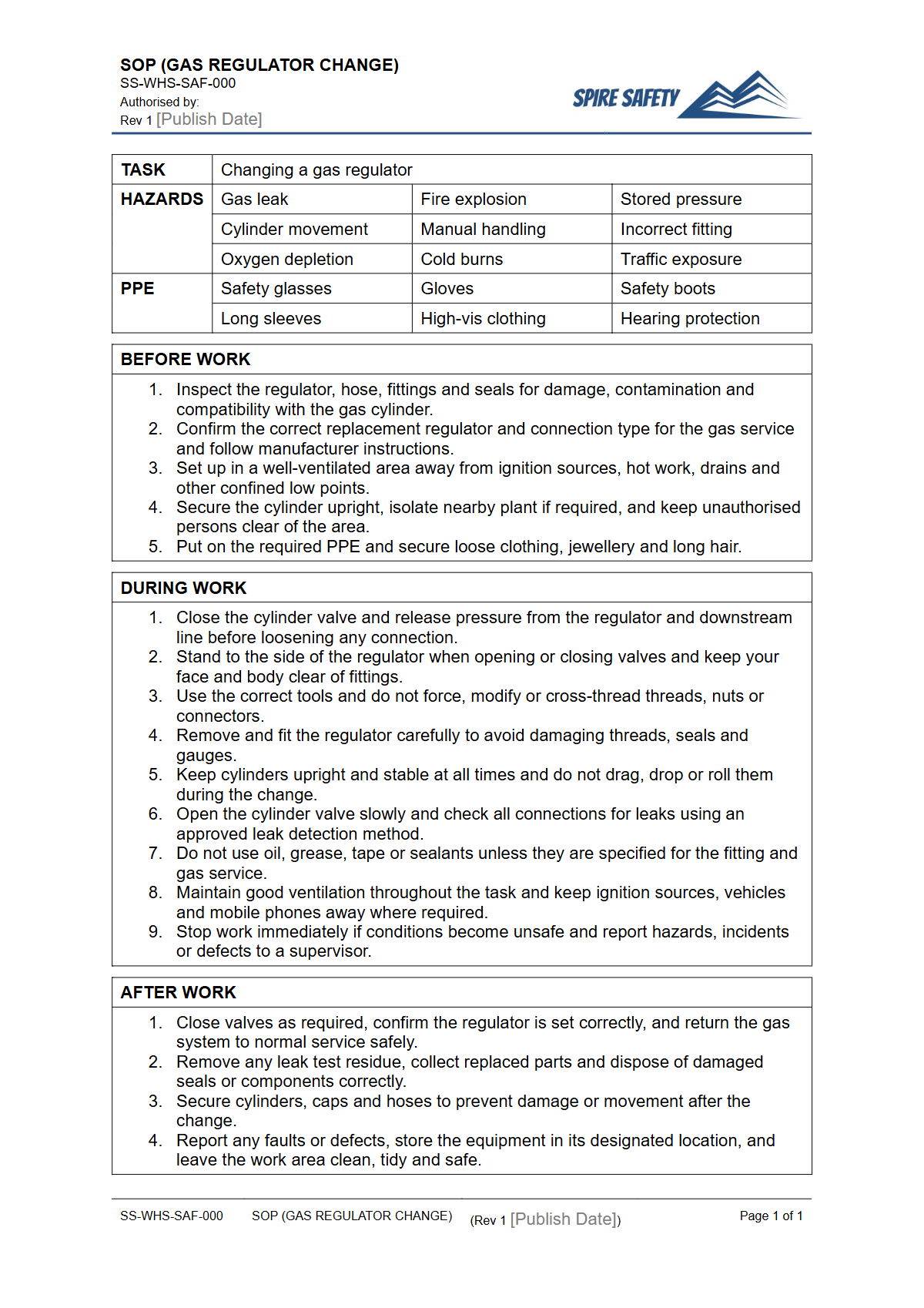
Download our free Safe Operating Procedure for Gas Regulator Changes. This DOCX and PDF template helps you document safe work steps for your team.
Free Safe Operating Procedure (Gas Regulator Change) Template
DOCX • 126 KB + PDF
Updated Oct 2026
No signup required
Purpose of the Free Safe Operating Procedure (Gas Regulator Change) Template
Changing gas regulators on pressurised cylinders is a high-risk task that demands a clear, documented process. This Free Safe Operating Procedure (Gas Regulator Change) Template provides a structured framework for outlining the required steps to perform this activity safely and consistently.
Using a standardised SOP helps minimise the risk of gas leaks, fire, or explosions by ensuring every worker follows a verified, safe sequence of actions. It serves as a vital training tool for new employees and a reference for experienced personnel, reinforcing safe work habits and demonstrating your organisation's commitment to proactive risk management.
Documenting high-risk tasks is a fundamental component of a systematic approach to safety. A well-defined SOP for changing gas regulators forms part of a broader safety framework, ensuring that control measures identified in your risk assessments are effectively implemented and communicated.
Integrating such procedures is a core element of effective WHS management systems, helping to create a safer and more organised workplace.
Video walkthrough
How to use the Free Safe Operating Procedure (Gas Regulator Change) Template
This Safe Operating Procedure is provided as a fully editable DOCX file, with a PDF version also available for easy printing and distribution. To use it, simply download the file and adapt the contents to match the specific context of your workplace.
Fill in the required details, including company information, specific gas types (e.g., Acetylene, Oxygen, Argon), equipment models, and required Personal Protective Equipment (PPE).
Important: This is a template resource. We have developed it as a starting point, aligned with Australian WHS principles.
You must customise this document to reflect the unique hazards, risks, and control measures relevant to your specific worksite, equipment, and operational procedures. Its effectiveness is entirely dependent on your customisation and implementation.
When to use a Gas Regulator Change SOP
A Safe Operating Procedure for changing a gas regulator should be used consistently as the primary reference document for the task. It is essential for training new operators and verifying the competency of existing workers.
The SOP should be readily accessible in any area where gas cylinders are used or changed, such as workshops, welding bays, or maintenance areas. It also serves as a critical document during safety audits and incident investigations.
For tasks that often involve compressed gas, like welding or cutting, having clear procedures is essential. This SOP can be used alongside other key documents, such as our free plasma cutter SOP, to build a comprehensive safety library for your workshop.
Who should use this Safe Operating Procedure
This template is designed for use by WHS managers, supervisors, and business owners responsible for creating and implementing safety documentation. The final, customised procedure should be used by any worker authorised to change gas regulators.
It is critical that only personnel who are trained, competent, and have demonstrated their understanding of the procedure are permitted to perform this task. Untrained staff should never be allowed to handle or change regulators on pressurised gas cylinders.
This principle of competency applies to all workshop equipment; for example, our free air compressor SOP template also highlights the importance of trained and authorised use.
Key Steps in Changing a Gas Regulator Safely
A comprehensive gas regulator SOP should cover several critical stages to ensure the task is completed without incident. Your customised procedure should detail the following:
- Preparation: Selecting the correct regulator for the gas type and pressure, inspecting the regulator and cylinder for damage, and ensuring the work area is free from ignition sources.
- Removal of Old Regulator: Following the correct sequence for shutting off the cylinder valve, purging residual gas from the system, and safely disconnecting the regulator.
- Installation of New Regulator: Attaching the new regulator, ensuring threads are correctly aligned (note that flammable gases often use left-hand threads), and tightening connections to the manufacturer's specification without over-tightening.
- Leak Testing: A mandatory step involving applying a non-corrosive, oil-free leak detection fluid (soapy water) to all connections after slowly opening the cylinder valve to check for bubbles.
- Returning to Service: Once confirmed leak-free, the system can be safely returned to operation.
Documenting these steps in detail removes ambiguity and reduces the likelihood of human error. If you need assistance developing comprehensive safety documents that go beyond individual SOPs, our WHS consulting services can provide tailored support for your business.
Integrating SOPs into Workplace Training
Safe Operating Procedures are not just documents to be filed away; they are active tools for training and ongoing safety management. Use this SOP as a centrepiece for toolbox talks on gas safety.
Conduct practical demonstrations where trainees follow the procedure under supervision. Regular reviews and refresher training based on the SOP help ensure that safety standards do not slip over time.
Ensuring you have robust procedures for all common workshop tasks, such as those detailed in our free circular saw SOP, helps build a consistent culture of safety.
By establishing and enforcing a clear procedure for high-risk tasks like changing a gas regulator, you take a significant step towards preventing serious workplace incidents. Explore our complete free WHS resources library for more templates to help you manage safety in your workplace.
Common mistakes
Common mistakes to avoid
- Using a regulator not rated for the specific gas type or pressure, creating a significant risk.
- Neglecting to perform a leak test with a suitable leak detection solution after connecting the regulator.
- Over-tightening connections with excessive force or large wrenches, which can damage threads and seals.
- Opening the main cylinder valve too quickly, causing a pressure surge that can damage the regulator's internal components.
Legal references
Legal considerations
The following legal requirements may be relevant to this type of work.
- Work Health and Safety Act (Harmonised) — Provides the primary duties for protecting workers and other people from work health and safety risks.
- Work Health and Safety Regulations (Harmonised) — Sets out requirements supporting the management of workplace hazards and risks.
The following codes may be relevant to this type of work.
- Managing WHS Risks Code of Practice — Provides practical guidance on identifying hazards, assessing risks and applying effective controls.
- Work Health and Safety Consultation, Cooperation and Coordination Code of Practice — Provides practical guidance on consulting workers and coordinating with other duty holders.
- Managing the Work Environment and Facilities Code of Practice — Provides practical guidance on safe work environments, workplace facilities and related controls.
Did you know
Left for Flammable
In Australia, gas cylinder connections are standardised to prevent errors. Flammable gases like acetylene and LPG use left-hand threads (which tighten counter-clockwise), while non-flammable gases like oxygen and nitrogen use standard right-hand threads.
Two-Stage Pressure Drop
Gas regulators work in one or two stages. A single-stage regulator reduces the high cylinder pressure to the delivery pressure in one step, while a two-stage regulator does it in two steps for a more constant, stable delivery pressure as the cylinder empties.
FAQ
Frequently asked questions
01What is the primary function of a gas regulator?
02How often should gas regulators and associated hoses be inspected?
03What are the signs of a faulty or failing gas regulator?
04Is an SOP legally required for changing a gas regulator in Australia?
Share this resource
Free Safe Operating Procedure (Gas Regulator Change) Template
Browse Categories
How To Use It
- 1Download and open in Word or PDF.
- 2Replace the placeholders with your business details.
- 3Get it reviewed by a WHS specialist before rollout.
Need it customised?
Our WHS consultants can adapt this template to your site, run a gap analysis, or audit what you already have in place.
Book a Free Consultation WHS consulting servicesor call 1300 156 382
Related templates
- Free Safe Operating Procedure (Gate Latch Repair) Template
- Free Safe Operating Procedure (Gate Track Cleaning) Template
- Free Safe Operating Procedure (Gatehouse Check In) Template
- Free Safe Operating Procedure (Generator Load Test) Template
- Free Safe Operating Procedure (Glass Awning Cleaning) Template
- Free Safe Operating Procedure (Glass Balustrade Clean) Template