
Free Safe Operating Procedure (Gate Track Cleaning) Template
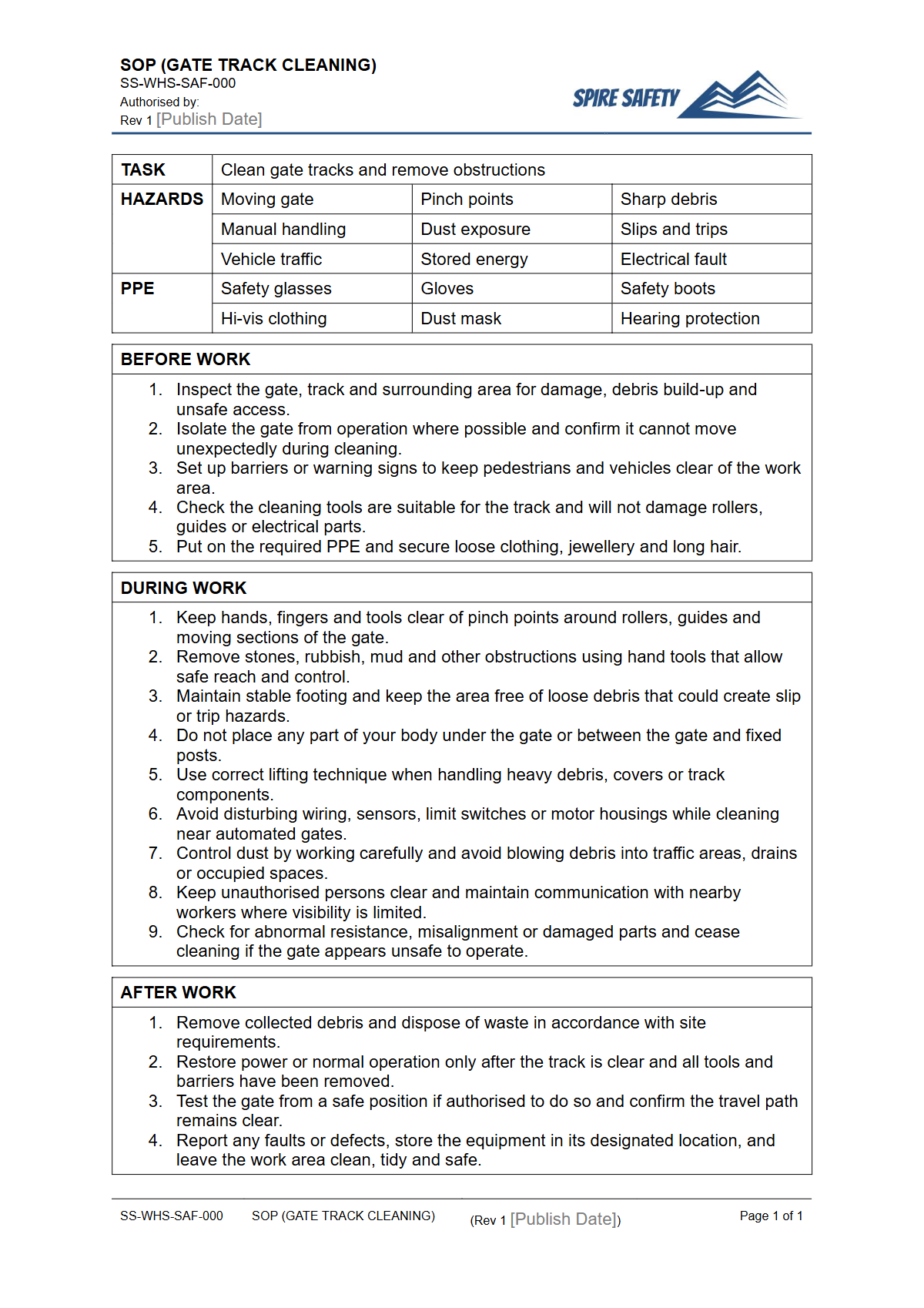
Download our free Safe Operating Procedure (Gate Track Cleaning) Template. This customisable DOCX and PDF helps you define safe work methods. Get yours today.
Free Safe Operating Procedure (Gate Track Cleaning) Template
DOCX • 126 KB + PDF
Updated Oct 2026
No signup required
Purpose of the Free Safe Operating Procedure (Gate Track Cleaning) Template
Maintaining clear and functional gate tracks is a common but essential task for many Australian businesses. While it seems straightforward, the process involves hazards that must be managed.
Our Free Safe Operating Procedure (Gate Track Cleaning) Template provides a structured framework for documenting the safest way to perform this job. This SOP helps you formally outline the step-by-step process, identify potential risks like slips, manual handling injuries, or exposure to cleaning agents, and specify the required control measures to protect your workers.
Using a standardised SOP ensures consistency in how the task is performed, regardless of who is doing it. It serves as a vital training tool for new employees and a refresher for existing staff, reinforcing safe work habits.
By systematically addressing the risks associated with gate track maintenance, you create a safer working environment and demonstrate a commitment to your Work Health and Safety (WHS) obligations.
Video walkthrough
How to use the Free Safe Operating Procedure (Gate Track Cleaning) Template
This template is designed as a starting point, delivered in both DOCX and PDF formats for your convenience. The DOCX file is fully editable, allowing you to tailor the content to the specific equipment, environment, and processes at your worksite.
A well-defined SOP is a critical element of effective WHS management systems, providing clear instructions that minimise ambiguity and risk.
To use the template effectively:
- Review: Conduct a thorough risk assessment of the gate track cleaning task in your specific environment. Identify all associated hazards, from the type of debris to the gate's operating mechanism.
- Customise: Adapt the document to reflect your findings. Add details about the specific tools used, required Personal Protective Equipment (PPE), and emergency procedures relevant to your site.
- Consult: Involve the workers who actually perform the cleaning task. Their practical experience is invaluable for creating a procedure that is both safe and workable.
- Approve: Have the final document reviewed and approved by a competent person, such as a supervisor or WHS manager.
Important: This is a template, not a finished document. We have provided a comprehensive starting point, but you must customise it to reflect the unique hazards and control measures of your workplace to ensure it is effective.
When to use this Safe Operating Procedure
An SOP for gate track cleaning should be used consistently as part of your site's maintenance schedule. It is particularly important when training new or inexperienced workers on the task, ensuring they learn the correct, safe method from the outset.
It should also be referenced during toolbox talks or pre-start meetings before the cleaning work begins to refresh knowledge of the key risks and controls. If your process involves working from a small height, you may also need to consult a specific step ladder SOP to cover those associated risks.
Who should use this SOP
This Safe Operating Procedure is intended for use by multiple roles within an organisation. WHS managers and supervisors will use it to establish and enforce safe work standards.
Maintenance team leaders are responsible for implementing the procedure and ensuring their team understands and follows it. Critically, the workers performing the cleaning are the end-users who must follow the documented steps to ensure their own safety and the safety of others.
For businesses needing guidance on implementing such processes, engaging expert WHS consulting can provide valuable direction and support.
Integrating SOPs into your safety framework
A Safe Operating Procedure is not a 'set and forget' document. It should be a living part of your safety management system that is regularly reviewed and updated.
A review should be triggered whenever there is a change in equipment, cleaning chemicals, or work environment. Furthermore, the effectiveness of all your procedural documents can be verified through a WHS compliance auditing program, which helps identify gaps between documented procedures and actual work practices.
Where tasks involve specific equipment, like using compressed air for clearing debris, a dedicated Free Air Compressor SOP should also be developed and referenced.
By properly developing, implementing, and reviewing this SOP, you embed a culture of safety into routine tasks. To discover more templates and checklists that can support your safety initiatives, explore our complete free WHS resources library.
Common mistakes
Common mistakes to avoid
- Forgetting to isolate the gate's power source before starting work.
- Using incorrect manual handling techniques to clear debris.
- Failing to wear appropriate PPE, such as gloves and eye protection, when using cleaning chemicals.
- Not blocking the gate to prevent uncontrolled movement on sloped ground.
Legal references
Legal considerations
The following legal requirements may be relevant to this type of work.
- Work Health and Safety Act (Harmonised) — Provides the primary duties for protecting workers and other people from work health and safety risks.
- Work Health and Safety Regulations (Harmonised) — Sets out requirements supporting the management of workplace hazards and risks.
The following codes may be relevant to this type of work.
- Managing WHS Risks Code of Practice — Provides practical guidance on identifying hazards, assessing risks and applying effective controls.
- Work Health and Safety Consultation, Cooperation and Coordination Code of Practice — Provides practical guidance on consulting workers and coordinating with other duty holders.
- Managing the Work Environment and Facilities Code of Practice — Provides practical guidance on safe work environments, workplace facilities and related controls.
Did you know
A Leading Cause of Injury
Slips, trips, and falls are one of the most common causes of serious workplace injuries in Australia. Proactive maintenance of walkways and access paths, like gate tracks, is a simple yet crucial control measure.
The Hierarchy of Control
Safe Operating Procedures are considered an 'administrative control' in the hierarchy of risk control. They are used to standardise work practices and minimise risk after higher-level controls, like elimination or substitution, have been considered.
FAQ
Frequently asked questions
01What hazards are involved in cleaning gate tracks?
02Is a Safe Operating Procedure legally required for gate track cleaning?
03How often should we review our Gate Track Cleaning SOP?
04Can I use this template for any type of automatic gate?
Share this resource
Free Safe Operating Procedure (Gate Track Cleaning) Template
Browse Categories
How To Use It
- 1Download and open in Word or PDF.
- 2Replace the placeholders with your business details.
- 3Get it reviewed by a WHS specialist before rollout.
Need it customised?
Our WHS consultants can adapt this template to your site, run a gap analysis, or audit what you already have in place.
Book a Free Consultation WHS consulting servicesor call 1300 156 382
Related templates
- Free Safe Operating Procedure (Gatehouse Check In) Template
- Free Safe Operating Procedure (Generator Load Test) Template
- Free Safe Operating Procedure (Glass Awning Cleaning) Template
- Free Safe Operating Procedure (Glass Balustrade Clean) Template
- Free Safe Operating Procedure (Glass Bottle Disposal) Template
- Free Safe Operating Procedure (Glass Canopy Cleaning) Template