
Free Safe Operating Procedure (Gatehouse Check In) Template
Download our free Safe Operating Procedure (Gatehouse Check In) template.
Free Safe Operating Procedure (Gatehouse Check In) Template
DOCX • 126 KB + PDF
Updated Oct 2026
No signup required
Purpose of the Free Safe Operating Procedure (Gatehouse Check In) Template
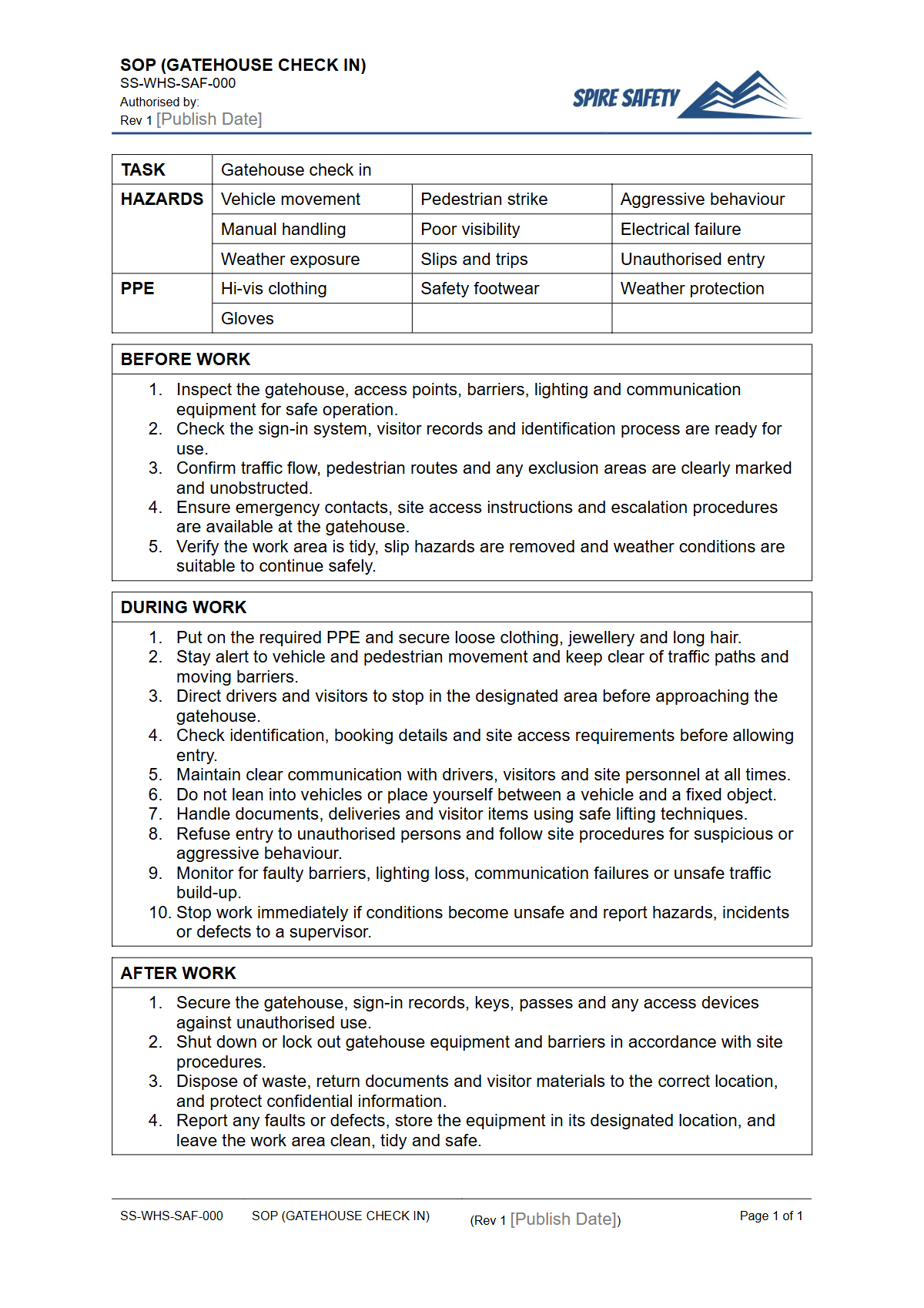
A gatehouse is the first line of defence in maintaining a safe and secure worksite. This Free Safe Operating Procedure (Gatehouse Check In) Template provides a clear, step-by-step framework for managing the flow of people, vehicles, and materials onto and off your site.
Implementing a formal SOP for this critical control point helps ensure that every person entering the site is authorised, inducted, and aware of the key safety rules and hazards. A well-defined procedure minimises the risk of unauthorised access, prevents uninducted personnel from entering hazardous areas, and establishes a clear record of who is on-site at any given time, which is vital during an emergency.
A gatehouse SOP is a foundational component of a site’s security and safety protocols. It standardises the process for verifying credentials, issuing visitor passes, communicating essential safety information (like PPE requirements), and managing vehicle movements.
By documenting these steps, you create a consistent process that reduces confusion and enhances overall site control. This procedure forms a crucial part of broader WHS management systems, demonstrating a systematic approach to managing site access risks.
Video walkthrough
How to use the Free Safe Operating Procedure (Gatehouse Check In) Template
This Safe Operating Procedure template is provided in both DOCX and PDF formats for your convenience. The DOCX file is fully editable, allowing you to adapt it to the specific needs of your workplace.
To get the most out of this resource, it is essential that you customise it thoroughly. A generic procedure is not effective; it must reflect your site's unique layout, traffic flow, emergency contacts, and specific entry requirements.
Note: We have created this document as a template to get you started. You must review and customise this Safe Operating Procedure to suit the specific hazards, personnel, and operational context of your worksite.
You are responsible for ensuring it aligns with your existing safety management system and meets your legal obligations.
When customising, consider aspects such as the different types of personnel (employees, contractors, visitors, delivery drivers), required inductions, and PPE checks. The SOP should also detail the steps for logging entries and exits, handling unannounced visitors, and protocols for managing after-hours access.
A robust check-in procedure is the first step before any work begins, whether it's a simple task covered by a step ladder SOP or complex work involving heavy machinery.
Your gatehouse process may need to verify that operators hold the correct ticket or VOC before being allowed on site to operate specific equipment. Integrating this check ensures that only competent individuals perform high-risk tasks, supporting machine-specific procedures like a free Telehandler SOP, which outlines the rules for safe operation once on site.
When to use a Gatehouse Check In SOP
A formal Gatehouse Check In SOP should be implemented at any worksite where controlling access is necessary to manage health and safety risks. This is particularly critical for industries such as construction, mining, manufacturing, warehousing, and large-scale infrastructure projects.
It is also essential for sites with specific security requirements or those that handle hazardous materials. Use this procedure to formalise your process, train your gatehouse staff, and provide a clear reference for all personnel.
This document is also a key piece of evidence during safety assessments. A documented and consistently applied gatehouse procedure demonstrates proactive risk management to regulators, clients, and principal contractors.
Procedures like this are often reviewed during a formal WHS compliance audit to verify that access controls are effectively implemented and maintained.
Who should use this Safe Operating Procedure
This Safe Operating Procedure is designed for use by multiple roles within an organisation. Primary users include security officers and gatehouse personnel who execute the check-in and check-out process daily.
Site managers, project managers, and supervisors should use it to understand and enforce site access policies. WHS managers and advisors will use this template to develop and integrate site access controls into the broader safety management system.
It also serves as a valuable training tool during staff and contractor inductions.
If you require assistance in adapting this template or integrating it into your existing safety framework, our team can provide expert guidance. Spire Safety offers WHS consulting services to help businesses of all sizes develop practical and effective safety solutions. For more downloadable documents, you can browse our complete free WHS resources library.
Common mistakes
Common mistakes to avoid
- Failing to tailor the template to specific site hazards and entry requirements.
- Inadequate training for gatehouse personnel on the procedure and their responsibilities.
- Neglecting to review and update the SOP after site changes or incidents.
- Inconsistent enforcement of the check-in and check-out process for all personnel.
Legal references
Legal considerations
The following legal requirements may be relevant to this type of work.
- Work Health and Safety Act (Harmonised) — Provides the primary duties for protecting workers and other people from work health and safety risks.
- Work Health and Safety Regulations (Harmonised) — Sets out requirements supporting the management of workplace hazards and risks.
The following codes may be relevant to this type of work.
- Managing WHS Risks Code of Practice — Provides practical guidance on identifying hazards, assessing risks and applying effective controls.
- Work Health and Safety Consultation, Cooperation and Coordination Code of Practice — Provides practical guidance on consulting workers and coordinating with other duty holders.
- Managing the Work Environment and Facilities Code of Practice — Provides practical guidance on safe work environments, workplace facilities and related controls.
Did you know
First Impressions Count
The gatehouse is often the first point of contact for visitors, contractors, and new employees. A professional and organised check-in process sets the safety tone for the entire site.
FAQ
Frequently asked questions
01What is the purpose of a gatehouse check-in SOP?
02Does this template cover emergency procedures?
03Can I use this SOP for contractor management?
04Is a gatehouse check-in procedure a legal requirement in Australia?
Share this resource
Free Safe Operating Procedure (Gatehouse Check In) Template
Browse Categories
How To Use It
- 1Download and open in Word or PDF.
- 2Replace the placeholders with your business details.
- 3Get it reviewed by a WHS specialist before rollout.
Need it customised?
Our WHS consultants can adapt this template to your site, run a gap analysis, or audit what you already have in place.
Book a Free Consultation WHS consulting servicesor call 1300 156 382
Related templates
- Free Safe Operating Procedure (Generator Load Test) Template
- Free Safe Operating Procedure (Glass Awning Cleaning) Template
- Free Safe Operating Procedure (Glass Balustrade Clean) Template
- Free Safe Operating Procedure (Glass Bottle Disposal) Template
- Free Safe Operating Procedure (Glass Canopy Cleaning) Template
- Free Safe Operating Procedure (Glass Crusher) Template