
Free Safe Operating Procedure (Glass Crusher) Template
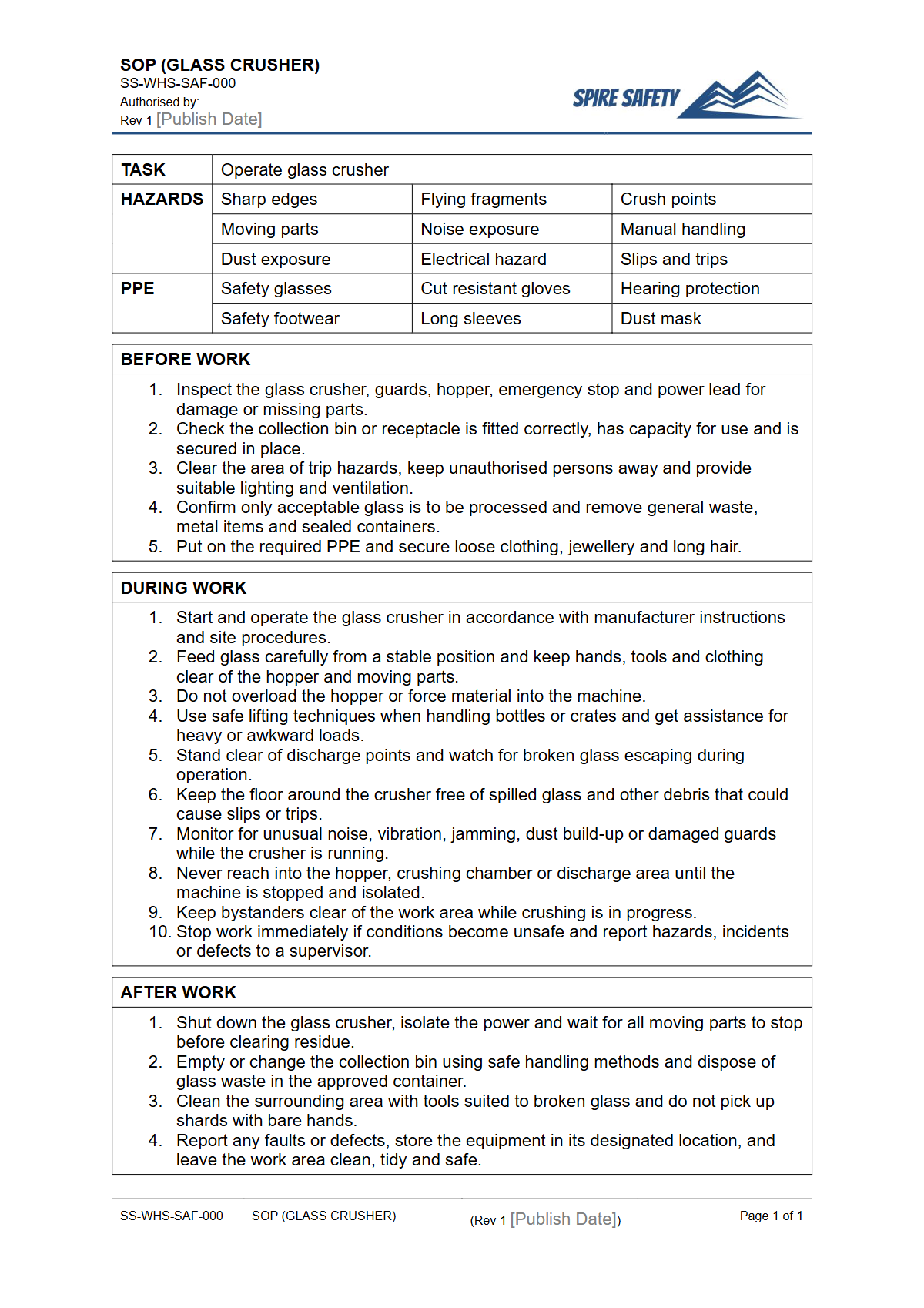
Download our free Safe Operating Procedure (SOP) for Glass Crushers. This DOCX/PDF template helps you outline safe work practices for glass crushing machinery.
Free Safe Operating Procedure (Glass Crusher) Template
DOCX • 126 KB + PDF
Updated Oct 2026
No signup required
Purpose of the Free Safe Operating Procedure (Glass Crusher) Template
This Free Safe Operating Procedure (Glass Crusher) Template provides a structured framework for documenting the safe use of glass crushing machinery in your workplace. Its primary purpose is to clearly outline the step-by-step process required to operate the equipment safely, minimising risks to operators and others.
Just as with other high-risk machinery detailed in resources like our Free Brake Press SOP, a documented procedure is critical for managing hazards such as cuts, entanglement, hazardous noise, and dust exposure.
By implementing a comprehensive SOP, you establish a consistent and safe method of work that can be easily communicated to all employees. This not only helps in meeting your duty of care but also forms a vital part of your overall WHS management systems. It serves as a key resource for worker induction, training, and ongoing competency assessment, ensuring everyone understands the identified risks and control measures.
Video walkthrough
How to use the Free Safe Operating Procedure (Glass Crusher) Template
Our Free Safe Operating Procedure (Glass Crusher) Template is available for instant download in both DOCX and PDF formats. The DOCX file is fully editable, allowing you to tailor the content to your specific operational needs.
To create an effective and relevant procedure, you must adapt this document to reflect your unique work environment and the specific equipment in use.
IMPORTANT: This document is a starting-point template and must be customised. We strongly recommend you consult with the people who operate the equipment daily.
You must add details specific to your workplace, including the manufacturer, make, and model of the glass crusher, site-specific hazards, existing control measures, and emergency shutdown procedures. A generic procedure is not sufficient to ensure safety.
Once customised, the SOP should be formally approved by management, and all relevant workers must be trained on its contents. The document should be reviewed periodically as part of your internal safety processes.
Regular reviews, often as part of a WHS compliance auditing program, ensure the procedure remains current and effective, especially if the equipment, process, or work environment changes.
When to use a Safe Operating Procedure
A glass crusher SOP is a dynamic tool that should be used consistently throughout operational activities. It is essential during the induction and training of new operators, providing them with a clear, authoritative guide to safe work practices from day one.
It also serves as an excellent resource for refresher training for experienced staff, helping to prevent complacency and reinforce correct procedures.
The procedure can be used as a reference for pre-start operational checks, toolbox talks, or safety meetings to discuss specific aspects of the task. For other common workshop equipment, a similar structured approach is recommended, as seen in our Free Air Compressor SOP. The SOP should be kept in a location where it is readily accessible to operators, either as a hard copy near the machine or on a readily available digital device.
Who should use this document
This template is designed for use by anyone responsible for workplace safety and operational management. This includes WHS Managers, Site Supervisors, Team Leaders, and Business Owners in sectors such as hospitality, waste management, recycling, and manufacturing.
These roles are responsible for ensuring that safe work systems are developed, implemented, and maintained.
The ultimate end-users of the finalised document are the plant operators themselves. They must be directly involved in the customisation process to ensure the SOP is practical, accurate, and reflects the realities of the task.
Their input is invaluable for identifying unforeseen hazards and effective control measures. Ensuring you have documented procedures for all high-risk equipment, like what is outlined in our circular saw SOP, is a cornerstone of good safety management.
By systematically addressing risks for all plant and equipment, you build a more robust safety culture. You can find more templates and checklists to support your safety initiatives in our free WHS resources library.
Common mistakes
Common mistakes to avoid
- Using a generic template without customising it for the specific make and model of the crusher.
- Failing to include specific, safe procedures for clearing jams or blockages.
- Not providing adequate, task-specific training on the finalised SOP to all operators.
- Storing the SOP in an office instead of making it easily accessible to operators at the point of use.
Legal references
Legal considerations
The following legal requirements may be relevant to this type of work.
- Work Health and Safety Act (Harmonised) — Provides the primary duties for protecting workers and other people from work health and safety risks.
- Work Health and Safety Regulations (Harmonised) — Sets out requirements supporting the management of workplace hazards and risks.
The following codes may be relevant to this type of work.
- Managing WHS Risks Code of Practice — Provides practical guidance on identifying hazards, assessing risks and applying effective controls.
- Work Health and Safety Consultation, Cooperation and Coordination Code of Practice — Provides practical guidance on consulting workers and coordinating with other duty holders.
- Managing the Work Environment and Facilities Code of Practice — Provides practical guidance on safe work environments, workplace facilities and related controls.
Did you know
Recycling Power
Crushed glass, known as cullet, melts at a lower temperature than the raw materials used to make new glass. Using cullet can reduce the energy required in manufacturing by up to 30%.
Hidden Hazard
Glass dust can contain respirable crystalline silica, a hazardous substance that can cause serious and irreversible lung disease. Proper ventilation, dust suppression, and respiratory protective equipment are critical controls.
FAQ
Frequently asked questions
01What hazards are associated with operating a glass crusher?
02Is a Safe Operating Procedure a legal requirement in Australia?
03How often should a glass crusher SOP be reviewed?
04Who should be involved in writing a glass crusher SOP?
Share this resource
Free Safe Operating Procedure (Glass Crusher) Template
Browse Categories
How To Use It
- 1Download and open in Word or PDF.
- 2Replace the placeholders with your business details.
- 3Get it reviewed by a WHS specialist before rollout.
Need it customised?
Our WHS consultants can adapt this template to your site, run a gap analysis, or audit what you already have in place.
Book a Free Consultation WHS consulting servicesor call 1300 156 382
Related templates
- Free Safe Operating Procedure (Glass Door Cleaning) Template
- Free Safe Operating Procedure (Glass Installation) Template
- Free Safe Operating Procedure (Glass Lifter) Template
- Free Safe Operating Procedure (Glass Partition Clean) Template
- Free Safe Operating Procedure (Glass Polisher) Template
- Free Safe Operating Procedure (Glass Rack Handling) Template