
Free Safe Operating Procedure (Glass Partition Clean) Template
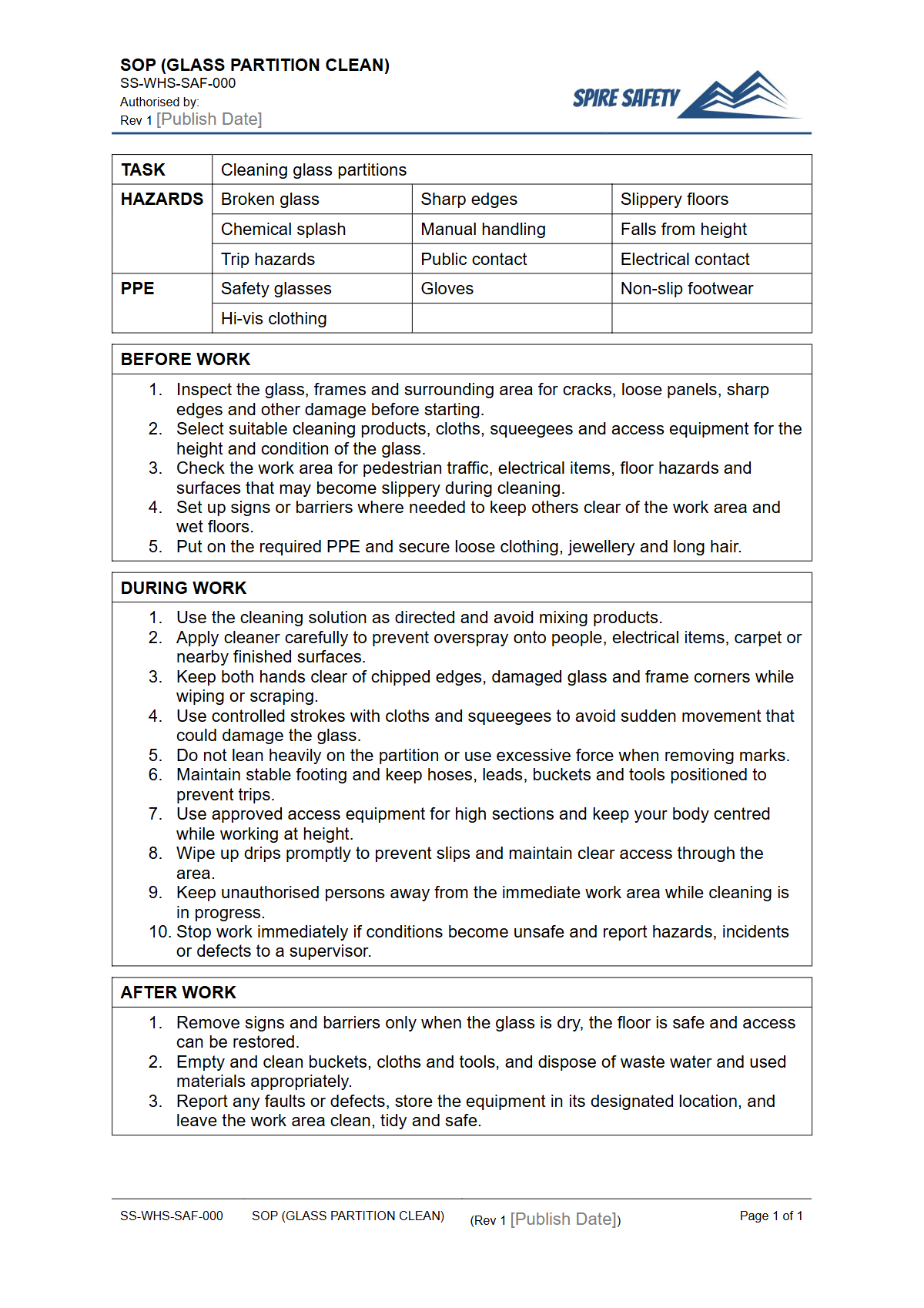
Download our free Safe Operating Procedure (Glass Partition Clean) template.
Free Safe Operating Procedure (Glass Partition Clean) Template
DOCX • 126 KB + PDF
Updated Oct 2026
No signup required
Purpose of the Free Safe Operating Procedure (Glass Partition Clean) Template
Maintaining a clean and professional workspace often involves routine tasks like cleaning glass partitions. While seemingly straightforward, this activity carries inherent risks, including slips from wet floors, ergonomic strain, exposure to cleaning chemicals, and potential falls when working at height.
This is where a structured safety document becomes essential. Our Free Safe Operating Procedure (Glass Partition Clean) Template provides a robust starting point for creating a site-specific guide to manage these risks effectively.
The primary purpose of this Safe Operating Procedure for glass partition cleaning is to provide a clear, step-by-step guide for workers to follow, ensuring the task is completed safely and consistently every time. It formalises a safe system of work by identifying potential hazards, outlining necessary control measures like Personal Protective Equipment (PPE), and detailing emergency responses.
Using an SOP helps an organisation meet its duty of care under Australian WHS legislation by taking proactive steps to ensure worker health and safety.
Video walkthrough
How to use the Free Safe Operating Procedure (Glass Partition Clean) Template
Begin by downloading the template in your preferred format—the DOCX file is fully editable to suit your business needs. This document is structured based on the model WHS framework and common industry practices, but it requires your direct input to be effective and relevant.
It is crucial to understand that this is a template, not a finished document. We have designed it to be a starting point, and you must customise it to reflect the specific equipment (e.g., squeegees, ladders, buckets), chemicals, environment, and personnel at your workplace. Fill in the blank sections with your company details, site-specific hazards, and chosen control measures. If you need expert guidance on tailoring documents to your operational risks, our WHS consulting services can provide specialised support.
When to use it
An SOP for cleaning glass partitions should be an integral part of your safety processes. It is used to induct new cleaning staff or contractors, providing them with clear instructions before they begin work.
It also serves as a vital tool for refresher training to reinforce safe work habits among existing staff.
This procedure should also be reviewed and referenced whenever there is a change in the work environment. This includes the introduction of new cleaning chemicals, the use of different access equipment like ladders or platforms, or following any near-miss or incident related to the task.
Regular reviews ensure the SOP remains a living document that accurately reflects current workplace conditions.
Who should use it
This document is intended for use by several key roles within an organisation. Primarily, it is for the workers and cleaners who perform the glass cleaning tasks, giving them a clear and accessible reference for safe work practices.
Supervisors and managers should use it to oversee work, conduct pre-start checks, and ensure procedures are consistently followed. WHS officers and committees can also use the SOP as a benchmark during safety inspections and for developing broader comprehensive WHS management systems.
Key Hazards and Controls to Customise
When adapting this template, pay close attention to the common hazards associated with cleaning glass partitions:
- Slips, trips, and falls: Detail the use of 'wet floor' signage, non-slip footwear, and procedures for managing spills immediately.
- Working at height: If partitions require ladders or platforms, specify the type of equipment to be used, pre-use inspection requirements, and safe setup procedures. Our free Step Ladder SOP provides more detailed guidance on this specific hazard.
- Hazardous Manual Tasks: Address risks from lifting heavy water buckets, over-reaching, or repetitive motions. Outline controls such as using smaller containers or taking regular breaks.
- Chemical Exposure: List the specific cleaning chemicals used, referencing their Safety Data Sheets (SDS). Specify required PPE, such as gloves and safety glasses, and ensure adequate ventilation.
By thoroughly customising this SOP, you create a valuable tool that not only guides behaviour but also demonstrates a commitment to a safe workplace. This documentation is a key piece of evidence during any WHS compliance auditing process, showing that risks have been identified and managed.
You can find more templates like this in our free WHS resources library to build out your safety documentation.
Common mistakes
Common mistakes to avoid
- Using the template without customising it for site-specific conditions and chemicals.
- Failing to provide adequate training to all relevant workers on the finalised SOP.
- Not providing or enforcing the use of specified Personal Protective Equipment (PPE).
- Neglecting to place 'wet floor' signs or barricade areas, creating slip hazards for others.
Legal references
Legal considerations
The following legal requirements may be relevant to this type of work.
- Work Health and Safety Act (Harmonised) — Provides the primary duties for protecting workers and other people from work health and safety risks.
- Work Health and Safety Regulations (Harmonised) — Sets out requirements supporting the management of workplace hazards and risks.
The following codes may be relevant to this type of work.
- Managing WHS Risks Code of Practice — Provides practical guidance on identifying hazards, assessing risks and applying effective controls.
- Work Health and Safety Consultation, Cooperation and Coordination Code of Practice — Provides practical guidance on consulting workers and coordinating with other duty holders.
- Managing the Work Environment and Facilities Code of Practice — Provides practical guidance on safe work environments, workplace facilities and related controls.
Did you know
Slips, Trips, and Falls
Slips, trips, and falls are a leading cause of serious injuries in Australian workplaces. According to Safe Work Australia, they account for thousands of workers' compensation claims each year, many resulting from wet or contaminated floors during cleaning activities.
FAQ
Frequently asked questions
01What should be included in an SOP for cleaning glass partitions?
02Is this SOP template enough to be compliant?
03How often should we review our glass partition cleaning SOP?
04Do I need an SOP for a simple task like cleaning glass?
Share this resource
Free Safe Operating Procedure (Glass Partition Clean) Template
Browse Categories
How To Use It
- 1Download and open in Word or PDF.
- 2Replace the placeholders with your business details.
- 3Get it reviewed by a WHS specialist before rollout.
Need it customised?
Our WHS consultants can adapt this template to your site, run a gap analysis, or audit what you already have in place.
Book a Free Consultation WHS consulting servicesor call 1300 156 382
Related templates
- Free Safe Operating Procedure (Glass Polisher) Template
- Free Safe Operating Procedure (Glass Rack Handling) Template
- Free Safe Operating Procedure (Glassware Handling) Template
- Free Safe Operating Procedure (Glassware Washing) Template
- Free Safe Operating Procedure (Glasswasher Cleaning) Template
- Free Safe Operating Procedure (GNSS Rover) Template