
Free Safe Operating Procedure (Glassware Washing) Template
Download our free Safe Operating Procedure for glassware washing. This DOCX/PDF template helps document safe work practices for your lab or kitchen.
Free Safe Operating Procedure (Glassware Washing) Template
DOCX • 126 KB + PDF
Updated Oct 2026
No signup required
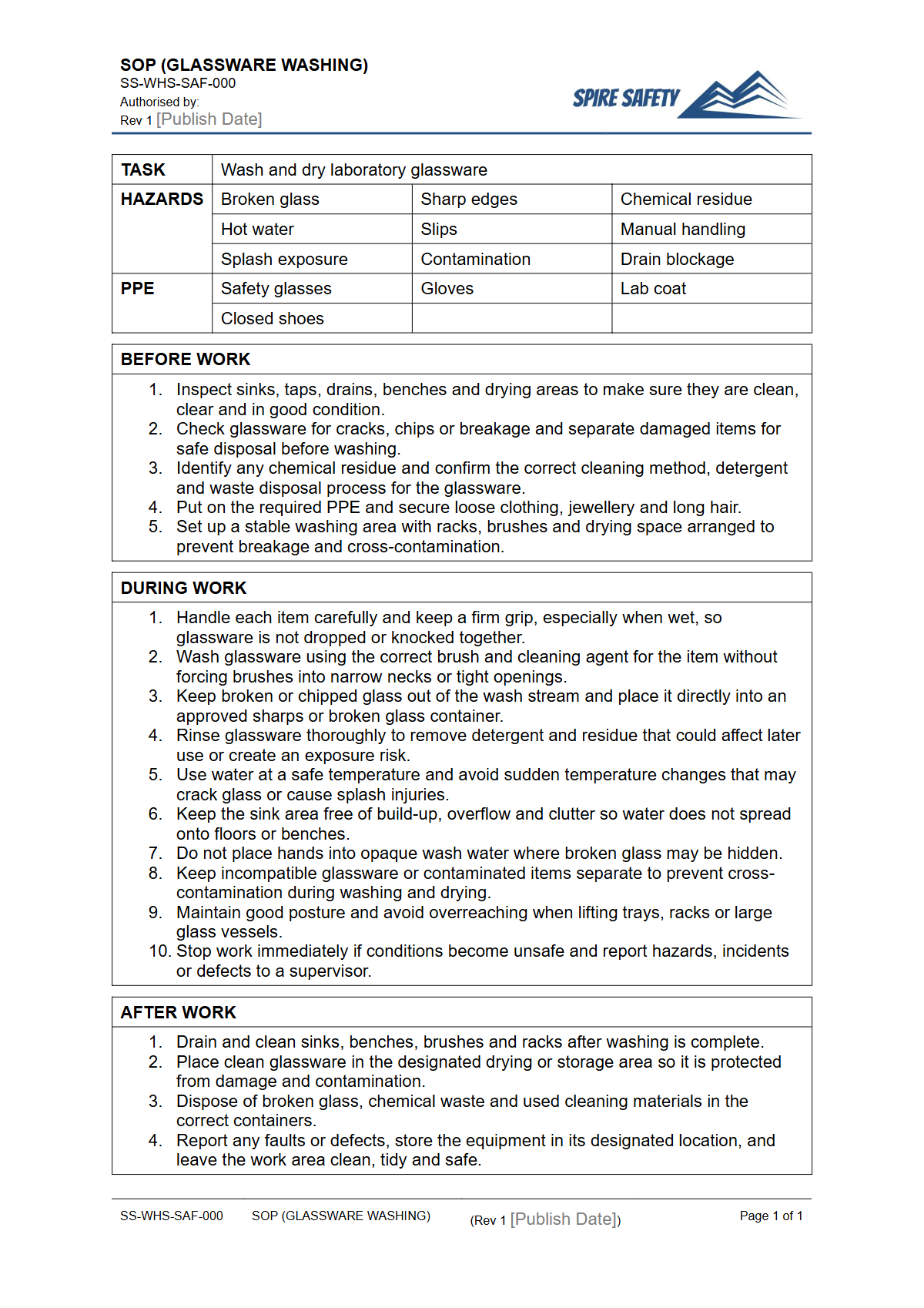
Purpose of the Free Safe Operating Procedure (Glassware Washing) Template
This Free Safe Operating Procedure (Glassware Washing) Template provides a structured starting point for organisations to document the required steps for safely washing glassware. The task, common in laboratories, hospitality, and manufacturing, presents several risks, including cuts from broken glass, exposure to hazardous cleaning chemicals, burns from hot water, and ergonomic strains.
By formalising the process, you create a clear, consistent, and trainable method that helps control these hazards. A documented SOP is a fundamental tool in managing work health and safety, demonstrating that you have established a safe system of work for a routine but potentially high-risk activity.
Using a standardised template ensures all critical safety elements are considered, from pre-operational checks and personal protective equipment (PPE) requirements to the final clean-up and storage. This process is a key part of an effective risk management framework.
Integrating this Safe Operating Procedure into your broader WHS management systems ensures it is part of a consistent and holistic approach to workplace safety, rather than a standalone document.
Video walkthrough
How to use the Free Safe Operating Procedure (Glassware Washing) Template
This template is available for download as a DOCX file for easy editing, as well as a PDF for straightforward distribution. To use it effectively, you must adapt it to the specific context of your workplace.
A generic procedure is not sufficient to ensure safety; it must reflect your unique equipment, chemicals, and environment.
Follow these steps:
- Download: Choose the DOCX version to begin customisation.
- Assess: Conduct a risk assessment for the glassware washing task at your site. Identify the specific types of glassware, the cleaning agents used, the water temperature, the washing equipment (e.g., automated washers, ultrasonic baths), and the workspace layout.
- Customise: Populate the template with your site-specific information. This includes detailing the exact PPE required (e.g., specific type of gloves, eye protection), step-by-step instructions for your process, emergency procedures for cuts or chemical splashes, and waste disposal requirements.
- Consult: Involve workers who perform the task in the drafting and review process. Their practical experience is invaluable for creating a procedure that is both safe and workable.
- Review and Approve: Once customised, have a competent person (like a supervisor or WHS manager) review and approve the final Safe Operating Procedure before it is issued.
Important: We provide this template as a guide. You must customise it with your own site-specific details.
We have no knowledge of your specific machinery, chemicals, operational environment, or the competency of your workers. Relying solely on this generic template without thorough customisation will not adequately protect your workers or fulfil your WHS duties.
If you need assistance tailoring this template or developing other safety documents to meet your specific needs, our WHS consulting team can provide expert guidance.
When to use this Safe Operating Procedure
A Safe Operating Procedure for glassware washing should be used as a primary reference document for training and daily operations. It is most effective when integrated into your safety management system and used at key moments.
This includes during the induction of new employees who will be performing the task, ensuring they learn the correct, safe method from the beginning. It should also be a central part of any refresher training programs to prevent procedural drift and complacency.
Furthermore, the SOP should be readily accessible in the work area for workers to reference as needed. Following an incident or near-miss related to glassware handling, the SOP must be reviewed and updated to incorporate any lessons learned. Documenting procedures for high-risk equipment is also a cornerstone of WHS management; beyond manual tasks, you should have clear instructions for powered tools, such as those detailed in our FREE Plasma Cutter SOP (Safe Operating Procedure) Template.
Who should use this Safe Operating Procedure
This SOP is intended for use by multiple roles within an organisation. Workers and operators are the primary users, as it provides them with the approved step-by-step instructions needed to perform their job safely.
Following the SOP helps ensure their own safety and that of their colleagues. Supervisors and line managers use the SOP as a tool for training their teams, monitoring correct work practices, and conducting safety observations or informal inspections.
WHS advisors and managers will use this template as part of their work in developing and implementing the organisation's overall safety management system. They are often responsible for facilitating the risk assessment and consultation process to ensure the SOP is robust and fit-for-purpose.
Regularly reviewing your SOPs is crucial, and this can be done as part of your internal review process or through a formal WHS compliance auditing program to ensure ongoing effectiveness.
While this document focuses on glassware, a comprehensive safety system documents all tasks, including those involving common equipment. For instance, safely accessing high storage shelves often requires a step ladder SOP to prevent falls.
You can explore our entire free WHS resources library to find more templates for other equipment and tasks relevant to your workplace.
Common mistakes
Common mistakes to avoid
- Failing to inspect glassware for cracks, fractures, or chips before washing.
- Using incompatible cleaning chemicals, incorrect dilutions, or mixing different chemicals.
- Not wearing appropriate personal protective equipment (PPE), especially safety glasses and suitable gloves.
- Leaving glassware to dry or be stored in precarious or high-traffic locations where it can be easily knocked over.
Legal references
Legal considerations
The following legal requirements may be relevant to this type of work.
- Work Health and Safety Act (Harmonised) — Provides the primary duties for protecting workers and other people from work health and safety risks.
- Work Health and Safety Regulations (Harmonised) — Sets out requirements supporting the management of workplace hazards and risks.
The following codes may be relevant to this type of work.
- Managing WHS Risks Code of Practice — Provides practical guidance on identifying hazards, assessing risks and applying effective controls.
- Work Health and Safety Consultation, Cooperation and Coordination Code of Practice — Provides practical guidance on consulting workers and coordinating with other duty holders.
- Managing the Work Environment and Facilities Code of Practice — Provides practical guidance on safe work environments, workplace facilities and related controls.
Did you know
Hidden Hazards
Lacerations from broken or chipped glassware are one of the most common injuries in laboratory settings. A simple washing task can become high-risk without a proper procedure that includes pre-inspection.
Chemical Compatibility
Not all detergents are safe for all types of glassware or contaminants. Using the wrong cleaning agent can damage scientific glassware, leave a residue that affects future experiments, or create unexpected chemical reactions.
FAQ
Frequently asked questions
01What should be included in a glassware washing SOP?
02Is a Safe Operating Procedure a legal requirement in Australia?
03How often should we review our Safe Operating Procedure for glassware washing?
04Can this SOP be used for both manual washing and automated dishwashers?
Share this resource
Free Safe Operating Procedure (Glassware Washing) Template
Browse Categories
How To Use It
- 1Download and open in Word or PDF.
- 2Replace the placeholders with your business details.
- 3Get it reviewed by a WHS specialist before rollout.
Need it customised?
Our WHS consultants can adapt this template to your site, run a gap analysis, or audit what you already have in place.
Book a Free Consultation WHS consulting servicesor call 1300 156 382
Related templates
- Free Safe Operating Procedure (Glasswasher Cleaning) Template
- Free Safe Operating Procedure (GNSS Rover) Template
- Free Safe Operating Procedure (Goal Post Inspection) Template
- Free Safe Operating Procedure (Golf Bunker Raking) Template
- Free Safe Operating Procedure (Golf Green Repair) Template
- Free Safe Operating Procedure (Golf Tee Maintenance) Template