
Free Safe Operating Procedure (GNSS Rover) Template
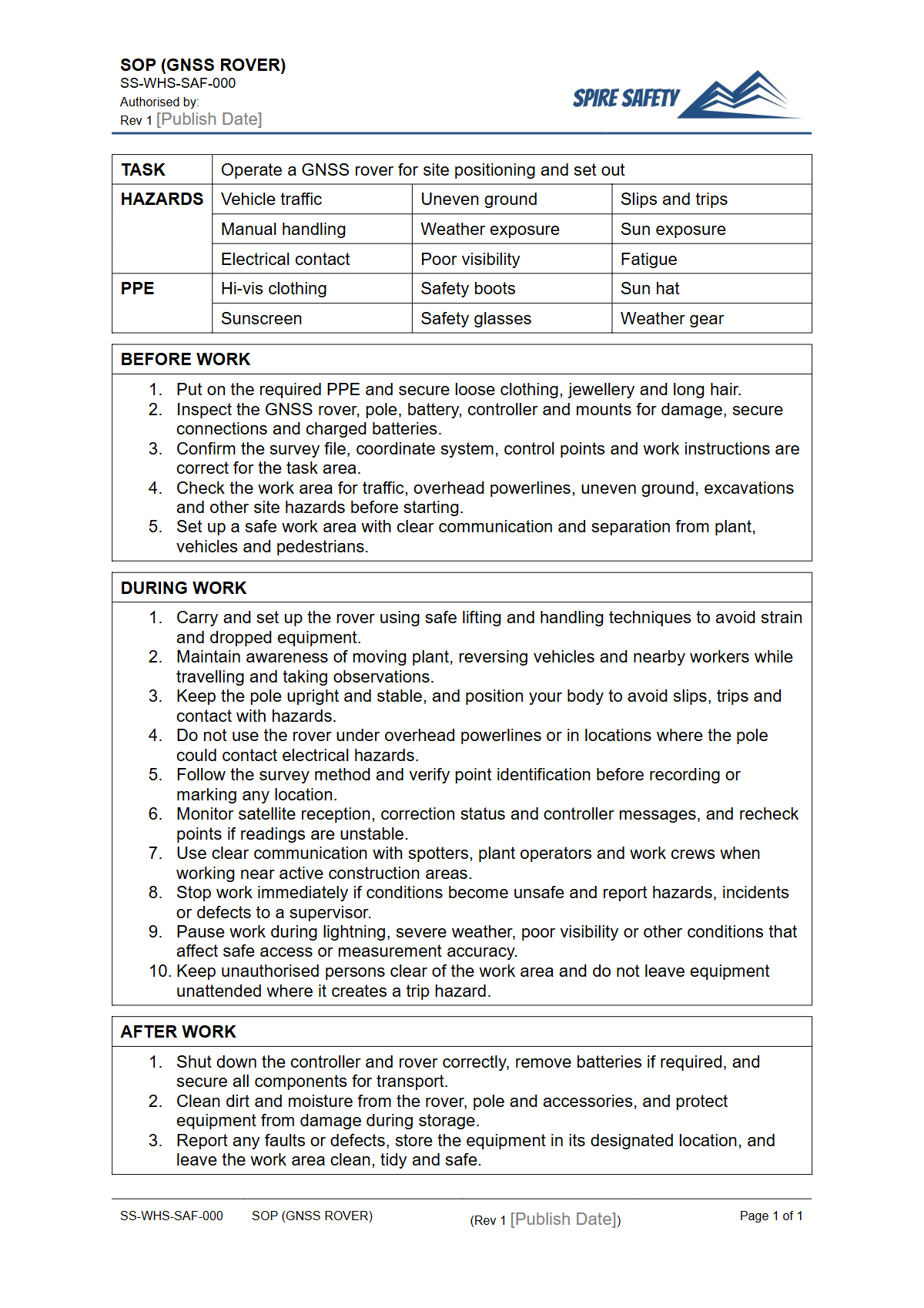
Download our Free Safe Operating Procedure (GNSS Rover) Template. A structured Word doc for creating clear WHS guidelines for surveyors and field staff.
Free Safe Operating Procedure (GNSS Rover) Template
DOCX • 126 KB + PDF
Updated Oct 2026
No signup required
Purpose of the Free Safe Operating Procedure (GNSS Rover) Template
This Free Safe Operating Procedure (GNSS Rover) Template provides a comprehensive starting point for organisations to document safe work practices for their surveying and field staff. A GNSS Rover is a critical tool for precise positioning in construction, land surveying, and civil engineering.
While the device itself poses minimal electrical risk, its use in dynamic and often hazardous outdoor environments necessitates clear safety protocols. Documenting these procedures helps in managing risks such as slips, trips, and falls on uneven terrain, exposure to environmental elements, interaction with traffic or heavy machinery, and ergonomic strains from manual handling.
A well-defined Safe Operating Procedure (SOP) is a fundamental component of a proactive safety culture. It ensures that all operators understand the identified hazards and the control measures required to work safely.
By formalising these steps, you create a consistent benchmark for training, supervision, and performance review. This template is designed to align with Australian WHS expectations, helping you fulfil your duty of care by providing a clear and safe system of work. It can be used alongside procedures for other common site equipment, such as those detailed in our FREE Dozer SOP (Safe Operating Procedure) Template.
What is a GNSS Rover?
A Global Navigation Satellite System (GNSS) Rover is a portable receiver that determines its precise location on Earth by receiving signals from constellations of satellites. It is commonly used by surveyors, engineers, and GIS professionals for tasks requiring high accuracy, such as setting out construction points, mapping topographical features, and conducting as-built surveys.
The 'rover' is the mobile unit used in the field, which often communicates with a stationary 'base station' to achieve centimetre-level accuracy through a technique called Real-Time Kinematic (RTK) positioning. Hazards often stem from the environment it's used in, rather than the device itself.
Video walkthrough
How to use the Free Safe Operating Procedure (GNSS Rover) Template
This resource is provided in both an editable DOCX format and a print-ready PDF file. The DOCX version is designed for easy customisation to reflect the specific context of your workplace.
It is crucial to adapt this document before implementation. Generic procedures are insufficient for managing unique site-specific risks.
We recommend a competent person, such as a WHS manager or an experienced surveyor, leads the customisation process.
Important: You must customise this template to your workplace. This involves adding your company name and logo, and detailing the specific models of GNSS equipment used.
You should also integrate site-specific information, such as emergency contact details, evacuation procedures, required Personal Protective Equipment (PPE), and any unique environmental or operational hazards present at your work locations. An SOP forms a vital part of your overall WHS management systems.
When to use a Safe Operating Procedure
An SOP for a GNSS Rover should be a core document used throughout the work lifecycle. It is not a document to be filed away and forgotten.
It should be used during worker inductions to ensure new team members are aware of the established safe work methods from day one. It serves as a primary reference for task-specific training and competency assessments for all surveyors and field technicians who will operate the equipment.
The SOP is also an excellent tool for pre-start meetings or toolbox talks, reinforcing key safety points before work begins in the field. Following an incident or a near-miss, the SOP must be reviewed and updated to incorporate any lessons learned and prevent recurrence.
Regular WHS compliance auditing can help verify that procedures like this are being consistently followed in practice.
Who should use this template
This Safe Operating Procedure template is intended for a range of personnel within an organisation to ensure a consistent and safe approach to using GNSS equipment. Key users include:
- Persons Conducting a Business or Undertaking (PCBUs): To meet their primary duty of care to provide safe systems of work.
- WHS Managers and Safety Officers: To develop, implement, and review workplace safety documentation.
- Supervisors and Team Leaders: To train their teams, supervise work, and enforce safety standards in the field.
- Surveyors and Field Technicians: As a practical guide for performing their work safely and a reference for correct procedure.
- Training Coordinators: To form the basis of their training and competency verification programs for operators.
For organisations involved in civil works, this document can be integrated with other plant-specific procedures, like our FREE Trencher SOP Template, to build a comprehensive safety library. Having a full suite of tailored SOPs ensures all high-risk tasks on a project are managed effectively.
You can browse our complete free WHS resources library for more templates.
Common mistakes
Common mistakes to avoid
- Failing to conduct a pre-start site assessment for environmental hazards like uneven ground, water bodies, or overhead powerlines.
- Neglecting to wear appropriate PPE, such as high-visibility clothing on active worksites or sun protection for extended outdoor work.
- Using the template as-is without customising it for specific site conditions, equipment models, and company emergency procedures.
- Not providing adequate training to operators on the finalised Safe Operating Procedure before they begin work in the field.
Legal references
Legal considerations
The following legal requirements may be relevant to this type of work.
- Work Health and Safety Act (Harmonised) — Provides the primary duties for protecting workers and other people from work health and safety risks.
- Work Health and Safety Regulations (Harmonised) — Sets out requirements supporting the management of workplace hazards and risks.
The following codes may be relevant to this type of work.
- Managing WHS Risks Code of Practice — Provides practical guidance on identifying hazards, assessing risks and applying effective controls.
- Work Health and Safety Consultation, Cooperation and Coordination Code of Practice — Provides practical guidance on consulting workers and coordinating with other duty holders.
- Managing the Work Environment and Facilities Code of Practice — Provides practical guidance on safe work environments, workplace facilities and related controls.
Did you know
RTK Accuracy
Modern GNSS rovers using Real-Time Kinematic (RTK) positioning can achieve centimetre-level accuracy, which is essential for construction set-out, infrastructure projects, and detailed mapping.
Beyond GPS
GNSS is a broader term than GPS. While GPS is the American system, modern rovers use signals from multiple constellations, including Russia's GLONASS, Europe's Galileo, and China's BeiDou, for improved reliability and coverage.
FAQ
Frequently asked questions
01Is a Safe Operating Procedure legally required for a GNSS Rover?
02What are the main hazards of using a GNSS Rover?
03How often should an SOP for a GNSS Rover be reviewed?
04Can I use this template for any brand of GNSS equipment?
Share this resource
Free Safe Operating Procedure (GNSS Rover) Template
Browse Categories
How To Use It
- 1Download and open in Word or PDF.
- 2Replace the placeholders with your business details.
- 3Get it reviewed by a WHS specialist before rollout.
Need it customised?
Our WHS consultants can adapt this template to your site, run a gap analysis, or audit what you already have in place.
Book a Free Consultation WHS consulting servicesor call 1300 156 382
Related templates
- Free Safe Operating Procedure (Goal Post Inspection) Template
- Free Safe Operating Procedure (Golf Bunker Raking) Template
- Free Safe Operating Procedure (Golf Green Repair) Template
- Free Safe Operating Procedure (Golf Tee Maintenance) Template
- Free Safe Operating Procedure (Goods Lift) Template
- Free Safe Operating Procedure (Goods Receipt Check) Template