
Free Safe Operating Procedure (Goods Receipt Check) Template
Download our free Safe Operating Procedure (Goods Receipt Check) template. This customisable DOCX & PDF helps standardise your inwards goods process.
Free Safe Operating Procedure (Goods Receipt Check) Template
DOCX • 126 KB + PDF
Updated Oct 2026
No signup required
Purpose of the Free Safe Operating Procedure (Goods Receipt Check) Template
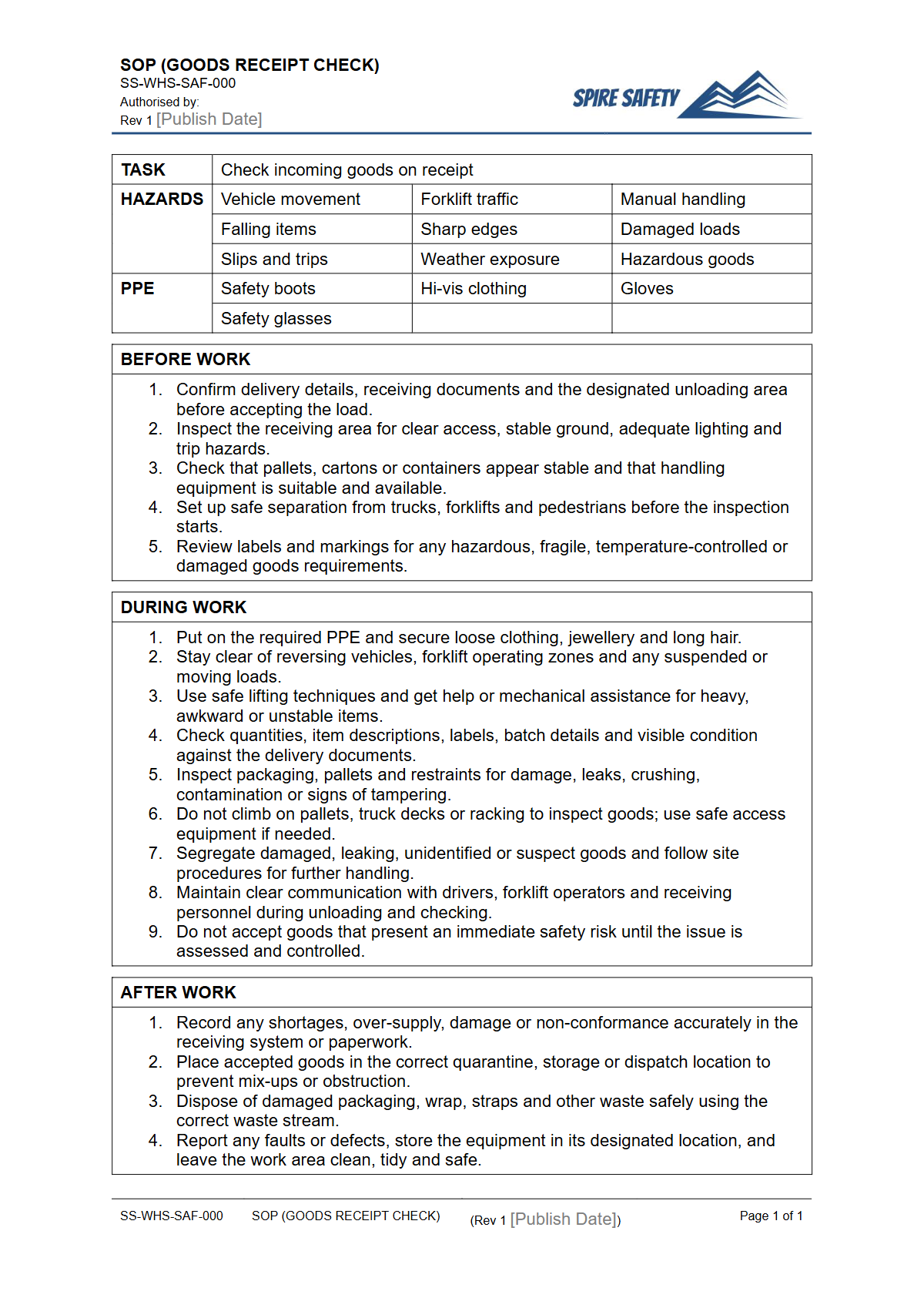
This free Safe Operating Procedure (Goods Receipt Check) template provides a structured framework for managing the process of receiving goods into your workplace. A documented SOP ensures that every delivery is handled consistently and safely, reducing the risk of injury and property damage.
It outlines the essential steps, from pre-arrival checks to final put-away, helping to control common hazards like manual handling injuries, vehicle interactions, and unidentified dangerous goods. By standardising this critical function, you create a more predictable and controlled environment, which is a cornerstone of effective WHS management systems.
Using this template helps your organisation to:
- Define clear responsibilities for workers involved in receiving goods.
- Identify and control hazards associated with unloading, inspecting, and moving stock.
- supports your compliance efforts with manual handling guidelines and other WHS duties.
- Create a verifiable record of safety and operational checks.
- Improve efficiency and accuracy in the inwards goods process.
Video walkthrough
How to use the Free Safe Operating Procedure (Goods Receipt Check) Template
Our Safe Operating Procedure for a goods receipt check is designed as a starting point. To make it effective, you must adapt it to the specific context of your business.
This involves reviewing each section and adding details relevant to your site, equipment, and the types of goods you handle. For example, if your team uses specific machinery for unloading, reference your procedures for that equipment, such as our FREE Telehandler SOP Template. This ensures the document is a practical tool, not a generic guide.
Customisation Steps:
Important Note: We have provided a comprehensive starting point based on Australian WHS principles. However, it is essential that you customise this template to reflect the specific hazards, equipment, personnel, and processes unique to your workplace.
Consultation with your workers during this process is critical for creating a practical and effective SOP.
- Download: Get the template in your preferred format (DOCX for editing or PDF for reference).
- Review and Assess: Walk through your current goods receiving process and compare it against the template. Identify any gaps or site-specific steps that need to be added.
- Add Detail: Insert information about your specific receiving bay layout, required Personal Protective Equipment (PPE), emergency procedures, and contact personnel.
- Consult: Share the draft SOP with your warehouse team, supervisors, and health and safety representatives to gather feedback. Their direct experience is invaluable for ensuring the procedure is practical and addresses real-world risks.
- Approve and Train: Once finalised, have the SOP formally approved. Train all relevant workers on the procedure and ensure they understand their roles and responsibilities.
When to use it
This Safe Operating Procedure should be the default process followed every time goods are delivered to your site. It is a live document that forms a key part of daily operations in any area that handles inwards freight, including warehouses, distribution centres, retail back-docks, and manufacturing facilities.
It should also be used during worker induction to train new team members on the correct procedure from day one. When checking items on high pallets or shelving, workers should follow established protocols for working at height, as detailed in documents like a FREE Step Ladder SOP Template.
Who should use it
This SOP is intended for all personnel involved in the goods receiving process. Clear roles prevent confusion and ensure accountability for safety and operational tasks. Key users include:
- Warehouse Staff / Storepersons: The primary users who perform the day-to-day tasks of unloading, checking, and moving goods.
- Forklift and Plant Operators: Any worker operating machinery to assist in the unloading process.
- Supervisors and Team Leaders: Responsible for overseeing the process, ensuring the SOP is followed, and addressing any issues that arise.
- WHS/Safety Managers: Responsible for developing, reviewing, and auditing the effectiveness of the SOP as part of the overall safety system.
- Maintenance Staff: May refer to the SOP when conducting work in the receiving area, such as servicing equipment like an air compressor used for cleaning. An established Free Air Compressor SOP ensures this is done safely.
Reviewing and Improving the SOP
A Safe Operating Procedure is not a 'set and forget' document. To remain effective, it requires periodic review.
Schedule a formal review at least every two years, or immediately following an incident, a near miss, or a significant change in your workplace (such as new equipment or a change in the types of goods received). Regular reviews can be integrated into your WHS compliance auditing schedule to verify that procedures are being followed correctly and are still effective at controlling risks.
By implementing and maintaining a robust SOP for your goods receipt checks, you build a stronger safety culture and a more efficient, reliable supply chain. Feel free to browse our complete free WHS resources library for more templates to support your safety management system.
Common mistakes
Common mistakes to avoid
- Failing to properly customise the template with site-specific equipment, hazards, and emergency contacts.
- Neglecting to train all relevant workers on the finalised SOP and document their competency.
- Allowing staff to bypass the procedure during busy periods, which significantly increases the risk of incidents.
- Inadequate record-keeping for received goods, making it difficult to trace issues or prove procedural adherence.
Legal references
Legal considerations
The following legal requirements may be relevant to this type of work.
- Work Health and Safety Act (Harmonised) — Provides the primary duties for protecting workers and other people from work health and safety risks.
- Work Health and Safety Regulations (Harmonised) — Sets out requirements supporting the management of workplace hazards and risks.
The following codes may be relevant to this type of work.
- Managing WHS Risks Code of Practice — Provides practical guidance on identifying hazards, assessing risks and applying effective controls.
- Work Health and Safety Consultation, Cooperation and Coordination Code of Practice — Provides practical guidance on consulting workers and coordinating with other duty holders.
- Managing the Work Environment and Facilities Code of Practice — Provides practical guidance on safe work environments, workplace facilities and related controls.
Did you know
Manual Handling Risk
In Australia, injuries from lifting, carrying, and handling objects are a leading cause of serious workers' compensation claims, making standardised procedures in areas like goods receiving critical.
The Cost of Damaged Goods
A thorough goods receipt check not only prevents damaged stock from entering your inventory but also identifies potential transport issues and safety hazards before they cause further problems downstream.
FAQ
Frequently asked questions
01What should be included in a goods receipt check SOP?
02Why is a Safe Operating Procedure important for receiving goods?
03How often should an SOP for goods receipt be reviewed?
04Is this template suitable for all industries in Australia?
Share this resource
Free Safe Operating Procedure (Goods Receipt Check) Template
Browse Categories
How To Use It
- 1Download and open in Word or PDF.
- 2Replace the placeholders with your business details.
- 3Get it reviewed by a WHS specialist before rollout.
Need it customised?
Our WHS consultants can adapt this template to your site, run a gap analysis, or audit what you already have in place.
Book a Free Consultation WHS consulting servicesor call 1300 156 382
Related templates
- Free Safe Operating Procedure (Grab Rail Cleaning) Template
- Free Safe Operating Procedure (Grade Laser) Template
- Free Safe Operating Procedure (Graffiti Paint Touchup) Template
- Free Safe Operating Procedure (Graffiti Removal) Template
- Free Safe Operating Procedure (Grain Dryer) Template
- Free Safe Operating Procedure (Grain Elevator) Template