
Free Safe Operating Procedure (Grain Elevator) Template
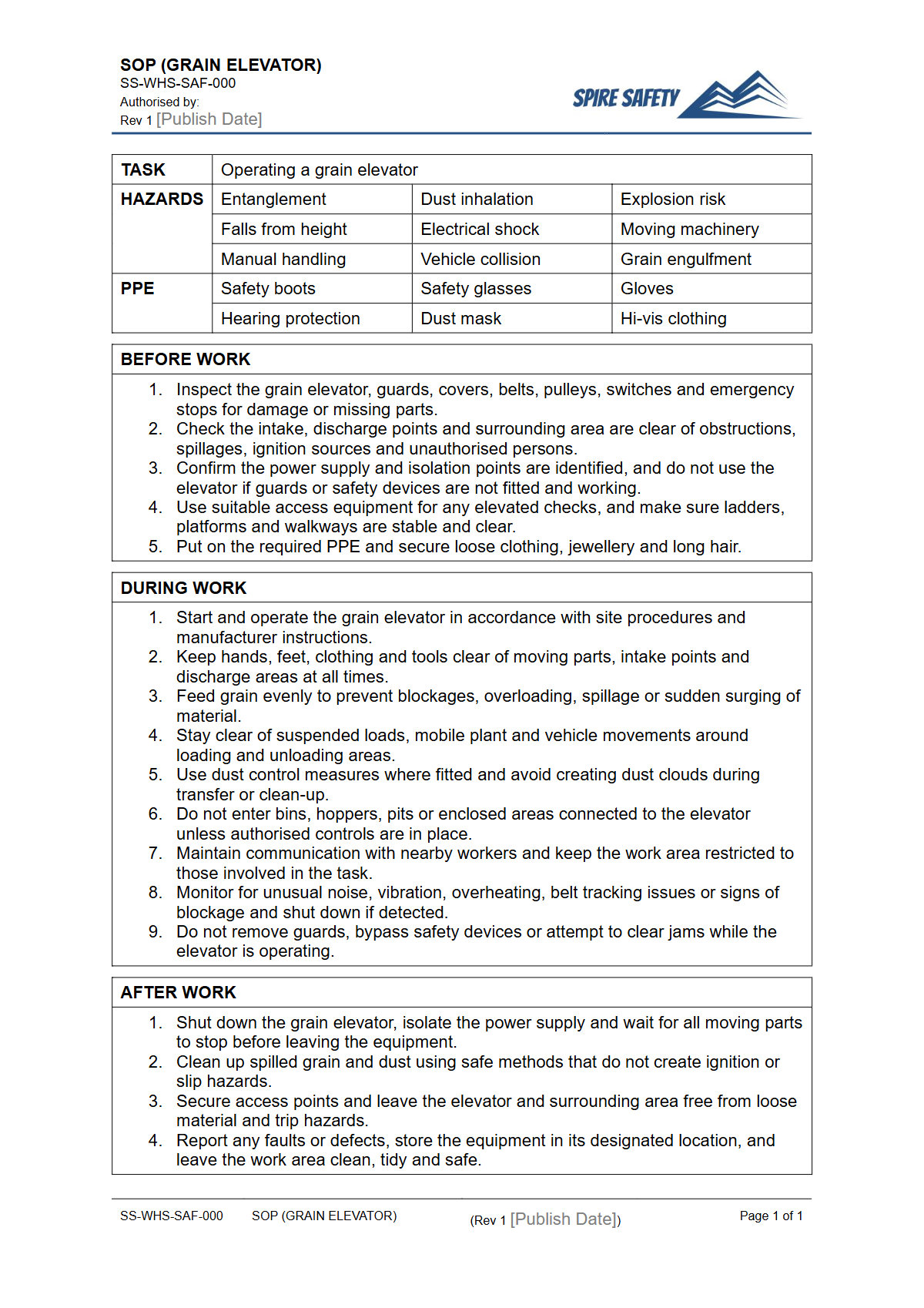
Download our Free Safe Operating Procedure (Grain Elevator) Template. This customisable DOCX and PDF resource helps outline safety steps for grain elevator use.
Free Safe Operating Procedure (Grain Elevator) Template
DOCX • 126 KB + PDF
Updated Oct 2026
No signup required
Purpose of the Free Safe Operating Procedure (Grain Elevator) Template
Operating grain elevators and associated equipment presents significant risks, including engulfment, entanglement in machinery, and dust explosions. Our Free Safe Operating Procedure (Grain Elevator) Template provides a structured starting point for documenting the required safety measures to control these hazards.
This document helps your organisation establish and communicate a consistent, safe method for all tasks involving grain elevators, from pre-start checks to shutdown and maintenance.
Using a standardised SOP promotes a systematic approach to safety, ensuring that all workers understand the identified hazards and the control measures in place. It forms a critical component of broader WHS management systems, demonstrating a commitment to providing a safe work environment as required by Australian WHS legislation.
The template is designed to guide you in clearly outlining operator responsibilities, required personal protective equipment (PPE), and emergency protocols.
Video walkthrough
How to use the Free Safe Operating Procedure (Grain Elevator) Template
This resource is available for immediate download in both DOCX and PDF formats. The DOCX version is fully editable, allowing you to tailor the content to the specific make and model of your grain elevator, the types of grain handled, and the unique layout of your facility.
A well-drafted SOP is specific and reflects the reality of your workplace operations, rather than being a generic document.
Important: This is a template only. For it to be effective, you must customise it to reflect the specific equipment, processes, and risks present in your workplace.
We are not liable for any incidents that may occur from the use of this document. It is your responsibility to ensure all safety measures are appropriate and comprehensive.
For related agricultural equipment, you might also find our FREE Grain Drill SOP (Safe Operating Procedure) Template useful.
When to use a Grain Elevator SOP
A Safe Operating Procedure for a grain elevator should be a living document, used consistently throughout day-to-day operations. It is essential during the induction and training of new operators to ensure they learn the correct, safe method from the beginning.
It should also be used for pre-operational checks to verify that all safety guards and emergency stops are functional before work commences.
The SOP serves as a critical reference for refresher training and for verifying operator competency over time. Following any incident, near-miss, or modification to the equipment, the SOP must be reviewed and updated to incorporate any new learnings or changes in procedure.
Many agricultural sites use a range of heavy equipment; for instance, a FREE Telehandler SOP Template can help manage risks for associated loading and unloading tasks.
Who should use this Safe Operating Procedure
This SOP should be used by several key roles within an organisation. WHS Managers and Site Supervisors are responsible for developing, implementing, and reviewing the procedure to ensure it aligns with legislative requirements and operational realities.
They must ensure it is readily accessible to all relevant personnel.
Operators and farmhands are the primary end-users, relying on the SOP for clear, step-by-step instructions on how to perform their tasks safely. Maintenance and service personnel should also consult the SOP, particularly the sections on isolation, lock-out/tag-out (LOTO), and safe shutdown before commencing any work.
The document can also be a key piece of evidence during a formal WHS compliance auditing process to demonstrate that safe systems of work are in place and being followed.
Integrating this procedure into your daily workflow helps standardise safe behaviour and creates a clear benchmark for performance. Similar principles apply to other common industrial equipment, and our Free Air Compressor SOP can provide guidance for those assets.
Spire Safety offers a wide range of templates and documents in our free WHS resources library to support your safety management efforts.
Common mistakes
Common mistakes to avoid
- Using a generic template without customising it for the specific elevator model and site conditions.
- Failing to include detailed Lock-Out/Tag-Out (LOTO) procedures for cleaning, maintenance, and clearing blockages.
- Neglecting to address confined space entry procedures for bins, silos, and pits.
- Forgetting to train all operators on the finalised SOP and document the training.
Legal references
Legal considerations
The following legal requirements may be relevant to this type of work.
- Work Health and Safety Act (Harmonised) — Provides the primary duties for protecting workers and other people from work health and safety risks.
- Work Health and Safety Regulations (Harmonised) — Sets out requirements supporting the management of workplace hazards and risks.
The following codes may be relevant to this type of work.
- Managing WHS Risks Code of Practice — Provides practical guidance on identifying hazards, assessing risks and applying effective controls.
- Work Health and Safety Consultation, Cooperation and Coordination Code of Practice — Provides practical guidance on consulting workers and coordinating with other duty holders.
- Managing the Work Environment and Facilities Code of Practice — Provides practical guidance on safe work environments, workplace facilities and related controls.
Did you know
The Danger of Dust
Grain dust is highly combustible and can cause a violent explosion when mixed with air in an enclosed space and exposed to an ignition source. Just 1mm of accumulated dust can be enough to fuel a secondary explosion.
Engulfment Speed
A worker can be completely buried in flowing grain in less than 20 seconds. The force exerted by the grain makes self-rescue virtually impossible once a person is submerged to knee-level.
FAQ
Frequently asked questions
01What are the biggest risks when operating a grain elevator?
02Is an SOP a legal requirement for a grain elevator in Australia?
03How often should a grain elevator SOP be reviewed?
04What is the difference between an SOP and a Safe Work Method Statement (SWMS)?
Share this resource
Free Safe Operating Procedure (Grain Elevator) Template
Browse Categories
How To Use It
- 1Download and open in Word or PDF.
- 2Replace the placeholders with your business details.
- 3Get it reviewed by a WHS specialist before rollout.
Need it customised?
Our WHS consultants can adapt this template to your site, run a gap analysis, or audit what you already have in place.
Book a Free Consultation WHS consulting servicesor call 1300 156 382
Related templates
- Free Safe Operating Procedure (Grandstand Cleaning) Template
- Free Safe Operating Procedure (Gravel Path Repair) Template
- Free Safe Operating Procedure (Gravel Raking) Template
- Free Safe Operating Procedure (Grease Filter Change) Template
- Free Safe Operating Procedure (Grease Filter Cleaning) Template
- Free Safe Operating Procedure (Grease Pump) Template