
Free Safe Operating Procedure (Grease Filter Change) Template
Download our free Safe Operating Procedure (Grease Filter Change) template. This customisable DOCX and PDF provides a clear framework for your kitchen safety.
Free Safe Operating Procedure (Grease Filter Change) Template
DOCX • 126 KB + PDF
Updated Oct 2026
No signup required
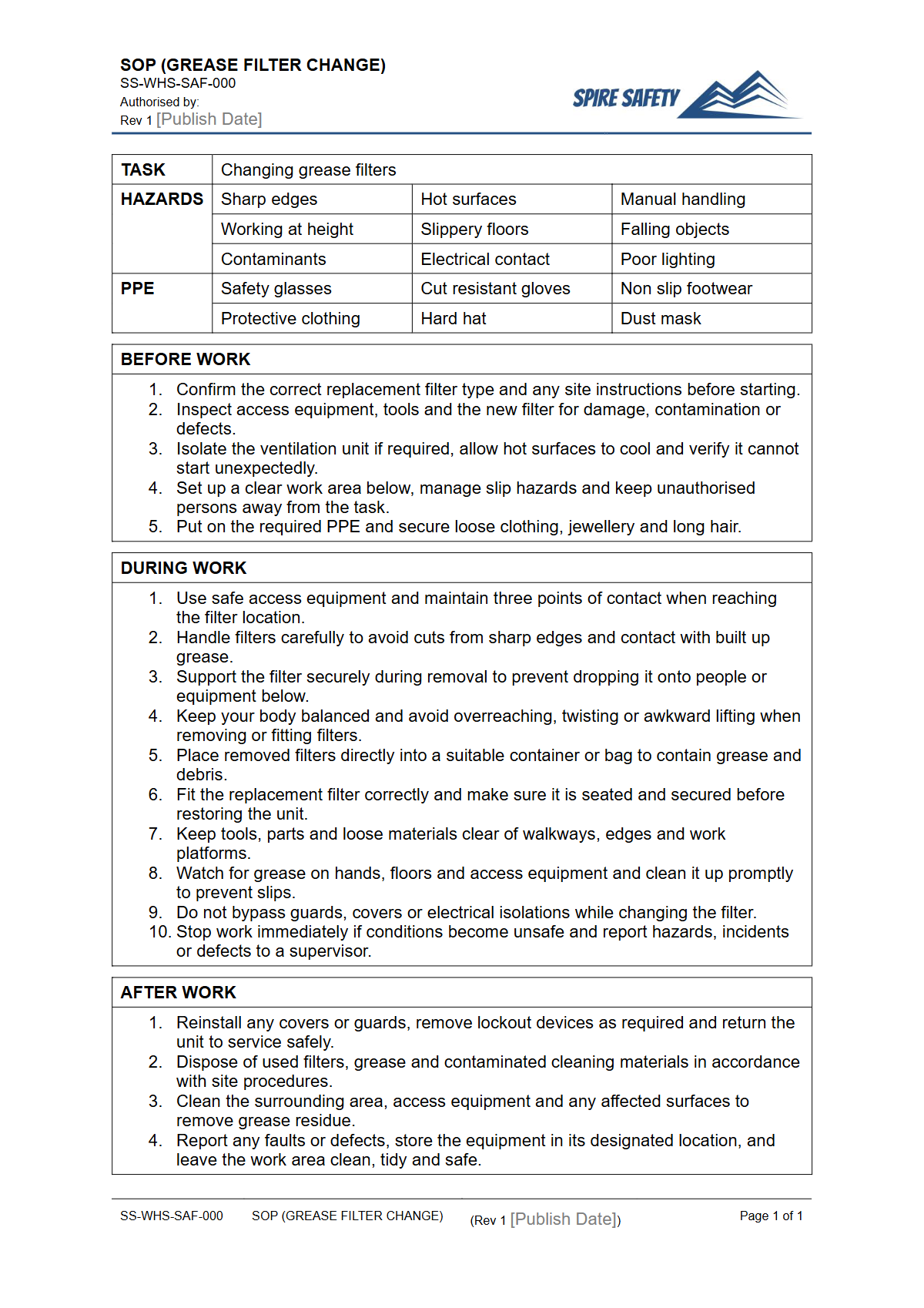
Purpose of the Free Safe Operating Procedure (Grease Filter Change) Template
Changing grease filters in a commercial kitchen exhaust hood is a critical task for fire prevention, hygiene, and maintaining air quality. To help your organisation manage this process safely and effectively, we offer a free Safe Operating Procedure (Grease Filter Change) Template.
This document provides a structured framework, aligned with Australian WHS principles, for outlining step-by-step processes, identifying specific hazards, and implementing essential control measures. A well-documented SOP is a cornerstone of a safe system of work, helping to minimise risks such as fires, slips, and manual handling injuries.
The primary purpose of this template is to guide you in creating a site-specific SOP that formalises the procedure for your workplace. Key hazards addressed include slips on greasy floors, falls from height while accessing the canopy, cuts from sharp metal edges, manual handling strains from lifting filters, and exposure to cleaning chemicals.
Because this task often requires working at height, integrating safe ladder use is critical; you can document these specific controls using resources like our free Step Ladder SOP to supplement your procedure.
Video walkthrough
How to use the Free Safe Operating Procedure (Grease Filter Change) Template
This document is a starting point. To make it effective, you must customise it to reflect the specific equipment, environment, and processes in your workplace.
Download the DOCX file and add details unique to your kitchen, including the make and model of your exhaust canopy, the specific types of filters used, the designated cleaning area, and the approved cleaning chemicals.
Important: We have provided a comprehensive but generic template. You must consult with your workers and adapt the content to your specific circumstances to ensure it is relevant and effective.
Add details about your emergency procedures, specific PPE requirements, and disposal methods for waste grease. Integrating such procedures is a key part of developing robust WHS management systems that protect your team and your business.
When to use it
A Safe Operating Procedure for changing grease filters should be used in several key situations. It is an essential training tool for new kitchen staff, apprentices, or any worker tasked with the job for the first time.
It should be readily accessible in the workplace as a practical on-the-job reference for workers to consult before and during the task. Furthermore, the SOP serves as a benchmark document during safety observations and for conducting internal WHS compliance auditing to verify that prescribed safe work methods are being followed consistently.
Who should use it
This SOP should be used by multiple roles within an organisation. Persons Conducting a Business or Undertaking (PCBUs), restaurant owners, and facility managers are responsible for ensuring a safe system of work is in place.
Kitchen managers and head chefs should use the SOP to train, supervise, and monitor staff performance. Most importantly, the kitchen hands, cleaners, or maintenance staff who perform the filter change must be trained in the SOP and follow it every time.
It's also a valuable tool for WHS committees and representatives to review as part of ongoing risk management consultation. Having clear procedures for critical tasks and emergencies is vital, which is why your safety library may also include documents like our defibrillator operation procedure.
Managing Risks Associated with Grease Filter Maintenance
Beyond the procedure itself, managing the risks involves a holistic approach. This includes establishing a regular cleaning schedule based on kitchen usage to prevent excessive grease accumulation, which is a major fire hazard.
Ensure the designated cleaning area is equipped with proper drainage and non-slip flooring. All chemicals used must have a corresponding Safety Data Sheet (SDS) available, and workers must be trained in their safe use.
By documenting these elements in your SOP, you create a clear and defensible system that demonstrates your organisation's commitment to safety. For more ready-to-use templates and checklists, explore our complete free WHS resources library.
Common mistakes
Common mistakes to avoid
- Not cleaning surrounding ductwork and canopy surfaces, allowing grease to accumulate elsewhere.
- Using ladders or access equipment incorrectly or on wet, slippery floors.
- Failing to properly secure filters back in place, creating a fire or falling object hazard.
- Disposing of collected grease improperly, creating environmental or slip hazards.
Legal references
Legal considerations
The following legal requirements may be relevant to this type of work.
- Work Health and Safety Act (Harmonised) — Provides the primary duties for protecting workers and other people from work health and safety risks.
- Work Health and Safety Regulations (Harmonised) — Sets out requirements supporting the management of workplace hazards and risks.
The following codes may be relevant to this type of work.
- Managing WHS Risks Code of Practice — Provides practical guidance on identifying hazards, assessing risks and applying effective controls.
- Work Health and Safety Consultation, Cooperation and Coordination Code of Practice — Provides practical guidance on consulting workers and coordinating with other duty holders.
- Managing the Work Environment and Facilities Code of Practice — Provides practical guidance on safe work environments, workplace facilities and related controls.
Did you know
Fire Risk
A significant percentage of commercial kitchen fires are caused by the ignition of grease and fat deposits in extraction systems. Regular filter cleaning is a primary fire prevention measure.
Australian Standard
Australian Standard AS 1851 sets out requirements for the routine servicing of fire protection systems and equipment, which includes kitchen exhaust systems in many commercial buildings.
FAQ
Frequently asked questions
01Is a Safe Operating Procedure a legal requirement for changing grease filters?
02How often should we change our kitchen grease filters?
03What PPE is needed for changing grease filters?
04Can I just use this template as-is without any changes?
Share this resource
Free Safe Operating Procedure (Grease Filter Change) Template
Browse Categories
How To Use It
- 1Download and open in Word or PDF.
- 2Replace the placeholders with your business details.
- 3Get it reviewed by a WHS specialist before rollout.
Need it customised?
Our WHS consultants can adapt this template to your site, run a gap analysis, or audit what you already have in place.
Book a Free Consultation WHS consulting servicesor call 1300 156 382
Related templates
- Free Safe Operating Procedure (Grease Filter Cleaning) Template
- Free Safe Operating Procedure (Grease Pump) Template
- Free Safe Operating Procedure (Grease Transfer Pump) Template
- Free Safe Operating Procedure (Grease Trap Cleaning) Template
- Free Safe Operating Procedure (Green Waste Inspection) Template
- Free Safe Operating Procedure (Green Waste Loading) Template