
Free Safe Operating Procedure (Grease Transfer Pump) Template
Download our free Safe Operating Procedure (Grease Transfer Pump) template. This customisable DOCX and PDF helps formalise your WHS processes. Get started now.
Free Safe Operating Procedure (Grease Transfer Pump) Template
DOCX • 126 KB + PDF
Updated Oct 2026
No signup required
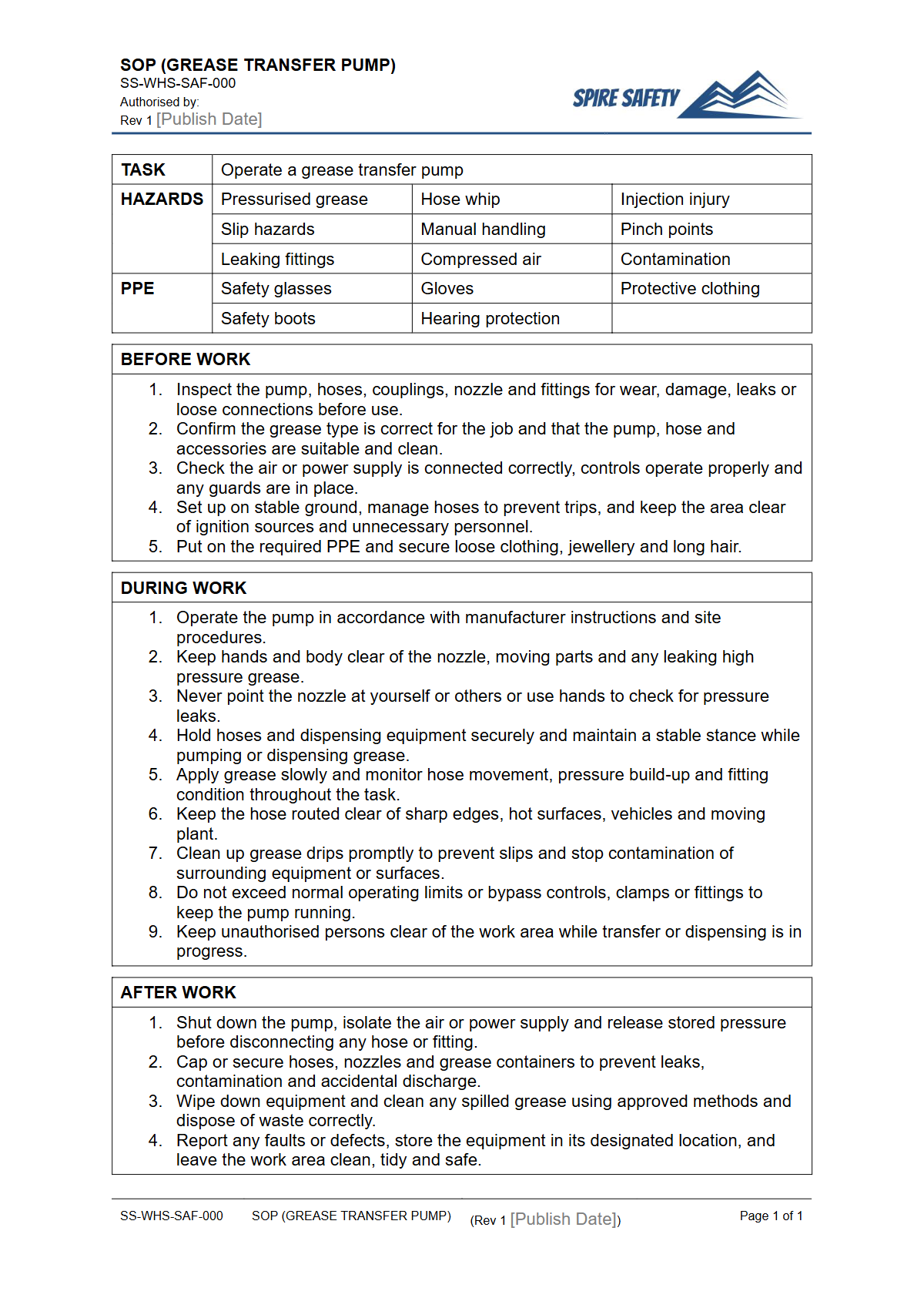
Purpose of the Free Safe Operating Procedure (Grease Transfer Pump) Template
Operating a grease transfer pump, whether air-powered, electric, or manual, introduces significant workplace hazards. This Free Safe Operating Procedure (Grease Transfer Pump) Template provides a structured framework to document and standardise the safe use of this equipment in your workplace.
A documented SOP is a practical tool for managing risks associated with high-pressure systems, chemical handling, and manual tasks. By formalising your procedures, you create a clear, consistent reference for workers, which is essential for training and supervision.
The primary purpose of this Safe Operating Procedure is to give you a comprehensive starting point for outlining pre-operational checks, step-by-step operating instructions, and post-operational tasks. Implementing a robust SOP helps control specific hazards like high-pressure injection injuries, skin contact with grease, and ergonomic strains from moving heavy drums.
A documented SOP is a key component of an effective WHS management system, demonstrating your organisation's commitment to providing a safe work environment.
Video walkthrough
How to use the Free Safe Operating Procedure (Grease Transfer Pump) Template
This template is provided in both DOCX and PDF formats for your convenience. The DOCX file is fully editable, allowing you to tailor the content to the specific equipment and processes at your site.
You should detail the specific make and model of your grease pump, the type of grease being used, required personal protective equipment (PPE), and emergency procedures.
Important Note: This document is a template we have developed to provide a starting point. You MUST customise it to reflect the specific equipment, chemicals, and processes used in your workplace.
Failure to do so could result in an inadequate risk control measure. We are not responsible for any incidents that may occur from the use of this template.
Once customised, the SOP should be used as a primary document for worker training and competency assessments. It should be made readily available to all operators and supervisors, either in a printed format near the work area or digitally through your company's systems.
Regular review and updates are essential to ensure it remains relevant.
When to use this Safe Operating Procedure
A Safe Operating Procedure for a grease transfer pump should be used as a core part of your daily safety practices. It is not a document to be filed away and forgotten. It should be actively used in several situations:
- Before any worker operates the equipment for the first time.
- During worker inductions, training, and refresher courses to ensure a consistent message.
- As a reference guide for operators to consult if they are unsure about a step.
- When conducting a risk assessment or job safety analysis (JSA) for tasks involving the pump.
- During incident investigations to determine if procedural deviations occurred.
- By supervisors to conduct safety observations and verify correct procedures are being followed.
The principles of documenting safe use are consistent across different types of machinery. For instance, the structured approach in this document is similar to what you would find in our free Air Compressor SOP template, promoting a consistent safety methodology across your site.
Who should use this Safe Operating Procedure
Multiple individuals within an organisation have a role in using and maintaining this Safe Operating Procedure to ensure its effectiveness:
- Persons Conducting a Business or Undertaking (PCBUs): Have the overall responsibility to provide safe systems of work, which includes ensuring SOPs are developed, implemented, and maintained.
- Supervisors and Managers: Are responsible for training workers on the SOP, enforcing its use, and ensuring it is readily accessible and understood by their team.
- Workers: Must follow the steps outlined in the customised SOP to perform their tasks safely. They should also be encouraged to provide feedback for improving the procedure.
- WHS Representatives and Committees: Can use the SOP as a tool for workplace inspections and when consulting on changes to work processes.
Regularly reviewing and updating your SOPs is crucial for maintaining safety standards. A formal WHS compliance audit can help identify gaps in your procedures and ensure they remain effective and aligned with current regulations.
This resource is just one of many we offer to support Australian businesses. You can explore our complete free WHS resources library for more templates, checklists, and guides to enhance your safety systems.
Common mistakes
Common mistakes to avoid
- Failing to depressurise the system before performing maintenance or changing fittings.
- Using a damaged or frayed hose, which can rupture under pressure.
- Not wearing appropriate personal protective equipment (PPE), particularly safety glasses and chemical-resistant gloves.
- Using the wrong type of grease for the application or machinery, leading to equipment failure.
Legal references
Legal considerations
The following legal requirements may be relevant to this type of work.
- Work Health and Safety Act (Harmonised) — Provides the primary duties for protecting workers and other people from work health and safety risks.
- Work Health and Safety Regulations (Harmonised) — Sets out requirements supporting the management of workplace hazards and risks.
The following codes may be relevant to this type of work.
- Managing WHS Risks Code of Practice — Provides practical guidance on identifying hazards, assessing risks and applying effective controls.
- Work Health and Safety Consultation, Cooperation and Coordination Code of Practice — Provides practical guidance on consulting workers and coordinating with other duty holders.
- Managing the Work Environment and Facilities Code of Practice — Provides practical guidance on safe work environments, workplace facilities and related controls.
Did you know
High-Pressure Dangers
Some industrial grease pumps can generate pressures exceeding 10,000 PSI (700 bar). An injection of grease at this pressure can cause severe tissue damage, gangrene, and may require amputation if not treated immediately as a surgical emergency.
Grease Composition
Grease is not just thick oil. It's a semi-solid lubricant made of a base oil (around 80-90%), a thickener (like lithium soap), and additives that provide properties like water resistance and extreme pressure tolerance.
FAQ
Frequently asked questions
01What are the main hazards associated with using a grease transfer pump?
02Is a Safe Operating Procedure a legal requirement in Australia?
03How often should an SOP for a grease transfer pump be reviewed?
04What should be included in training for operating a grease transfer pump?
Share this resource
Free Safe Operating Procedure (Grease Transfer Pump) Template
Browse Categories
How To Use It
- 1Download and open in Word or PDF.
- 2Replace the placeholders with your business details.
- 3Get it reviewed by a WHS specialist before rollout.
Need it customised?
Our WHS consultants can adapt this template to your site, run a gap analysis, or audit what you already have in place.
Book a Free Consultation WHS consulting servicesor call 1300 156 382
Related templates
- Free Safe Operating Procedure (Grease Trap Cleaning) Template
- Free Safe Operating Procedure (Green Waste Inspection) Template
- Free Safe Operating Procedure (Green Waste Loading) Template
- Free Safe Operating Procedure (Green Waste Sorting) Template
- Free Safe Operating Procedure (Green Waste Transfer) Template
- Free Safe Operating Procedure (Greenhouse Cleaning) Template