
Free Safe Operating Procedure (Greenhouse Cleaning) Template
Download our free Safe Operating Procedure (Greenhouse Cleaning) Template.
Free Safe Operating Procedure (Greenhouse Cleaning) Template
DOCX • 126 KB + PDF
Updated Oct 2026
No signup required
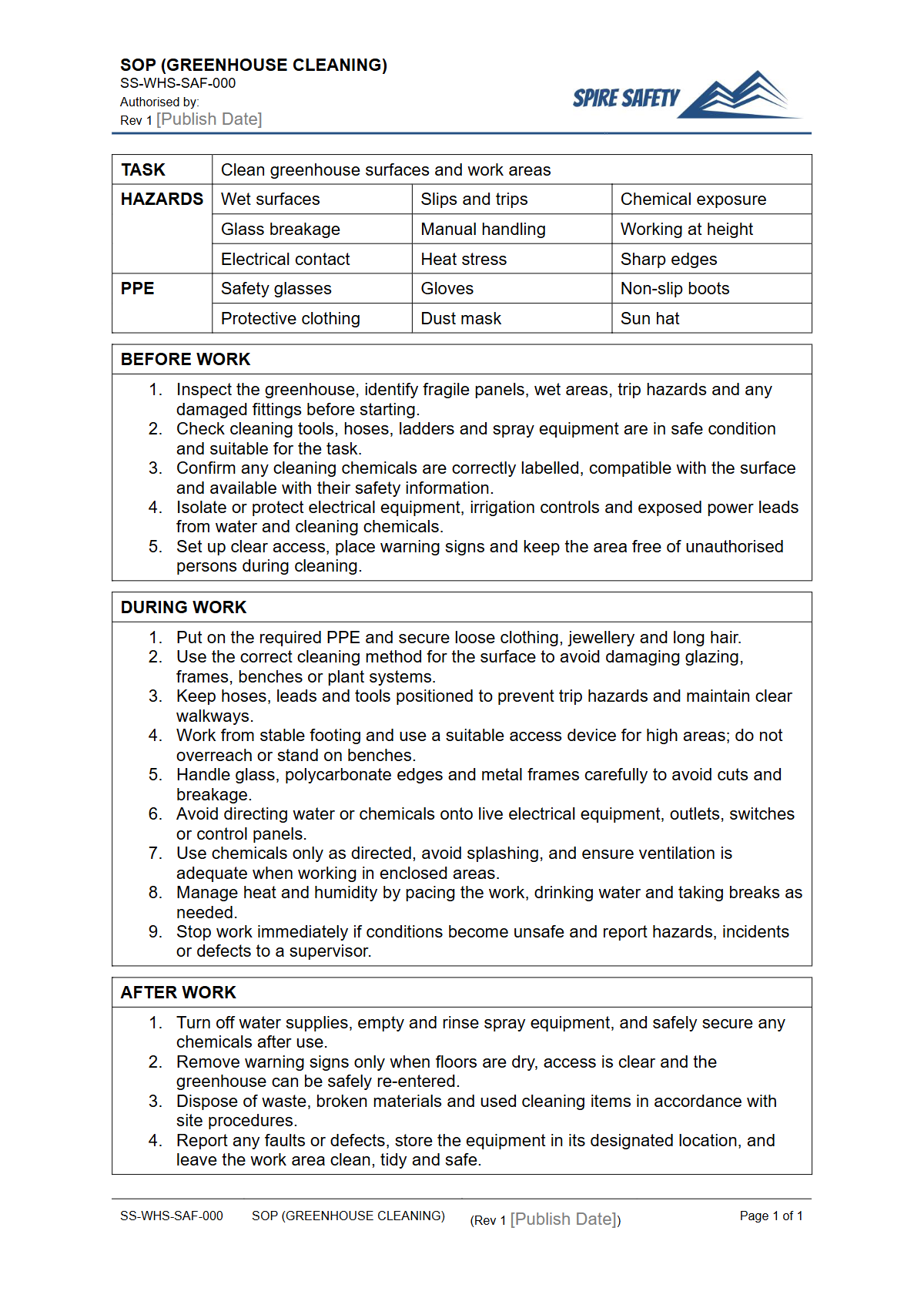
Purpose of the Free Safe Operating Procedure (Greenhouse Cleaning) Template
Establishing clear, safe work methods is crucial for any task involving potential hazards. This free Safe Operating Procedure (Greenhouse Cleaning) Template provides a structured starting point for documenting the step-by-step process for cleaning greenhouses, helping to manage risks and ensure worker safety.
It is designed to be adapted for various horticultural and agricultural operations across Australia.
A Safe Operating Procedure, or SOP, is a fundamental tool in any effective safety management system. Its purpose is to provide clear, written instructions that outline the safest and most efficient way to perform a specific task.
For greenhouse cleaning, this involves managing a unique set of hazards. These can include exposure to residual pesticides or cleaning chemicals, risks associated with manual handling of equipment, potential slips and trips on wet surfaces, and hazards from using equipment like pressure washers. This SOP template helps your organisation document control measures to mitigate these risks, forming a key part of your overall WHS management systems.
By systematically breaking down the task, you can identify potential dangers at each step and specify the required safety controls. This includes detailing the necessary Personal Protective Equipment (PPE), pre-operational checks for equipment, and emergency procedures.
Using a structured SOP promotes consistent and safe work practices among all employees, reducing the likelihood of incidents and injuries.
Video walkthrough
How to use the Free Safe Operating Procedure (Greenhouse Cleaning) Template
This resource is available for immediate download as a DOCX file, allowing for easy editing and customisation. A PDF version is also provided for straightforward printing and distribution.
To effectively use this template, you should gather input from workers who perform the cleaning tasks, as they have firsthand knowledge of the practical challenges and risks involved.
Important Note: This document is a template and must be customised to your specific workplace. We have provided a framework, but you are responsible for adding details relevant to your site's unique equipment, chemical products, layouts, and control measures.
The finalised SOP should be reviewed and approved by a competent person before implementation.
The procedure should be detailed enough to be easily understood by a new worker but concise enough to be a practical reference on the job. Consider including photos of your specific equipment and PPE setups to improve clarity.
For certain tasks, like cleaning high windows or structures, you may also need to reference a specific FREE Step Ladder SOP (Safe Operating Procedure) Template to cover associated fall risks.
When to use it
This Safe Operating Procedure should be an active document within your workplace. It is not a 'set and forget' tool.
Its primary use is as a basis for training new and existing employees on the established safe method for cleaning greenhouses. It should be readily accessible to all relevant workers, either in a printed format near the work area or digitally.
The SOP should also be used as a reference for pre-start meetings or toolbox talks before cleaning operations commence. Furthermore, it is a critical document to review following any incident, near miss, or when there is a change in equipment, chemicals, or cleaning processes.
Regular reviews, as part of your safety management cycle, ensure the procedure remains relevant and effective. An independent review can also provide valuable insights, which is a key component of our WHS compliance auditing services.
Who should use it
This SOP template is designed for use by several key roles within an organisation. Persons Conducting a Business or Undertaking (PCBUs), such as farm owners or company directors, are responsible for ensuring safe systems of work are in place.
Farm managers, supervisors, and team leaders will use the template to draft, implement, and enforce the procedure on a day-to-day basis.
The most important users, however, are the workers themselves. The SOP is written for them, providing guidance to perform their tasks safely and consistently.
Involving workers in the development and review process is not just good practice; it is a requirement under WHS legislation, as it fosters a stronger safety culture and ensures the procedures are practical and effective. For related agricultural tasks, you might also find our FREE Grain Drill SOP (Safe Operating Procedure) Template useful for standardising other high-risk activities on your property.
In case of a medical emergency during any work task, having clear instructions is vital. It's wise to complement your operational SOPs with emergency response plans, such as our Free Safe Operating Procedure (Defibrillator Operation) Template.
If your cleaning process involves using machinery, ensure each piece of equipment has its own SOP. For example, if compressed air is used for clearing debris, workers must be trained on the Free Air Compressor SOP (Safe Operating Procedure) Template. For more guidance and other useful documents, browse our complete free WHS resources library.
Common mistakes
Common mistakes to avoid
- Using a generic template without customising it for site-specific equipment, chemicals, and hazards.
- Failing to adequately train all relevant workers on the finalised SOP and confirm their understanding.
- Not providing or enforcing the use of the specific Personal Protective Equipment (PPE) listed in the procedure.
- Forgetting to review and update the SOP after an incident, or when work processes and equipment change.
Legal references
Legal considerations
The following legal requirements may be relevant to this type of work.
- Work Health and Safety Act (Harmonised) — Provides the primary duties for protecting workers and other people from work health and safety risks.
- Work Health and Safety Regulations (Harmonised) — Sets out requirements supporting the management of workplace hazards and risks.
The following codes may be relevant to this type of work.
- Managing WHS Risks Code of Practice — Provides practical guidance on identifying hazards, assessing risks and applying effective controls.
- Work Health and Safety Consultation, Cooperation and Coordination Code of Practice — Provides practical guidance on consulting workers and coordinating with other duty holders.
- Managing the Work Environment and Facilities Code of Practice — Provides practical guidance on safe work environments, workplace facilities and related controls.
Did you know
Slips, Trips and Falls
Slips, trips and falls are a leading cause of serious injuries in the agricultural sector. Maintaining clean, dry, and unobstructed floor surfaces is a critical control measure in any greenhouse environment.
Chemical Dilution
Incorrectly diluting cleaning chemicals can be dangerous, either by making them ineffective or by creating a solution that is too strong, increasing the risk of chemical burns, respiratory issues, and environmental damage.
FAQ
Frequently asked questions
01What is a Safe Operating Procedure for greenhouse cleaning?
02What hazards should be included in a greenhouse cleaning SOP?
03How often should we review our greenhouse cleaning SOP?
04Is this template compliant with Australian WHS laws?
Share this resource
Free Safe Operating Procedure (Greenhouse Cleaning) Template
Browse Categories
How To Use It
- 1Download and open in Word or PDF.
- 2Replace the placeholders with your business details.
- 3Get it reviewed by a WHS specialist before rollout.
Need it customised?
Our WHS consultants can adapt this template to your site, run a gap analysis, or audit what you already have in place.
Book a Free Consultation WHS consulting servicesor call 1300 156 382
Related templates
- Free Safe Operating Procedure (Greenhouse Shading) Template
- Free Safe Operating Procedure (Greenhouse Venting) Template
- Free Safe Operating Procedure (Grinding Wheel Change) Template
- Free Safe Operating Procedure (Grizzly Feeder) Template
- Free Safe Operating Procedure (Ground Crew Handover) Template
- Free Safe Operating Procedure (Ground Equipment Staging) Template