
Free Safe Operating Procedure (Ground Equipment Staging) Template
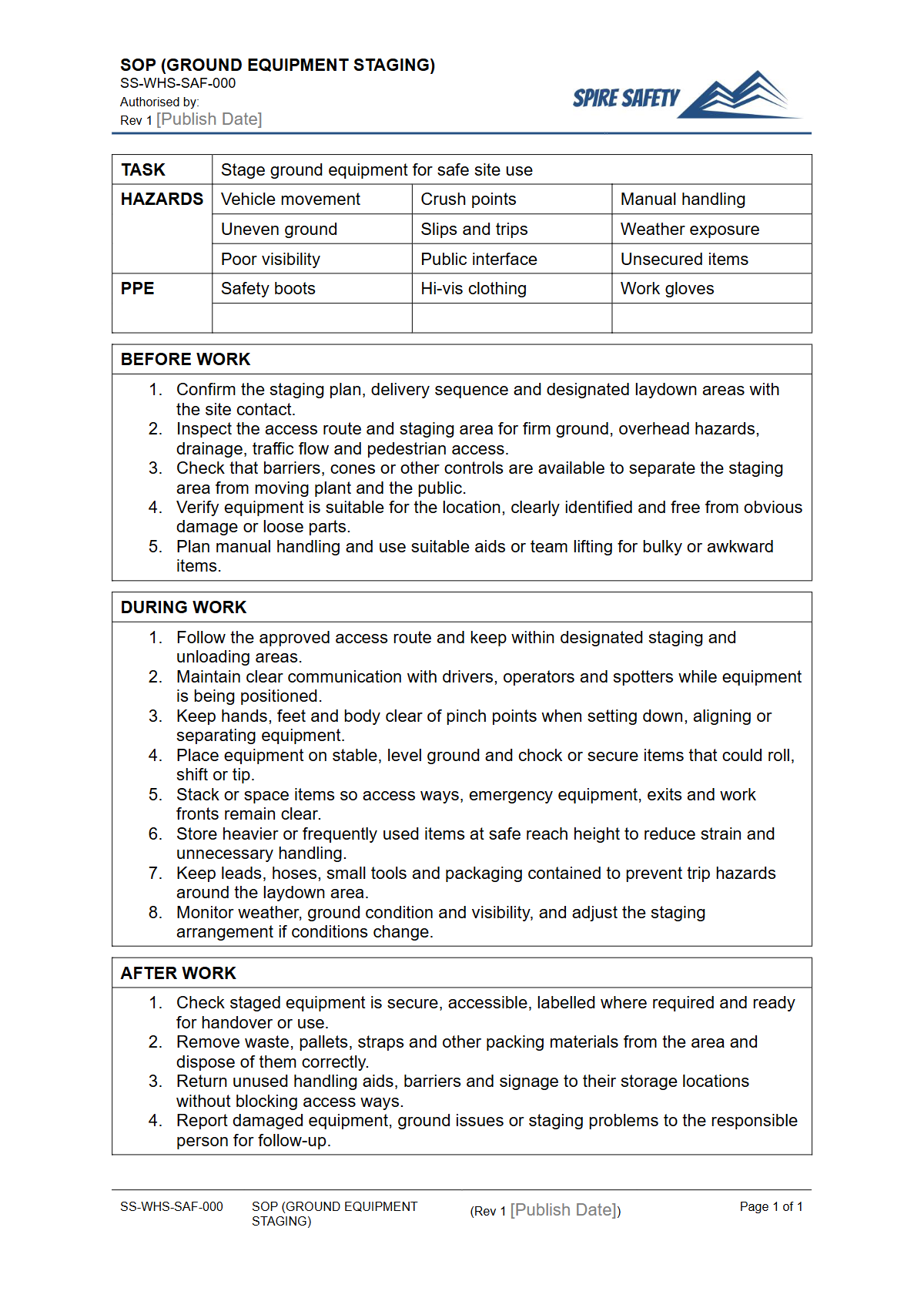
Download our free Safe Operating Procedure for ground equipment staging. This DOCX & PDF template helps you outline safe work steps and controls.
Free Safe Operating Procedure (Ground Equipment Staging) Template
DOCX • 126 KB + PDF
Updated Oct 2026
No signup required
Purpose of the Free Safe Operating Procedure (Ground Equipment Staging) Template
This free Safe Operating Procedure (Ground Equipment Staging) Template provides a structured framework for documenting the required steps to safely position vehicles, servicing equipment, and other plant around an aircraft. Ground equipment staging is a high-risk activity common in aviation, transport, and logistics, where precision is critical to prevent costly damage to aircraft and, more importantly, to protect ground crew from harm.
A formal SOP ensures that all personnel follow a consistent, safe, and efficient process, minimising the risks of collision, personal injury, and operational delays.
Developing a robust SOP is a fundamental component of a proactive safety culture. It serves as a key document within broader WHS management systems, demonstrating a commitment to risk management and operational excellence.
This template helps a Person Conducting a Business or Undertaking (PCBU) meet their primary duty of care by providing clear, written instructions for a hazardous task, forming the basis for effective worker training and supervision.
Video walkthrough
How to use the Free Safe Operating Procedure (Ground Equipment Staging) Template
This template is designed as a starting point, aligned with Australian WHS principles. To make it effective, you must adapt it to the specific context of your operations.
Start by downloading the DOCX file and adding your company branding. Then, methodically work through each section, detailing the unique aspects of your workplace.
This includes specifying the types of aircraft and ground support equipment (GSE) involved, defining exclusion zones, outlining communication protocols (including radio use and hand signals), and listing the required personal protective equipment (PPE).
A generic procedure is not sufficient for compliance or safety. For example, the staging process for a small regional aircraft will differ significantly from that for a large wide-body jet.
Likewise, if your operations involve specific plant, you should develop detailed procedures for that equipment, such as our free telehandler SOP template. We have created this document as a guide; you must complete it with your site-specific information, consult with your workers during the drafting process, and secure the necessary sign-offs from management before implementation.
When to use it
A Safe Operating Procedure for ground equipment staging should be used consistently as a reference and training tool. It is essential for inducting and training new ground crew, ensuring they understand the approved methods from day one.
It should also be a central document for pre-start meetings or toolbox talks before any staging operation begins, serving as a reminder of key risks and controls. Furthermore, the SOP should be reviewed and updated regularly, especially after an incident, when new equipment or aircraft types are introduced, or following a change in the operating environment.
Regular reviews ensure the procedure remains relevant and effective. This process can be supported by formal assessments to verify that the documented steps are being followed correctly in practice.
Engaging a third party for WHS compliance auditing can provide an objective evaluation of your procedures and their implementation, identifying any gaps between the documented SOP and actual work practices.
Who should use it
This Safe Operating Procedure is intended for use by multiple roles within an organisation. Operations Managers and WHS Advisors will use it to establish and document the standard for safe work.
Supervisors and Team Leaders are responsible for implementing the SOP, training their teams, and ensuring adherence on the ground. Most importantly, the ground crew, equipment operators, and marshallers who perform the staging tasks must be thoroughly familiar with the procedure and follow it meticulously.
Competency is key, and this SOP is a tool for achieving it. Any worker operating equipment around an aircraft, whether it's a belt loader, a fuel truck, or even simple access equipment like that covered in a step ladder SOP, must be trained on the relevant procedures.
Documenting these steps ensures everyone has a clear and unified understanding of their roles and responsibilities. For related ground maintenance tasks that might occur nearby, other specific procedures like a dozer SOP may also be required to manage simultaneous operations.
This document is one of many available from Spire Safety. For more templates, checklists, and guides, browse our complete free WHS resources library.
Common mistakes
Common mistakes to avoid
- Failing to customise the template with site-specific details like aircraft types, equipment models, and exclusion zones.
- Neglecting to conduct and document pre-operational checks on all ground support equipment before use.
- Inadequate communication protocols between ground crew members, flight crew, and air traffic control during operations.
- Assuming workers understand the procedure without providing formal training, competency assessment, and ongoing supervision.
Legal references
Legal considerations
The following legal requirements may be relevant to this type of work.
- Work Health and Safety Act (Harmonised) — Provides the primary duties for protecting workers and other people from work health and safety risks.
- Work Health and Safety Regulations (Harmonised) — Sets out requirements supporting the management of workplace hazards and risks.
The following codes may be relevant to this type of work.
- Managing WHS Risks Code of Practice — Provides practical guidance on identifying hazards, assessing risks and applying effective controls.
- Work Health and Safety Consultation, Cooperation and Coordination Code of Practice — Provides practical guidance on consulting workers and coordinating with other duty holders.
- Managing the Work Environment and Facilities Code of Practice — Provides practical guidance on safe work environments, workplace facilities and related controls.
Did you know
Damage on the Ground
A significant percentage of aircraft damage occurs during ground operations, not in the air. Collisions with ground support equipment are a leading cause, making proper staging procedures critical for both safety and financial reasons.
Standardised Signals
International aviation relies on standardised marshalling hand signals to guide aircraft and ground equipment. These signals overcome language barriers and the noisy tarmac environment, ensuring clear communication between marshallers and operators.
FAQ
Frequently asked questions
01What is ground equipment staging in aviation?
02Why is a Safe Operating Procedure for ground equipment staging so important?
03Does this SOP template cover all types of ground support equipment (GSE)?
04Who is responsible for implementing this Safe Operating Procedure?
Share this resource
Free Safe Operating Procedure (Ground Equipment Staging) Template
Browse Categories
How To Use It
- 1Download and open in Word or PDF.
- 2Replace the placeholders with your business details.
- 3Get it reviewed by a WHS specialist before rollout.
Need it customised?
Our WHS consultants can adapt this template to your site, run a gap analysis, or audit what you already have in place.
Book a Free Consultation WHS consulting servicesor call 1300 156 382
Related templates
- Free Safe Operating Procedure (Ground Penetrating Radar) Template
- Free Safe Operating Procedure (Ground Power Unit) Template
- Free Safe Operating Procedure (Groundcover Planting) Template
- Free Safe Operating Procedure (Grounds Litter Pickup) Template
- Free Safe Operating Procedure (Grout Injection Pump) Template
- Free Safe Operating Procedure (Grout Mixer) Template