
Free Safe Operating Procedure (Ground Penetrating Radar) Template
Download our free Safe Operating Procedure template for Ground Penetrating Radar (GPR). This customisable DOCX & PDF helps you document safe work methods.
Free Safe Operating Procedure (Ground Penetrating Radar) Template
DOCX • 126 KB + PDF
Updated Oct 2026
No signup required
Purpose of the Free Safe Operating Procedure (Ground Penetrating Radar) Template
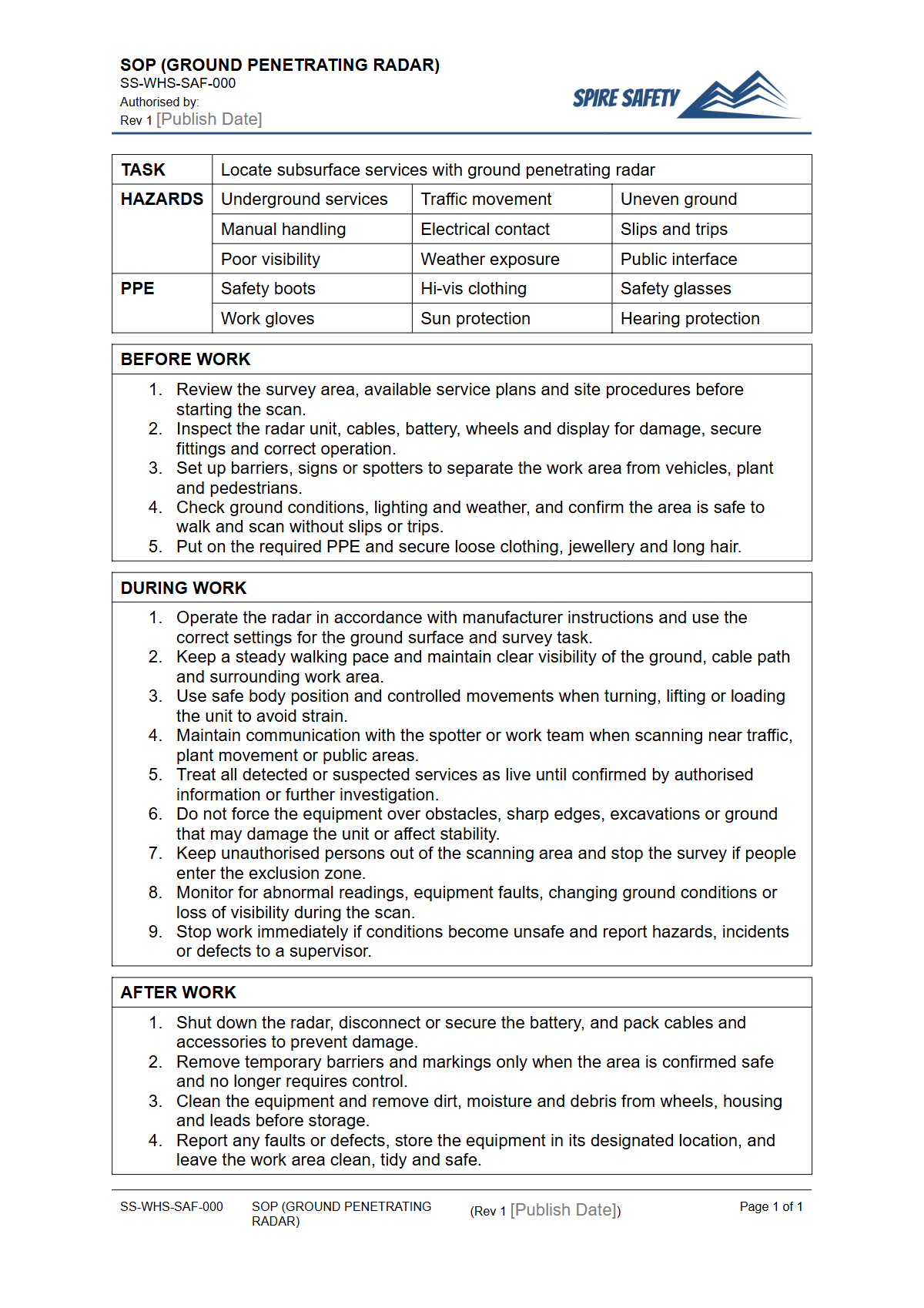
This Free Safe Operating Procedure (Ground Penetrating Radar) Template provides a structured framework for documenting the safe use of GPR equipment in your workplace. Ground Penetrating Radar is a critical tool for detecting subsurface utilities, rebar, voids, and other objects before any ground disturbance or cutting occurs.
Using it correctly is essential for preventing costly and dangerous service strikes, structural damage, and harm to personnel. This SOP template helps your organisation establish a clear, repeatable process for GPR surveys, manage associated risks, and ensure workers are informed of the correct operational steps and safety controls.
Video walkthrough
How to use the Free Safe Operating Procedure (Ground Penetrating Radar) Template
Our template is available as a DOCX file for easy editing and a PDF for straightforward distribution. To use it, simply download the file and adapt the contents to your specific operational context.
This includes detailing the make and model of your GPR unit, the specific tasks it's used for, and the unique environmental conditions of your worksites. It is crucial to understand that this is a template, not a finished document.
We have provided a comprehensive starting point, but you must customise it to reflect your own risk assessments, personnel competencies, and organisational procedures to ensure it is effective for your business.
Customising Your GPR SOP
A well-drafted SOP forms a key part of your overall safety framework. When customising this document, you should integrate it with other critical safety documents, such as risk assessments and training records.
Ensuring your procedures are documented, implemented, and reviewed is a core part of developing a robust WHS management system that protects your workers and your business.
When to use a Safe Operating Procedure for GPR
An SOP for GPR should be implemented and followed before any activity that requires subsurface investigation. This includes, but is not limited to, locating utilities before excavation, scanning concrete slabs prior to coring or cutting, conducting geotechnical surveys, or performing archaeological investigations.
The procedure should be referenced during toolbox talks and pre-start meetings to reinforce safe work methods. Having a clear SOP is particularly vital when works involve mechanical digging, which is often addressed in a free Trencher SOP template.
Who should use this template
This template is designed for use by WHS managers, safety advisors, project managers, and site supervisors responsible for creating and implementing workplace safety documentation. It serves as a guide for developing a procedure that operators must be trained in and follow.
The final, customised SOP should be used by all personnel who operate, supervise, or work in close proximity to GPR survey activities. Competency to perform the work is just as important as the procedure itself, forming a critical control measure.
Integrating GPR into Site Operations
On a busy worksite, multiple activities occur simultaneously. The GPR survey is often one of the first steps in a larger construction or excavation project.
The information gathered informs the work of other plant operators. Clear procedures, like a Dozer SOP template, are needed for all high-risk equipment to ensure a coordinated and safe approach across the entire site.
Key Elements of a GPR Safe Operating Procedure
A comprehensive GPR SOP should cover all phases of the equipment's use. Our template guides you through several key sections:
- Associated Risks and Hazards: Identifying potential dangers such as manual handling of the equipment, ergonomic strain, slip and trip hazards on uneven ground, and exposure to environmental elements.
- Pre-operational Checks: A checklist to ensure the GPR unit, including batteries, cables, and display console, is in safe working order before use.
- Step-by-step Operational Guide: A clear sequence for conducting a survey, from setting up the survey grid to marking out findings on the ground.
- Data Interpretation and Marking: Guidelines on how to interpret GPR data correctly and the standard method for marking located services on the site.
- Emergency Procedures: Instructions on what to do in case of an incident, equipment failure, or unexpected discovery.
- Post-operational Tasks: Steps for safely powering down, cleaning, and storing the equipment.
Regularly reviewing the effectiveness of your documented procedures is essential for continuous improvement. This can be achieved through scheduled WHS compliance auditing, which helps identify gaps and confirms that documented processes are being followed in practice.
Even seemingly simple tasks on a worksite require documented procedures to ensure consistency and safety. A detailed SOP for GPR use should exist alongside other procedural documents, such as a step ladder SOP, to build a comprehensive safety system where no task is overlooked.
For more templates and safety resources covering a wide range of equipment and tasks, browse our complete free WHS resources library.
Common mistakes
Common mistakes to avoid
- Failing to account for site-specific soil conditions and electromagnetic interference.
- Relying solely on GPR without cross-referencing Dial Before You Dig (DBYD/BYDA) plans.
- Inadequate operator training in both equipment use and complex data interpretation.
- Using a generic procedure without customising it for the specific GPR model and task.
Legal references
Legal considerations
The following legal requirements may be relevant to this type of work.
- Work Health and Safety Act (Harmonised) — Provides the primary duties for protecting workers and other people from work health and safety risks.
- Work Health and Safety Regulations (Harmonised) — Sets out requirements supporting the management of workplace hazards and risks.
The following codes may be relevant to this type of work.
- Managing WHS Risks Code of Practice — Provides practical guidance on identifying hazards, assessing risks and applying effective controls.
- Work Health and Safety Consultation, Cooperation and Coordination Code of Practice — Provides practical guidance on consulting workers and coordinating with other duty holders.
- Managing the Work Environment and Facilities Code of Practice — Provides practical guidance on safe work environments, workplace facilities and related controls.
Did you know
Historical Roots
The first patent related to Ground Penetrating Radar technology was filed in 1910 by Gotthelf Leimbach and Heinrich Löwy, who proposed using it to locate buried objects, with early experiments focused on measuring the depth of glaciers.
Soil Matters
The effectiveness of GPR is heavily dependent on ground conditions. It works best in dry, sandy soils but can be less effective in dense, wet clays or saline soils, which absorb and scatter the radar signal.
FAQ
Frequently asked questions
01What information should be included in a Ground Penetrating Radar SOP?
02Is a Safe Operating Procedure legally required for using GPR in Australia?
03How often should a GPR SOP be reviewed?
04Can a generic SOP be used for all types of GPR equipment?
Share this resource
Free Safe Operating Procedure (Ground Penetrating Radar) Template
Browse Categories
How To Use It
- 1Download and open in Word or PDF.
- 2Replace the placeholders with your business details.
- 3Get it reviewed by a WHS specialist before rollout.
Need it customised?
Our WHS consultants can adapt this template to your site, run a gap analysis, or audit what you already have in place.
Book a Free Consultation WHS consulting servicesor call 1300 156 382
Related templates
- Free Safe Operating Procedure (Ground Power Unit) Template
- Free Safe Operating Procedure (Groundcover Planting) Template
- Free Safe Operating Procedure (Grounds Litter Pickup) Template
- Free Safe Operating Procedure (Grout Injection Pump) Template
- Free Safe Operating Procedure (Grout Mixer) Template
- Free Safe Operating Procedure (Grout Pump) Template