
Free Safe Operating Procedure (Grounds Litter Pickup) Template
Download our free Safe Operating Procedure (Grounds Litter Pickup) template.
Free Safe Operating Procedure (Grounds Litter Pickup) Template
DOCX • 126 KB + PDF
Updated Oct 2026
No signup required
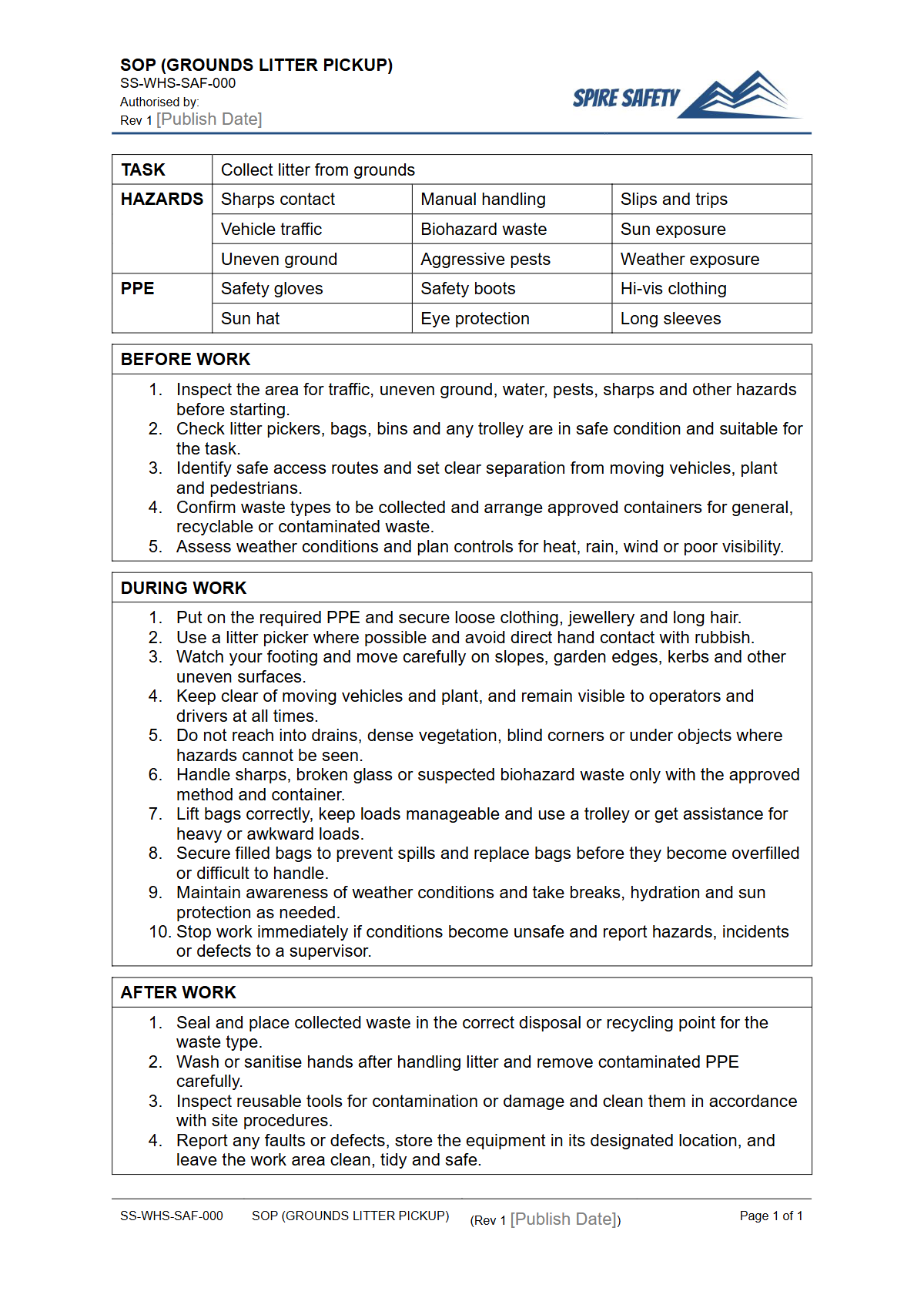
Purpose of the Free Safe Operating Procedure (Grounds Litter Pickup) Template
Managing public spaces, worksites, or large properties involves the routine task of litter collection. While it may seem straightforward, this activity carries numerous health and safety risks.
This Free Safe Operating Procedure (Grounds Litter Pickup) Template provides a structured framework for documenting and controlling these risks. It helps organisations fulfil their duty of care by establishing clear, safe instructions for workers.
Formalising the process is crucial for managing hazards such as sharps, biological waste, hazardous substances, manual handling injuries, and environmental exposure.
A documented SOP ensures consistency in training and task execution. It demonstrates a commitment to workplace safety and provides a clear reference point for workers and supervisors.
By outlining step-by-step instructions, required PPE, and emergency responses, this template helps minimise the likelihood of incidents and injuries. It forms a key part of a proactive approach to safety, moving beyond assumptions and establishing a formal, repeatable process for a common but hazardous task.
This is similar to how a business might formalise ladder safety using a free Step Ladder SOP template to prevent falls.
Video walkthrough
How to Use the Free Safe Operating Procedure (Grounds Litter Pickup) Template
This document is a template, not a finished procedure. To be effective, it must be customised to reflect the specific environment, tasks, and hazards present in your workplace.
Download the DOCX file and adapt it by conducting a site-specific risk assessment. Identify all potential hazards related to your grounds, the types of litter commonly found, the equipment available, and your organisation's emergency procedures.
You should consult with your workers during this process to ensure the SOP is practical and addresses their real-world experience.
Important: We are not a law firm. This document is a template and a starting point.
It is your responsibility to ensure the final, customised document meets the specific needs and legal obligations of your business and jurisdiction. Once customised, the SOP should be integrated into your broader WHS management system. This includes using it as a basis for worker training, competency assessments, and regular safety observations.
When to Use This SOP
A Safe Operating Procedure for grounds litter pickup should be a core document for your operational safety files. It should be used consistently as a primary training tool for any new employees, contractors, or volunteers assigned to the task.
It also serves as an excellent resource for refresher training and regular toolbox talks, helping to keep safety front-of-mind for your team. The SOP should be reviewed and referenced during incident investigations to identify any procedural gaps or failures.
Furthermore, this procedure should be reviewed and updated periodically—typically annually, or whenever there is a change in process, equipment, or location. Changes such as the introduction of new types of collection equipment or encountering new waste streams (e.g., after a public event) should trigger an immediate review.
A robust SOP is a living document that is fundamental during a WHS compliance audit, demonstrating proactive risk management.
Who Should Use This Procedure
This SOP is designed for a broad range of workers and their managers. Primary users include grounds maintenance staff, cleaners, council workers, park rangers, event staff, and any other personnel responsible for maintaining the cleanliness and safety of outdoor areas.
It provides them with the essential step-by-step guidance needed to perform their duties safely. Supervisors and managers should also use this document to understand the risks involved, ensure correct procedures are being followed, and provide effective supervision.
Health and Safety Representatives (HSRs) and WHS committees will find this template valuable for consultation and for verifying that adequate risk controls are in place. Ultimately, the Person Conducting a Business or Undertaking (PCBU) is responsible for ensuring a safe work environment, and implementing a specific, customised SOP like this is a practical step toward meeting that obligation.
For complex sites, seeking professional advice through WHS consulting can help ensure all unique hazards are identified and controlled. If a serious incident does occur, having documented procedures for emergencies, like a Safe Operating Procedure for defibrillator operation, is also critical.
Common mistakes
Common mistakes to avoid
- Assuming the task is 'common sense' and not providing any formal training or procedure.
- Failing to provide, maintain, or enforce the use of appropriate Personal Protective Equipment (PPE) like gloves and tongs.
- Not having a clear, pre-defined process for safely managing and disposing of hazardous finds like needles, chemicals, or biohazards.
- Overlooking ergonomic risks associated with repetitive bending, lifting heavy bags, and carrying equipment over long distances.
Legal references
Legal considerations
The following legal requirements may be relevant to this type of work.
- Work Health and Safety Act (Harmonised) — Provides the primary duties for protecting workers and other people from work health and safety risks.
- Work Health and Safety Regulations (Harmonised) — Sets out requirements supporting the management of workplace hazards and risks.
The following codes may be relevant to this type of work.
- Managing WHS Risks Code of Practice — Provides practical guidance on identifying hazards, assessing risks and applying effective controls.
- Work Health and Safety Consultation, Cooperation and Coordination Code of Practice — Provides practical guidance on consulting workers and coordinating with other duty holders.
- Managing the Work Environment and Facilities Code of Practice — Provides practical guidance on safe work environments, workplace facilities and related controls.
Did you know
Manual Handling Impact
Serious claims for manual handling injuries are a significant issue in Australian workplaces, highlighting the need for proper procedures even for tasks that appear simple, like bending to pick up litter.
The Hidden Danger of Sharps
A single needlestick injury from a discarded sharp can expose a worker to blood-borne viruses, potentially requiring months of stressful testing and preventative medical treatment.
FAQ
Frequently asked questions
01What are the main hazards involved in grounds litter pickup?
02Is a Safe Operating Procedure legally required for litter pickup?
03What PPE is typically needed for picking up litter?
04How often should a SOP for litter pickup be reviewed?
Share this resource
Free Safe Operating Procedure (Grounds Litter Pickup) Template
Browse Categories
How To Use It
- 1Download and open in Word or PDF.
- 2Replace the placeholders with your business details.
- 3Get it reviewed by a WHS specialist before rollout.
Need it customised?
Our WHS consultants can adapt this template to your site, run a gap analysis, or audit what you already have in place.
Book a Free Consultation WHS consulting servicesor call 1300 156 382
Related templates
- Free Safe Operating Procedure (Grout Injection Pump) Template
- Free Safe Operating Procedure (Grout Mixer) Template
- Free Safe Operating Procedure (Grout Pump) Template
- Free Safe Operating Procedure (Guillotine Shear Operation) Template
- Free Safe Operating Procedure (Gutter Cleaning) Template
- Free Safe Operating Procedure (Hail Net Installation) Template