
Free Safe Operating Procedure (Guillotine Shear Operation) Template
Download our free Safe Operating Procedure (SOP) template for guillotine shears. A structured starting point for Australian WHS. Customise it for your site.
Free Safe Operating Procedure (Guillotine Shear Operation) Template
DOCX • 152 KB + PDF
Updated Oct 2026
No signup required
Purpose of the Free Safe Operating Procedure (Guillotine Shear Operation) Template
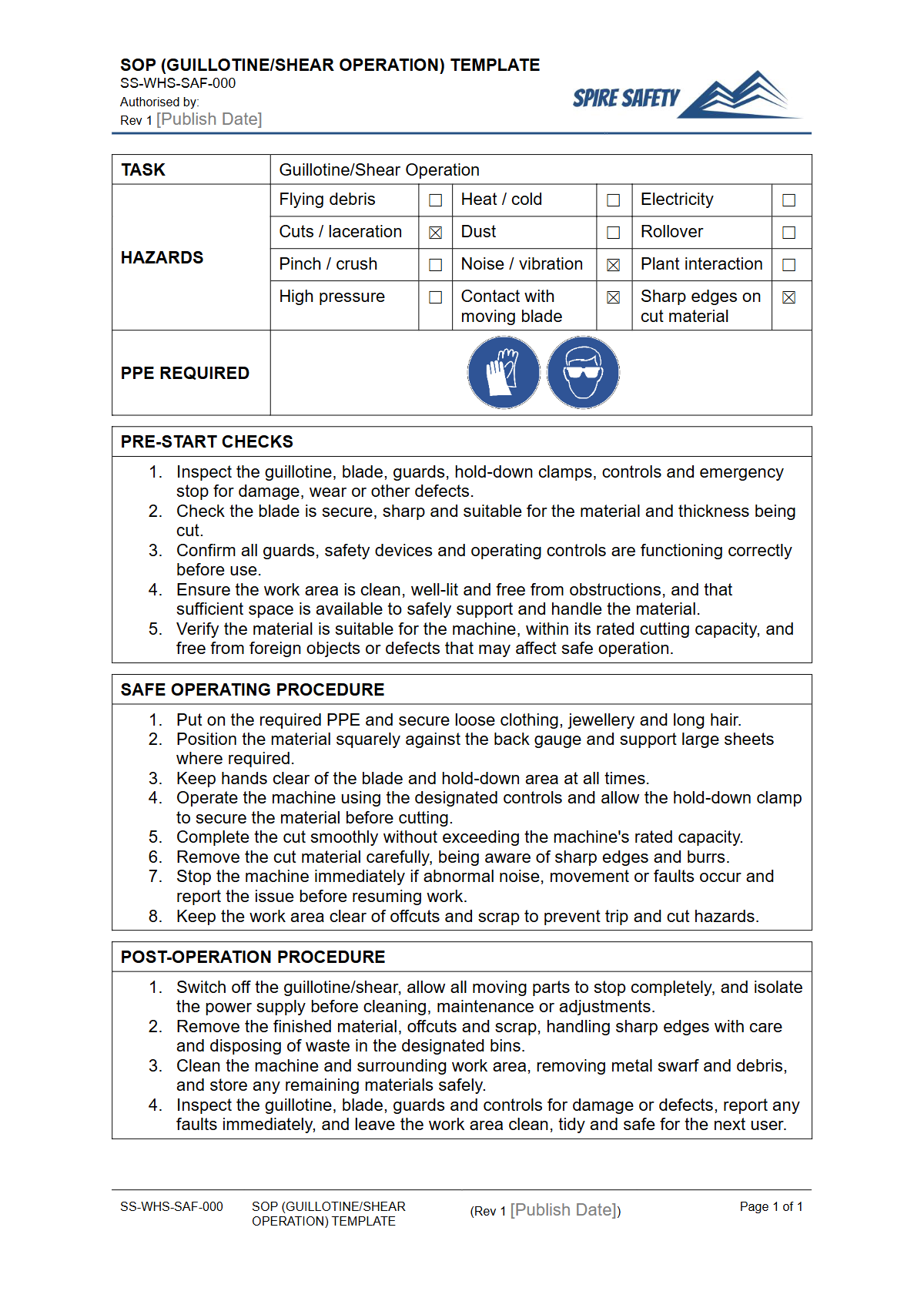
Operating a guillotine shear presents significant risks, including amputation, severe lacerations, and crushing injuries. This free Safe Operating Procedure (Guillotine Shear Operation) template provides a structured starting point for documenting the controls needed to manage these hazards effectively.
A well-developed SOP is a critical administrative control that standardises the work process, ensuring every operator follows a consistent, safe method for every task. It forms an essential component of training, competency assessment, and demonstrating due diligence under Australian WHS laws.
By clearly outlining pre-start checks, operational steps, and shutdown procedures, this SOP helps embed safe work practices into your daily operations. Integrating such documented procedures is a fundamental part of maintaining an effective WHS management system, helping to protect your workers and your business from the severe consequences of a machinery-related incident.
It provides a formal basis for communication about safety, ensuring everyone understands their responsibilities.
Video walkthrough
How to use the Free Safe Operating Procedure (Guillotine Shear Operation) Template
This document is a template and must be adapted to suit your specific workplace. Before use, you must conduct a site-specific risk assessment for your guillotine shear, considering the make and model, the types of material being cut, and the work environment.
Your finalised SOP should include details such as required PPE, specific machine controls, blade maintenance schedules, and emergency stop locations.
Please note: This document is a template. To be effective, we require you to customise it to reflect the specific hazards, equipment, and processes of your workplace.
We recommend consulting with operators, supervisors, and other relevant personnel during this process. The structure is similar to our other plant documents, like our free brake press SOP template, which can be useful for standardising documentation across your workshop.
For complex situations, engaging with WHS consulting services can provide expert guidance.
When to use it
A Safe Operating Procedure is not a document to be filed and forgotten. It should be actively used in several key situations to maximise its effectiveness.
It is a critical tool for the induction and training of new operators, providing them with a clear, step-by-step guide to follow. For experienced staff, it serves as the basis for regular refresher training and competency checks, preventing complacency and the development of unsafe habits.
The SOP should also be referenced during pre-task planning, especially for non-routine or complex cutting jobs. In the unfortunate event of an incident or near miss, the SOP is an invaluable document for investigation, helping to determine if the procedure was followed and whether it needs to be updated.
Like other key safety documents, such as a free CNC Machine SOP, it should be part of a scheduled review cycle to ensure it remains current and effective.
Who should use it
A comprehensive SOP for guillotine shear operation is relevant to several roles within an organisation. Machine operators are the primary users, relying on it to guide their work and reinforce safe techniques.
Supervisors and managers use it to train staff, monitor compliance, and conduct workplace inspections. They are responsible for ensuring the procedures are understood and consistently followed on the workshop floor.
WHS advisors and managers will use this template as a basis for developing a site-specific document that integrates with the broader safety framework. Furthermore, maintenance personnel must be familiar with the SOP, particularly the lockout-tagout and energy isolation procedures required for safe servicing and blade changes.
The effectiveness of these procedures should be verified through activities like WHS compliance auditing to ensure they are being implemented correctly on the ground. Having other relevant SOPs, like an air compressor SOP, ensures a consistent approach to all plant and equipment.
You can browse more templates in our free WHS resources library to build out your documentation.
Common mistakes
Common mistakes to avoid
- Using a generic SOP without customising it for the specific machine, materials, and workplace environment.
- Failing to provide adequate, practical training on the SOP to all operators, including casual and new staff.
- Not enforcing the use of the SOP, allowing unsafe workarounds and shortcuts to become common practice.
- Neglecting to review and update the SOP after a near miss, incident, or change to equipment or processes.
Legal references
Legal considerations
The following legal requirements may be relevant to this type of work.
- Work Health and Safety Act (Harmonised) — Provides the primary duties for protecting workers and other people from work health and safety risks.
- Work Health and Safety Regulations (Harmonised) — Sets out requirements supporting the management of workplace hazards and risks.
The following codes may be relevant to this type of work.
- Managing WHS Risks Code of Practice — Provides practical guidance on identifying hazards, assessing risks and applying effective controls.
- Work Health and Safety Consultation, Cooperation and Coordination Code of Practice — Provides practical guidance on consulting workers and coordinating with other duty holders.
- Managing the Work Environment and Facilities Code of Practice — Provides practical guidance on safe work environments, workplace facilities and related controls.
Did you know
Guarding is Critical
A high percentage of serious injuries involving guillotine shears are attributed to inadequate, missing, or deliberately bypassed machine guarding. Fixed and interlocked guards are essential to prevent access to the cutting blade and hold-down clamps during operation.
Multiple Energy Sources
Guillotines can have multiple energy sources (electrical, pneumatic, hydraulic), all of which must be identified and isolated under a specific lockout-tagout procedure before any maintenance or cleaning work begins.
FAQ
Frequently asked questions
01What is a Safe Operating Procedure (SOP)?
02Why is an SOP for a guillotine shear so important?
03Who is responsible for writing a Guillotine Shear SOP?
04How often should a Guillotine Shear SOP be reviewed?
Share this resource
Free Safe Operating Procedure (Guillotine Shear Operation) Template
Browse Categories
How To Use It
- 1Download and open in Word or PDF.
- 2Replace the placeholders with your business details.
- 3Get it reviewed by a WHS specialist before rollout.
Need it customised?
Our WHS consultants can adapt this template to your site, run a gap analysis, or audit what you already have in place.
Book a Free Consultation WHS consulting servicesor call 1300 156 382
Related templates
- Free Safe Operating Procedure (Gutter Cleaning) Template
- Free Safe Operating Procedure (Hail Net Installation) Template
- Free Safe Operating Procedure (Hair Clipper Cleaning) Template
- Free Safe Operating Procedure (Hair Salon Cleanup) Template
- Free Safe Operating Procedure (Hairdressing Room Clean) Template
- Free Safe Operating Procedure (Hand Basin Descaling) Template