
Free Safe Operating Procedure (Hand Basin Descaling) Template
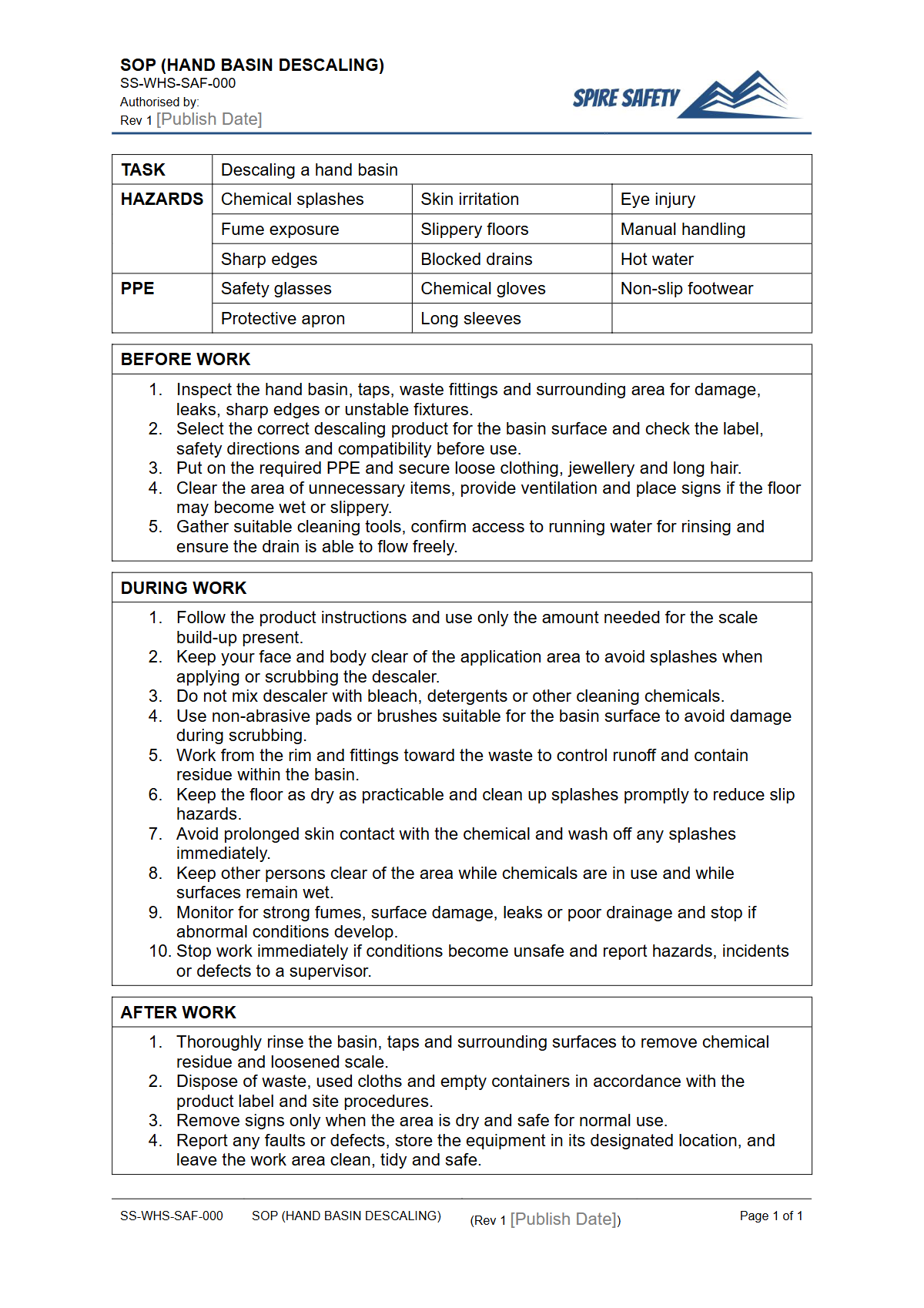
Download our free Safe Operating Procedure (Hand Basin Descaling) Template. This customisable DOCX and PDF helps you manage risks from cleaning chemicals.
Free Safe Operating Procedure (Hand Basin Descaling) Template
DOCX • 126 KB + PDF
Updated Oct 2026
No signup required
Purpose of the Free Safe Operating Procedure (Hand Basin Descaling) Template
This Safe Operating Procedure (SOP) template provides a structured framework for safely descaling hand basins in commercial or workplace environments. Its primary purpose is to help you document a clear, step-by-step process that minimises health and safety risks for workers.
Using this free Safe Operating Procedure (Hand Basin Descaling) Template as your starting point helps formalise controls for hazards such as exposure to cleaning chemicals, manual handling, and potential slip and fall incidents from wet floors. It's a foundational document for worker training and risk management.
A properly documented procedure is a key part of any workplace's safety protocols. This includes being prepared for incidents.
While descaling, workers handle chemicals that can cause harm if misused, so ensuring your team is prepared for any emergency is critical. This might include having access to first aid and knowing a clear procedure for defibrillator operation in case of a serious medical event.
Video walkthrough
How to use the Free Safe Operating Procedure (Hand Basin Descaling) Template
To use this template, simply download the DOCX file and adapt it to your specific operational needs. The document is pre-formatted to guide you through the essential components of an SOP, including risk assessment, required Personal Protective Equipment (PPE), step-by-step instructions, and emergency procedures.
You should consult the Safety Data Sheet (SDS) for the specific descaling product you use and incorporate its recommendations directly into your final SOP.
Important: This document is a template and must be customised for your organisation. We cannot know the specific hazards of your workplace, the equipment and chemicals you use, or your unique site conditions.
You are responsible for adapting this SOP to reflect the specific risks and control measures relevant to your operations. This ensures the final procedure is practical and effective for protecting your team. This process is similar for all procedural documents, whether for a cleaning task or for equipment like that detailed in our free Air Compressor SOP.
When to use a Safe Operating Procedure for Hand Basin Descaling
This Safe Operating Procedure should be developed and implemented before workers are assigned the task of descaling hand basins. It is particularly useful for organisations that manage facilities with hard water, leading to frequent limescale build-up.
It should be used to train new staff, provide refreshers for existing employees, and serve as a reference for supervisors. The procedure should also be reviewed and updated whenever a new chemical is introduced, a process changes, or as part of your scheduled safety reviews.
For many cleaning tasks, access equipment is required, so ensure procedures for the correct use of step ladders are also in place if needed.
Who should use this Safe Operating Procedure
This template is designed for anyone responsible for workplace safety and facility maintenance. This includes WHS Managers, Facility Managers, Cleaning Supervisors, and small business owners.
They are responsible for customising the template and ensuring it is effectively implemented. The final, site-specific SOP is then used by the frontline workers—such as cleaners and maintenance staff—who perform the descaling task.
It forms a crucial part of their training, ensuring they understand the risks and the safe work methods required to control them. Documenting procedures like this is a fundamental part of implementing comprehensive WHS management systems that protect both workers and the business.
Integrating tailored SOPs into your daily operations is a proactive step towards a safer workplace. It's an activity that demonstrates due diligence and can be verified through regular WHS compliance auditing. To see more templates like this one, you can explore our complete free WHS resources library for a wide range of tools to support your safety goals.
Common mistakes
Common mistakes to avoid
- Mixing descaling agents with other cleaners (especially bleach), which can create toxic chlorine gas.
- Failing to ensure adequate ventilation in small, enclosed bathrooms or cleaning cupboards.
- Not wearing the correct PPE, particularly eye protection, leading to a high risk of chemical splash injuries.
- Using a strong acid-based descaler on sensitive materials like marble or certain metals, causing permanent damage.
Legal references
Legal considerations
The following legal requirements may be relevant to this type of work.
- Work Health and Safety Act (Harmonised) — Provides the primary duties for protecting workers and other people from work health and safety risks.
- Work Health and Safety Regulations (Harmonised) — Sets out requirements supporting the management of workplace hazards and risks.
The following codes may be relevant to this type of work.
- Managing WHS Risks Code of Practice — Provides practical guidance on identifying hazards, assessing risks and applying effective controls.
- Work Health and Safety Consultation, Cooperation and Coordination Code of Practice — Provides practical guidance on consulting workers and coordinating with other duty holders.
- Managing the Work Environment and Facilities Code of Practice — Provides practical guidance on safe work environments, workplace facilities and related controls.
Did you know
Hard Water Headaches
The limescale you're removing is mainly calcium carbonate. It's deposited as hard water, which is rich in dissolved minerals, evaporates from surfaces.
The SDS is Key
The Safety Data Sheet (SDS) for your chosen descaling product is the most important source of information for your risk assessment, dictating the necessary PPE and first aid measures.
FAQ
Frequently asked questions
01What kind of chemicals are used for descaling hand basins?
02What PPE is required for hand basin descaling?
03How often should hand basins be descaled?
04Is this hand basin descaling SOP template compliant with Australian WHS laws?
Share this resource
Free Safe Operating Procedure (Hand Basin Descaling) Template
Browse Categories
How To Use It
- 1Download and open in Word or PDF.
- 2Replace the placeholders with your business details.
- 3Get it reviewed by a WHS specialist before rollout.
Need it customised?
Our WHS consultants can adapt this template to your site, run a gap analysis, or audit what you already have in place.
Book a Free Consultation WHS consulting servicesor call 1300 156 382
Related templates
- Free Safe Operating Procedure (Hand Harvesting) Template
- Free Safe Operating Procedure (Hand Hedge Trimming) Template
- Free Safe Operating Procedure (Hand Hygiene Station) Template
- Free Safe Operating Procedure (Hand Loading Freight) Template
- Free Safe Operating Procedure (Hand Seed Sowing) Template
- Free Safe Operating Procedure (Hand Unloading Freight) Template