
Free Safe Operating Procedure (Hand Loading Freight) Template
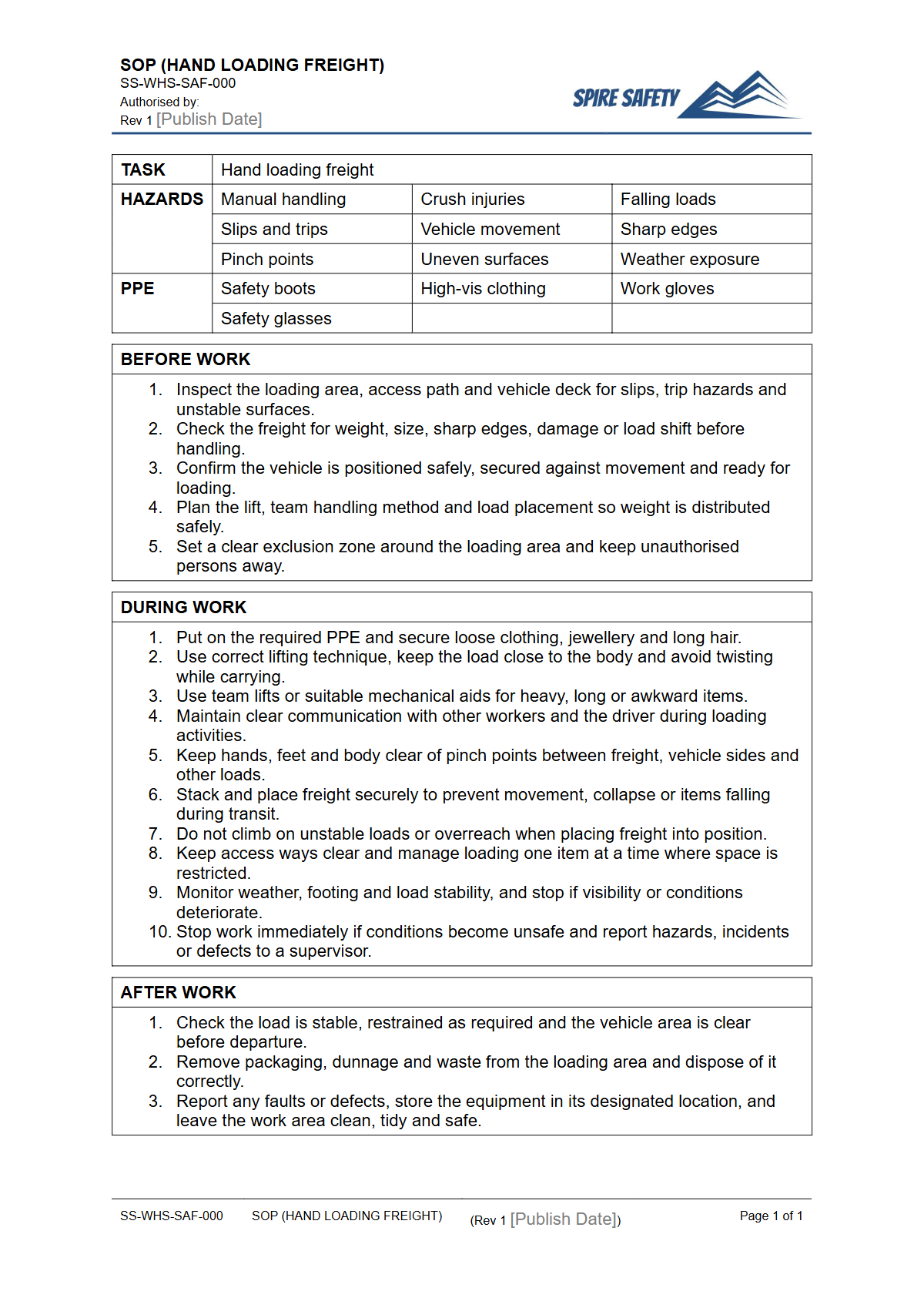
Download our free Safe Operating Procedure (Hand Loading Freight) template. This customisable DOCX and PDF helps formalise safe manual freight handling tasks.
Free Safe Operating Procedure (Hand Loading Freight) Template
DOCX • 126 KB + PDF
Updated Oct 2026
No signup required
Purpose of the Free Safe Operating Procedure (Hand Loading Freight) Template
This Free Safe Operating Procedure (Hand Loading Freight) Template provides a structured starting point for documenting the risks and controls associated with manual freight handling tasks in your workplace. Its primary purpose is to establish a clear, step-by-step guide for workers, helping to prevent musculoskeletal injuries—one of the most common and costly types of workplace injuries in Australia.
By formalising the process for lifting, carrying, and setting down goods, this SOP helps ensure that safe work practices are consistently applied. Integrating this procedure into your operations is a practical step towards building robust WHS management systems and demonstrating your commitment to worker safety.
Video walkthrough
How to use the Free Safe Operating Procedure (Hand Loading Freight) Template
This document is designed as a foundational template, not a finished procedure. To make it effective, you must adapt it to your specific operational context.
This involves consulting with your workers and customising the content to reflect the unique types of freight, lifting aids, vehicles, and environmental conditions at your site. A competent person should oversee this process, ensuring all site-specific hazards are identified and controlled.
Please note: This document is a template only. It must be customised by a competent person to suit the specific tasks, equipment, environment, and workers at your site.
We recommend a thorough risk assessment is conducted before finalising and implementing any procedure. For assistance with this process, consider engaging professional WHS consulting services.
What to Include in Your Hand Loading Freight SOP
A comprehensive SOP for hand loading freight should be detailed and easy to understand. Key sections to develop include:
- Required PPE: Specify mandatory personal protective equipment such as high-visibility clothing, steel-toed boots, and suitable gloves.
- Risk Assessment: Detail the potential hazards (e.g., awkward postures, heavy loads, repetitive movements, slip/trip hazards) and the corresponding control measures.
- Pre-Start Checks: Outline steps for workers to take before starting, such as assessing the load's weight and stability, checking for a clear travel path, and ensuring any mechanical aids are in good working order.
- Step-by-Step Instructions: Provide clear, sequential instructions for the entire task. This should cover correct lifting techniques (e.g., bending the knees, keeping the back straight), team lifting protocols for heavy or awkward items, and procedures for loading onto vehicles or shelving.
- Emergency Procedures: Detail the immediate actions to take in case of an incident, such as an injury or a dropped load. This could include first aid contacts and references to other relevant procedures, like a Safe Operating Procedure for defibrillator operation if one is available on site.
When to use it
A Safe Operating Procedure for hand loading freight should be a central part of your daily operations and safety management. It is most effective when used for worker inductions, ongoing training sessions, and as a reference during pre-start meetings or toolbox talks.
It should also be reviewed and discussed as part of any post-incident investigation to identify areas for improvement. This SOP should exist alongside procedures for other common workplace tasks; for instance, if freight is stored on high shelves, workers should also be trained on your step ladder SOP.
Who should use it
Safety is a shared responsibility, and this SOP is relevant to several roles within an organisation. The Person Conducting a Business or Undertaking (PCBU) is ultimately responsible for ensuring it is developed and implemented.
Supervisors and managers must use it to train workers and monitor compliance. Workers have a duty to follow the procedures they have been trained in to protect their own health and safety and that of their colleagues.
Safety professionals will also use the SOP as a tool for conducting WHS compliance auditing and identifying opportunities for continuous improvement.
By implementing and consistently following a well-drafted Safe Operating Procedure, you can significantly reduce the risk of manual handling injuries. Explore our complete free WHS resources library for more templates and guides to support your safety management system.
Common mistakes
Common mistakes to avoid
- Using a generic template without customising it for specific site conditions and freight types.
- Failing to consult with workers who actually perform the task when drafting the procedure.
- Treating the SOP as a 'set and forget' document instead of a live document that requires regular review.
- Not providing adequate training on the finalised SOP, assuming workers will just read and understand it.
Legal references
Legal considerations
The following legal requirements may be relevant to this type of work.
- Work Health and Safety Act (Harmonised) — Provides the primary duties for protecting workers and other people from work health and safety risks.
- Work Health and Safety Regulations (Harmonised) — Sets out requirements supporting the management of workplace hazards and risks.
The following codes may be relevant to this type of work.
- Managing WHS Risks Code of Practice — Provides practical guidance on identifying hazards, assessing risks and applying effective controls.
- Work Health and Safety Consultation, Cooperation and Coordination Code of Practice — Provides practical guidance on consulting workers and coordinating with other duty holders.
- Managing the Work Environment and Facilities Code of Practice — Provides practical guidance on safe work environments, workplace facilities and related controls.
Did you know
Manual Handling Injuries
According to Safe Work Australia, hazardous manual tasks are a leading cause of workplace injury, accounting for a significant number of serious workers' compensation claims each year.
The Hierarchy of Control
An SOP is an administrative control. It's more effective to first try and eliminate the task (e.g., automation) or substitute the hazard (e.g., using forklifts or pallet jacks) before relying on an SOP alone.
FAQ
Frequently asked questions
01What is a Safe Operating Procedure for hand loading freight?
02Is a manual handling SOP a legal requirement in Australia?
03How often should a hand loading freight SOP be reviewed?
04Can I use this template for lifting any type of freight?
Share this resource
Free Safe Operating Procedure (Hand Loading Freight) Template
Browse Categories
How To Use It
- 1Download and open in Word or PDF.
- 2Replace the placeholders with your business details.
- 3Get it reviewed by a WHS specialist before rollout.
Need it customised?
Our WHS consultants can adapt this template to your site, run a gap analysis, or audit what you already have in place.
Book a Free Consultation WHS consulting servicesor call 1300 156 382
Related templates
- Free Safe Operating Procedure (Hand Seed Sowing) Template
- Free Safe Operating Procedure (Hand Unloading Freight) Template
- Free Safe Operating Procedure (Handheld Metal Detector) Template
- Free Safe Operating Procedure (Handrail Cleaning) Template
- Free Safe Operating Procedure (Hangar Cleaning) Template
- Free Safe Operating Procedure (Hangar Door Operation) Template