
Free Safe Operating Procedure (Hangar Cleaning) Template
Download our Free Safe Operating Procedure (Hangar cleaning) Template. This customisable DOCX & PDF provides a structured framework for safe cleaning tasks.
Free Safe Operating Procedure (Hangar Cleaning) Template
DOCX • 126 KB + PDF
Updated Oct 2026
No signup required
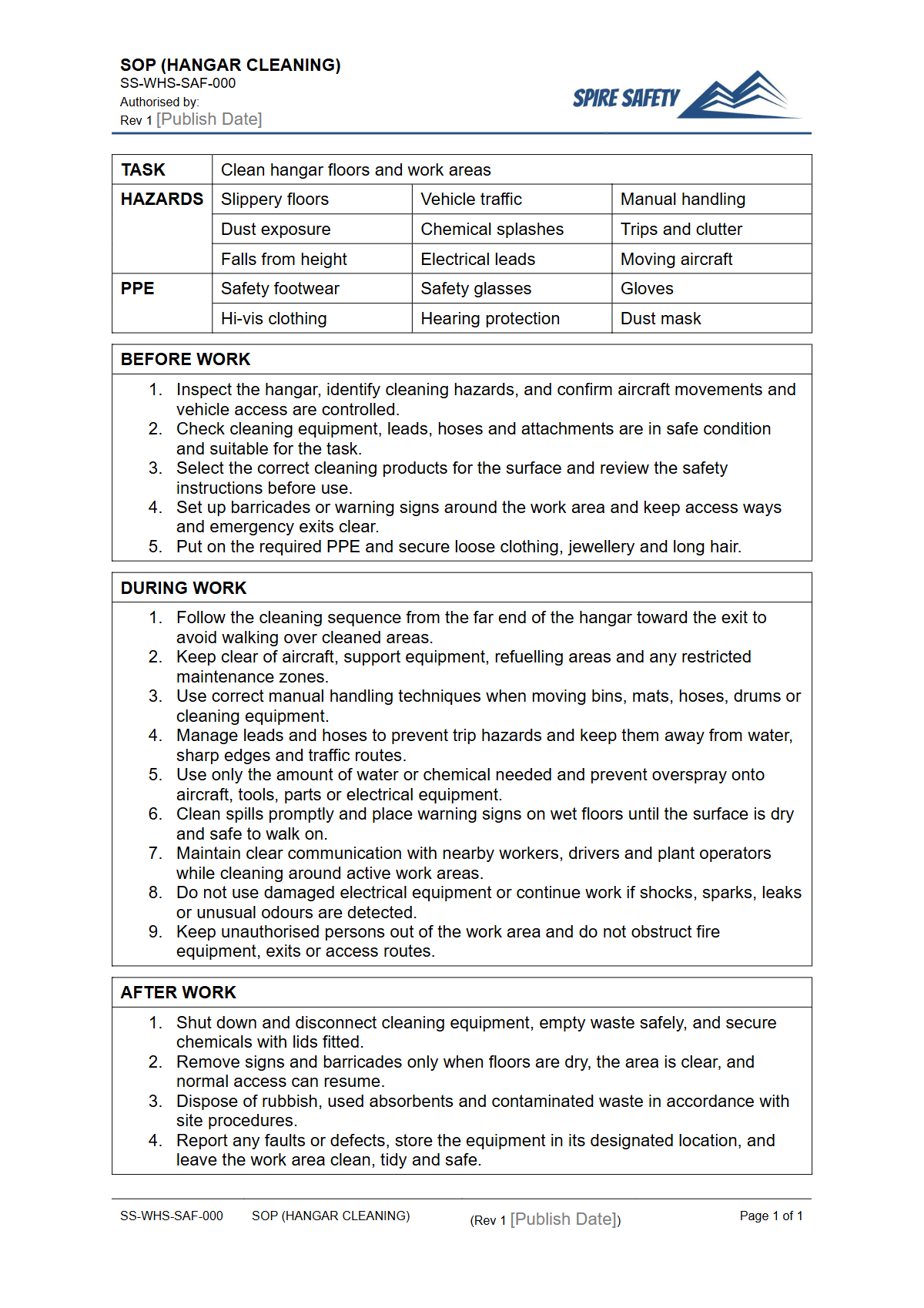
Purpose of the Free Safe Operating Procedure (Hangar Cleaning) Template
Hangar cleaning presents unique WHS challenges, from vast floor spaces and working at heights to the use of industrial-strength chemicals near sensitive, high-value aircraft. This Free Safe Operating Procedure (Hangar Cleaning) Template provides a structured starting point for organisations to document a formal, safe system of work for these essential tasks.
It is designed to help you identify specific hazards, assess risks, and implement effective control measures to protect your workers.
A documented SOP is a critical tool for ensuring tasks are performed consistently and safely every time. It helps meet your primary duty of care obligations under WHS legislation by providing clear, step-by-step instructions that minimise the risk of injury or damage. Formalising your procedures is a cornerstone of building robust and effective WHS management systems.
Key Considerations for Hangar Cleaning
This SOP template prompts you to consider specific hazards prevalent in an aviation environment, including:
- Chemical Handling: Use and storage of detergents, solvents, and degreasers, requiring reference to Safety Data Sheets (SDS).
- Slips, Trips, and Falls: Wet floors, trailing hoses, and equipment cables are common hazards in large, open areas.
- Working at Height: Cleaning high walls, light fixtures, or the upper sections of aircraft using elevated work platforms or scaffolding.
- Manual Tasks: Handling heavy equipment like industrial vacuum cleaners, floor scrubbers, and pressure washers.
- Aircraft Damage: Preventing contact between cleaning equipment and aircraft, and ensuring chemical compatibility with sensitive surfaces and components.
Video walkthrough
How to use the Free Safe Operating Procedure (Hangar Cleaning) Template
This template is provided in both DOCX and PDF formats for your convenience. The DOCX file is fully editable, allowing you to tailor the content to the specific environment, equipment, chemicals, and personnel at your facility.
A generic procedure is not sufficient; you must adapt it to reflect your actual workplace conditions and risks.
Important: We have provided a comprehensive framework, but it is your responsibility to customise this document. This involves consulting with your workers and other stakeholders to ensure the procedures are practical and effective for your site.
For tasks involving specific equipment, you may need to integrate other SOPs, such as adapting our FREE Step Ladder SOP Template for height-related tasks if scissor lifts or scaffolds are not used.
When to use a Hangar Cleaning SOP
A Safe Operating Procedure for hangar cleaning should be used as a primary reference document for all cleaning activities within the hangar. It is essential for:
- Worker Training and Induction: Ensuring all new and existing employees or contractors understand the approved, safe method for conducting their work.
- Routine Cleaning Schedules: Guiding daily, weekly, or monthly cleaning tasks to maintain a safe and organised workspace.
- Deep Cleans and Shutdowns: Providing a clear plan for periodic, intensive cleaning activities that may involve different hazards or equipment.
- Incident Investigation: Serving as a benchmark for expected safe behaviour when reviewing why an incident or near-miss occurred.
Regular reviews of your SOP are vital to ensure it remains current. We recommend updating it annually or whenever there is a change in equipment, chemicals, processes, or following a relevant safety incident.
Our WHS compliance auditing services can help identify gaps in your procedures and ensure they remain aligned with best practice.
Who should use it
This SOP is intended for use by all personnel involved in the management and execution of hangar cleaning tasks. Key users include:
- Persons Conducting a Business or Undertaking (PCBUs): To help fulfil their duty of care.
- WHS Managers and Safety Officers: For developing, implementing, and reviewing safety protocols.
- Supervisors and Team Leaders: To train workers, enforce procedures, and conduct pre-start checks.
- Cleaning Staff and Contractors: As a practical, step-by-step guide to performing their job safely.
By using this SOP, you ensure everyone has access to emergency procedures and understands their role in maintaining a safe environment. This includes being prepared for medical emergencies, which can be supported by clear documentation like our Free Safe Operating Procedure (Defibrillator Operation) Template.
The SOP should be made readily available to all relevant workers in the areas where cleaning tasks are performed. Explore our complete free WHS resources library for more templates to support your safety management system.
Common mistakes
Common mistakes to avoid
- Using a generic SOP without customising it for specific site hazards and aircraft types.
- Failing to make Safety Data Sheets (SDS) for all cleaning chemicals readily available to workers.
- Providing inadequate training on the SOP, especially for new or contract staff.
- Neglecting to cordon off cleaning areas, creating slip and trip hazards for other personnel.
Legal references
Legal considerations
The following legal requirements may be relevant to this type of work.
- Work Health and Safety Act (Harmonised) — Provides the primary duties for protecting workers and other people from work health and safety risks.
- Work Health and Safety Regulations (Harmonised) — Sets out requirements supporting the management of workplace hazards and risks.
The following codes may be relevant to this type of work.
- Managing WHS Risks Code of Practice — Provides practical guidance on identifying hazards, assessing risks and applying effective controls.
- Work Health and Safety Consultation, Cooperation and Coordination Code of Practice — Provides practical guidance on consulting workers and coordinating with other duty holders.
- Managing the Work Environment and Facilities Code of Practice — Provides practical guidance on safe work environments, workplace facilities and related controls.
Did you know
Slips and Trips
Slips, trips, and falls are a leading cause of workplace injuries in Australia. Large, wet hangar floors during cleaning create a significant risk area that requires strict controls like signage and non-slip surfaces.
Chemical Sensitivity
Aircraft utilise advanced materials like composites and specialised coatings that can be easily damaged by incorrect cleaning agents. Using an unapproved chemical can compromise the structural integrity or airworthiness of a component.
FAQ
Frequently asked questions
01What should be included in a Hangar Cleaning SOP?
02How often should we review our hangar cleaning procedure?
03Is this template suitable for cleaning both military and civilian hangars?
04Who is responsible for implementing the Safe Operating Procedure?
Share this resource
Free Safe Operating Procedure (Hangar Cleaning) Template
Browse Categories
How To Use It
- 1Download and open in Word or PDF.
- 2Replace the placeholders with your business details.
- 3Get it reviewed by a WHS specialist before rollout.
Need it customised?
Our WHS consultants can adapt this template to your site, run a gap analysis, or audit what you already have in place.
Book a Free Consultation WHS consulting servicesor call 1300 156 382
Related templates
- Free Safe Operating Procedure (Hangar Door Operation) Template
- Free Safe Operating Procedure (Hard Waste Collection) Template
- Free Safe Operating Procedure (Hard Waste Sorting) Template
- Free Safe Operating Procedure (Hardness Tester) Template
- Free Safe Operating Procedure (Hardscape Cleaning) Template
- Free Safe Operating Procedure (Harvester Head) Template