
Free Safe Operating Procedure (Hard Waste Sorting) Template
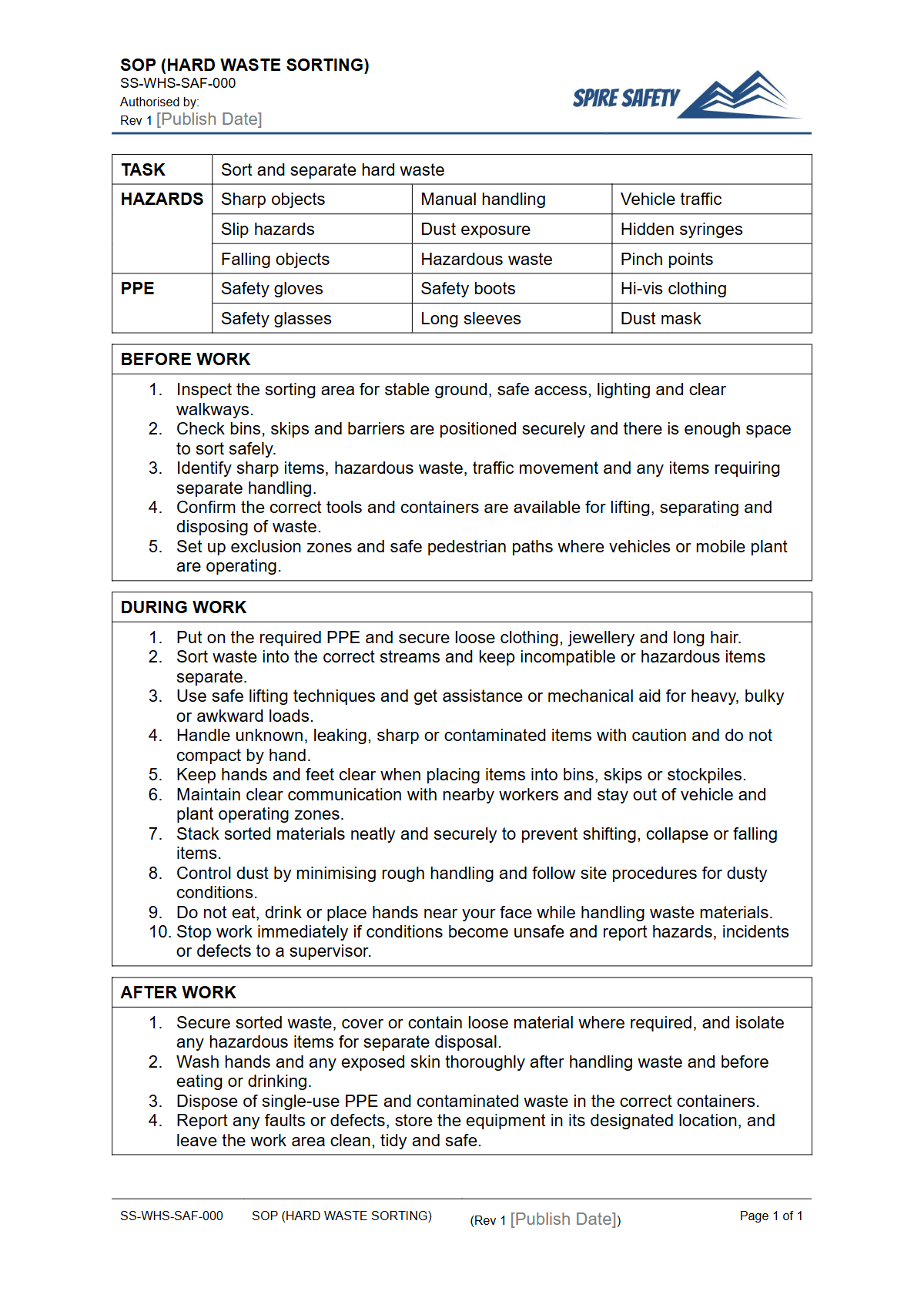
Download our free Safe Operating Procedure (Hard Waste Sorting) template to manage risks from manual tasks, machinery, and hazardous materials.
Free Safe Operating Procedure (Hard Waste Sorting) Template
DOCX • 126 KB + PDF
Updated Oct 2026
No signup required
Purpose of the Free Safe Operating Procedure (Hard Waste Sorting) Template
Managing hard waste involves significant risks, from hazardous manual tasks to exposure to unknown substances. This Free Safe Operating Procedure (Hard Waste Sorting) Template provides a structured framework for documenting the step-by-step process required to sort hard waste safely.
It is designed to help your organisation identify potential hazards and implement effective control measures, forming a key part of your administrative controls under the hierarchy of controls.
The primary purpose of a Safe Operating Procedure (SOP) is to ensure tasks are performed consistently and safely every time. For hard waste sorting, this includes outlining procedures for identifying and segregating different material types, using plant and equipment correctly, and managing hazards such as sharps, asbestos, chemicals, and heavy or awkward items.
It also standardises the use of Personal Protective Equipment (PPE) and emergency responses. For related tasks involving vehicles, you may also need a specific Safe Operating Procedure for a body truck to detail loading and transport risks.
Key Hazards Addressed:
- Hazardous manual tasks (lifting, carrying, pushing, pulling)
- Crush injuries from plant and mobile equipment
- Cuts and puncture wounds from sharps (e.g., glass, metal, needles)
- Exposure to hazardous substances (chemicals, dust, asbestos)
- Slips, trips, and falls in the sorting area
- Noise from machinery
Video walkthrough
How to use the Free Safe Operating Procedure (Hard Waste Sorting) Template
This document is a template, not a finished product. To be effective, it must be customised to the specific circumstances of your workplace.
Before implementation, a person conducting a business or undertaking (PCBU) must conduct a site-specific risk assessment for all activities related to hard waste sorting. This involves identifying all foreseeable hazards, assessing the associated risks, and determining appropriate control measures.
Important: We have created this template as a starting point. You must adapt it to reflect your unique operational environment, including the types of waste handled, the specific machinery in use (such as developing a telehandler SOP if one is used for moving bulk materials), your facility layout, and your state or territory's WHS legislation.
It is crucial to consult with your workers and any health and safety representatives during this customisation process. Their direct experience is invaluable for creating a practical and effective procedure. This SOP should be integrated into your broader safety framework and can be a foundational document when developing a complete WHS management system.
When to use it
A hard waste sorting SOP should be used as a primary reference tool for multiple operational purposes. It is essential for the induction and training of new employees, ensuring they understand the approved safe method for the task from day one.
It should also be used for refresher training for existing workers to reinforce correct procedures and introduce any process updates.
The SOP should be readily accessible in the work area for workers to consult before and during the task. It also serves as a critical document for supervisors and managers to conduct observations, verify competency, and provide performance feedback.
Finally, it should be reviewed as part of any incident investigation or when a change is introduced to the task, such as new equipment or a change in the types of waste being processed.
Who should use it
This Safe Operating Procedure is intended for use by all personnel involved in the hard waste management process. This includes:
- Workers and Operators: To understand and follow the safe work method for sorting hard waste.
- Supervisors and Team Leaders: To train workers, monitor compliance, and enforce safe work practices.
- WHS Managers and Advisors: To develop, implement, and review safety procedures as part of the overall WHS management system.
- Business Owners and PCBUs: To meet their primary duty of care to provide and maintain a safe system of work.
For organisations that lack the internal expertise to conduct the necessary risk assessments and customisation, engaging external support can provide clarity and ensure a robust outcome. Partnering with a provider of specialist WHS consulting can help tailor this document to your precise operational needs. The effectiveness of this SOP and other safety documents should be periodically checked as part of your verification activities, such as through regular WHS compliance auditing.
This template is one of many resources designed to support Australian businesses in managing their safety obligations. You can explore our complete free WHS resources library for more templates, checklists, and guides.
Common mistakes
Common mistakes to avoid
- Using the generic template without customising it for the specific workplace, equipment, and waste streams.
- Failing to adequately train workers on the finalised SOP and confirm their understanding.
- Not making the SOP easily accessible to workers in the areas where sorting tasks are performed.
- Forgetting to review and update the SOP after an incident or when processes change.
Legal references
Legal considerations
The following legal requirements may be relevant to this type of work.
- Work Health and Safety Act (Harmonised) — Provides the primary duties for protecting workers and other people from work health and safety risks.
- Work Health and Safety Regulations (Harmonised) — Sets out requirements supporting the management of workplace hazards and risks.
The following codes may be relevant to this type of work.
- Managing WHS Risks Code of Practice — Provides practical guidance on identifying hazards, assessing risks and applying effective controls.
- Work Health and Safety Consultation, Cooperation and Coordination Code of Practice — Provides practical guidance on consulting workers and coordinating with other duty holders.
- Managing the Work Environment and Facilities Code of Practice — Provides practical guidance on safe work environments, workplace facilities and related controls.
Did you know
Waste Industry Risks
According to Safe Work Australia, the waste collection, treatment, and disposal industry has one of the highest rates of serious workers' compensation claims, with vehicle incidents and muscular stress being leading causes.
Hidden Dangers
Hard waste can contain unexpected hazardous materials, including old batteries that pose a fire risk, unidentified chemical containers, and asbestos in discarded building materials.
FAQ
Frequently asked questions
01What is a Safe Operating Procedure for hard waste sorting?
02What hazards should be included in a hard waste sorting SOP?
03Is this template enough for my WHS compliance obligations?
04How often should we review our hard waste sorting SOP?
Share this resource
Free Safe Operating Procedure (Hard Waste Sorting) Template
Browse Categories
How To Use It
- 1Download and open in Word or PDF.
- 2Replace the placeholders with your business details.
- 3Get it reviewed by a WHS specialist before rollout.
Need it customised?
Our WHS consultants can adapt this template to your site, run a gap analysis, or audit what you already have in place.
Book a Free Consultation WHS consulting servicesor call 1300 156 382
Related templates
- Free Safe Operating Procedure (Hardness Tester) Template
- Free Safe Operating Procedure (Hardscape Cleaning) Template
- Free Safe Operating Procedure (Harvester Head) Template
- Free Safe Operating Procedure (Hay Bale Handling) Template
- Free Safe Operating Procedure (Hay Bale Stacking) Template
- Free Safe Operating Procedure (Hazardous Waste Intake) Template