
Free Safe Operating Procedure (Hazardous Waste Intake) Template
Our Safe Operating Procedure for hazardous waste intake provides a structured framework for managing chemical risks.
Free Safe Operating Procedure (Hazardous Waste Intake) Template
DOCX • 126 KB + PDF
Updated Oct 2026
No signup required
Purpose of the Free Safe Operating Procedure (Hazardous Waste Intake) Template
Handling hazardous waste presents significant risks to workers and the environment. A systematic approach is essential to control hazards like chemical burns, toxic exposure, fires, and explosions.
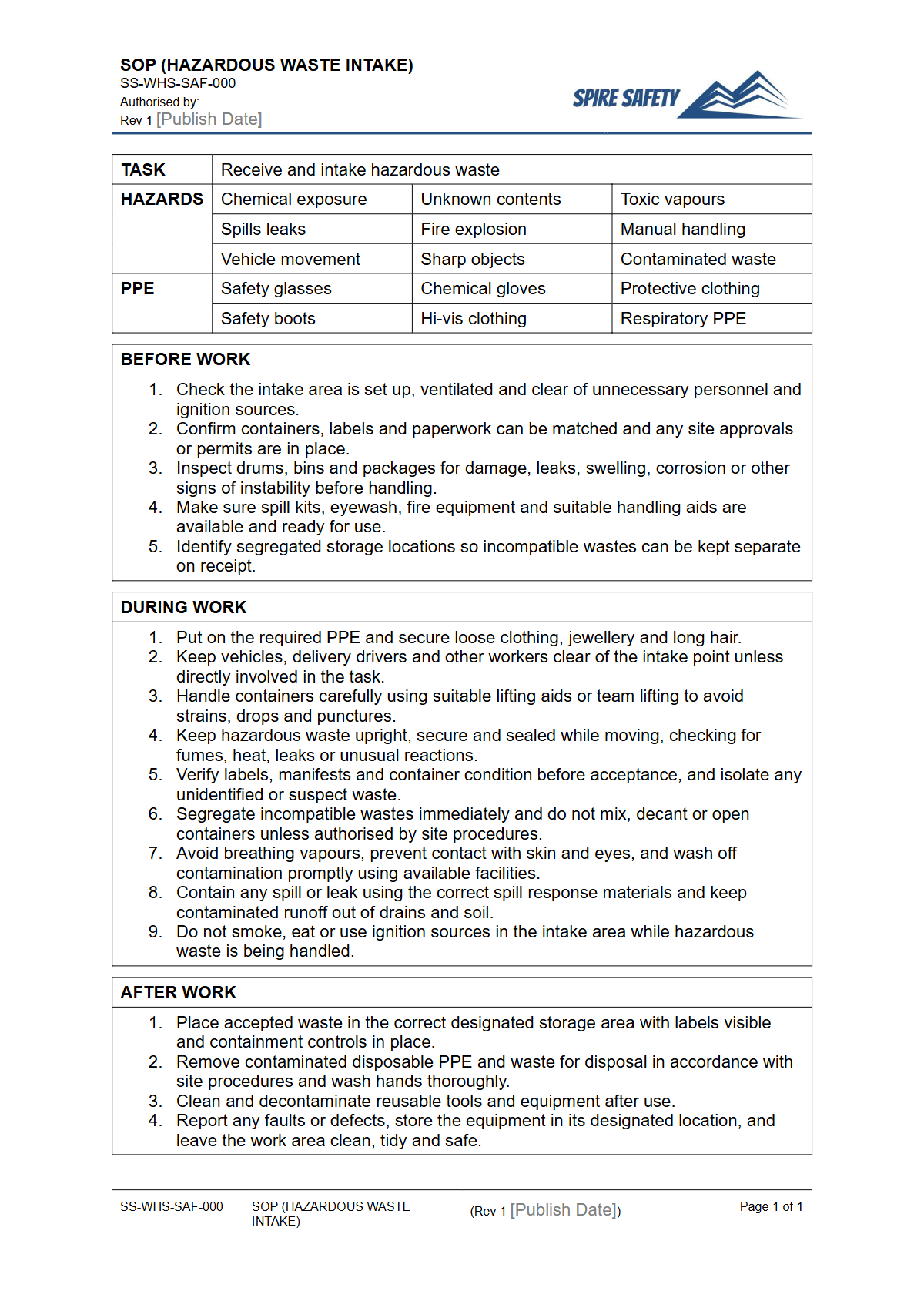
This Free Safe Operating Procedure (Hazardous Waste Intake) Template provides a structured starting point for documenting the required safety controls and work steps for receiving, assessing, and storing hazardous materials at your workplace. Properly implemented, this SOP helps your organisation meet its duty of care by providing clear, actionable guidance to workers, reducing the likelihood of incidents and ensuring a consistent, safe method of work.
A well-drafted SOP is a critical component of a robust safety framework. It demonstrates a commitment to operational safety and forms a key part of your overall WHS management systems, integrating directly with risk assessments and training programs to create a safer work environment for everyone.
Video walkthrough
How to use the Free Safe Operating Procedure (Hazardous Waste Intake) Template
This template is designed for easy customisation. It outlines a standard sequence of actions, safety checks, and required personal protective equipment (PPE) for the task of hazardous waste intake.
Download the DOCX file and adapt it to the specific types of waste, equipment, and environmental conditions at your facility. It's crucial to perform a site-specific risk assessment and incorporate its findings directly into the procedure.
Important: This is a template, not a finished document. To be effective, you must customise it to reflect the specific hazards and control measures relevant to your workplace.
We recommend a competent person, such as a WHS manager or site supervisor, leads the customisation process in consultation with the workers who will perform the task. Finalised procedures should be easy for operators to understand and follow.
What's included in this Safe Operating Procedure?
Our template provides a comprehensive structure for your document. It includes sections for detailing the task, identifying potential hazards, specifying mandatory PPE, and listing pre-operational checks.
The core of the document is the step-by-step procedure, which guides the user from initial waste arrival and documentation checks through to safe handling, segregation, and temporary storage. It also includes prompts for emergency shutdown and response procedures.
This logical flow is similar to what you might find in our FREE Conveyer System SOP (Safe Operating Procedure) Template, which also breaks down a complex task into manageable, safe steps.
Adapting the Safe Operating Procedure for specific waste types
Hazardous waste is not a single category. Your intake procedure must be tailored to the specific chemical and physical properties of the materials you handle, such as flammables, corrosives, oxidisers, or toxic substances.
This requires consulting the Safety Data Sheet (SDS) for each substance. The information in the SDS, particularly in sections concerning handling, storage, and emergency measures, must be reflected in your finalised SOP. For instance, procedures for handling liquid waste in drums will differ significantly from those for solid, contaminated materials that might be managed by equipment like that covered in our Free Air Compressor SOP (Safe Operating Procedure) Template.
When to use this Safe Operating Procedure
This Safe Operating Procedure should be used every time hazardous waste is received at your site. It is a live document intended for active use, not just for filing.
It should be readily available at the point of work for operators to reference. Furthermore, the SOP should be a central part of induction and refresher training for all personnel involved in the task.
It's also critical to review and update the SOP regularly—at a minimum, on an annual basis, or whenever a process changes, new equipment is introduced, or an incident occurs. These reviews can be integrated into your regular WHS compliance auditing schedule to ensure ongoing relevance and effectiveness.
Who should use this Safe Operating Procedure
This procedure is intended for use by all workers tasked with receiving, handling, or supervising the intake of hazardous waste. This includes roles such as warehouse and logistics personnel, waste management technicians, laboratory staff, and site supervisors.
Before using the SOP, all personnel must be trained in its contents and be deemed competent to perform the task safely. Competency includes understanding the specific hazards of the wastes they handle, correct use of PPE, and knowledge of emergency and spill response actions.
Developing these specific procedures and training plans can be complex, and engaging external WHS consulting can provide valuable expertise and an objective view of your processes.
For more templates and safety resources covering a wide range of tasks and equipment, browse our complete free WHS resources library. We offer a variety of tools to help your organisation build a stronger safety culture.
Common mistakes
Common mistakes to avoid
- Using a generic template without customising it for site-specific wastes and equipment.
- Failing to train workers on the finalised SOP and confirm their understanding.
- Not making the SOP easily accessible to workers at the location where the task is performed.
- Forgetting to include procedures for spills, exposure, and other potential emergencies.
Legal references
Legal considerations
The following legal requirements may be relevant to this type of work.
- Work Health and Safety Act (Harmonised) — Provides the primary duties for protecting workers and other people from work health and safety risks.
- Work Health and Safety Regulations (Harmonised) — Sets out requirements supporting the management of workplace hazards and risks.
The following codes may be relevant to this type of work.
- Managing WHS Risks Code of Practice — Provides practical guidance on identifying hazards, assessing risks and applying effective controls.
- Work Health and Safety Consultation, Cooperation and Coordination Code of Practice — Provides practical guidance on consulting workers and coordinating with other duty holders.
- Managing the Work Environment and Facilities Code of Practice — Provides practical guidance on safe work environments, workplace facilities and related controls.
Did you know
GHS Standardisation
The Globally Harmonized System (GHS) of Classification and Labelling of Chemicals uses standardised pictograms, signal words, and hazard statements to communicate risks on labels and Safety Data Sheets worldwide.
Waste Segregation
A primary cause of serious incidents is the improper mixing of incompatible hazardous wastes, which can lead to violent chemical reactions, toxic gas release, or fires. Correct segregation based on chemical compatibility is a critical step in any intake procedure.
FAQ
Frequently asked questions
01What is a Safe Operating Procedure for hazardous waste intake?
02Is this hazardous waste intake SOP a legal compliance document?
03What other WHS documents are needed for handling hazardous waste?
04How often should we review our hazardous waste intake SOP?
Share this resource
Free Safe Operating Procedure (Hazardous Waste Intake) Template
Browse Categories
How To Use It
- 1Download and open in Word or PDF.
- 2Replace the placeholders with your business details.
- 3Get it reviewed by a WHS specialist before rollout.
Need it customised?
Our WHS consultants can adapt this template to your site, run a gap analysis, or audit what you already have in place.
Book a Free Consultation WHS consulting servicesor call 1300 156 382
Related templates
- Free Safe Operating Procedure (Hearing Aid Cleaning) Template
- Free Safe Operating Procedure (Heat Knife) Template
- Free Safe Operating Procedure (Heat Press) Template
- Free Safe Operating Procedure (Heat Sealer) Template
- Free Safe Operating Procedure (Heat Shrink Tunnel) Template
- Free Safe Operating Procedure (Heat Stress Monitor) Template