
Free Safe Operating Procedure (Heat Shrink Tunnel) Template
Document the safe use of heat shrink tunnels with our detailed template. Download this free Safe Operating Procedure to standardise your processes today.
Free Safe Operating Procedure (Heat Shrink Tunnel) Template
DOCX • 126 KB + PDF
Updated Oct 2026
No signup required
Purpose of the Free Safe Operating Procedure (Heat Shrink Tunnel) Template
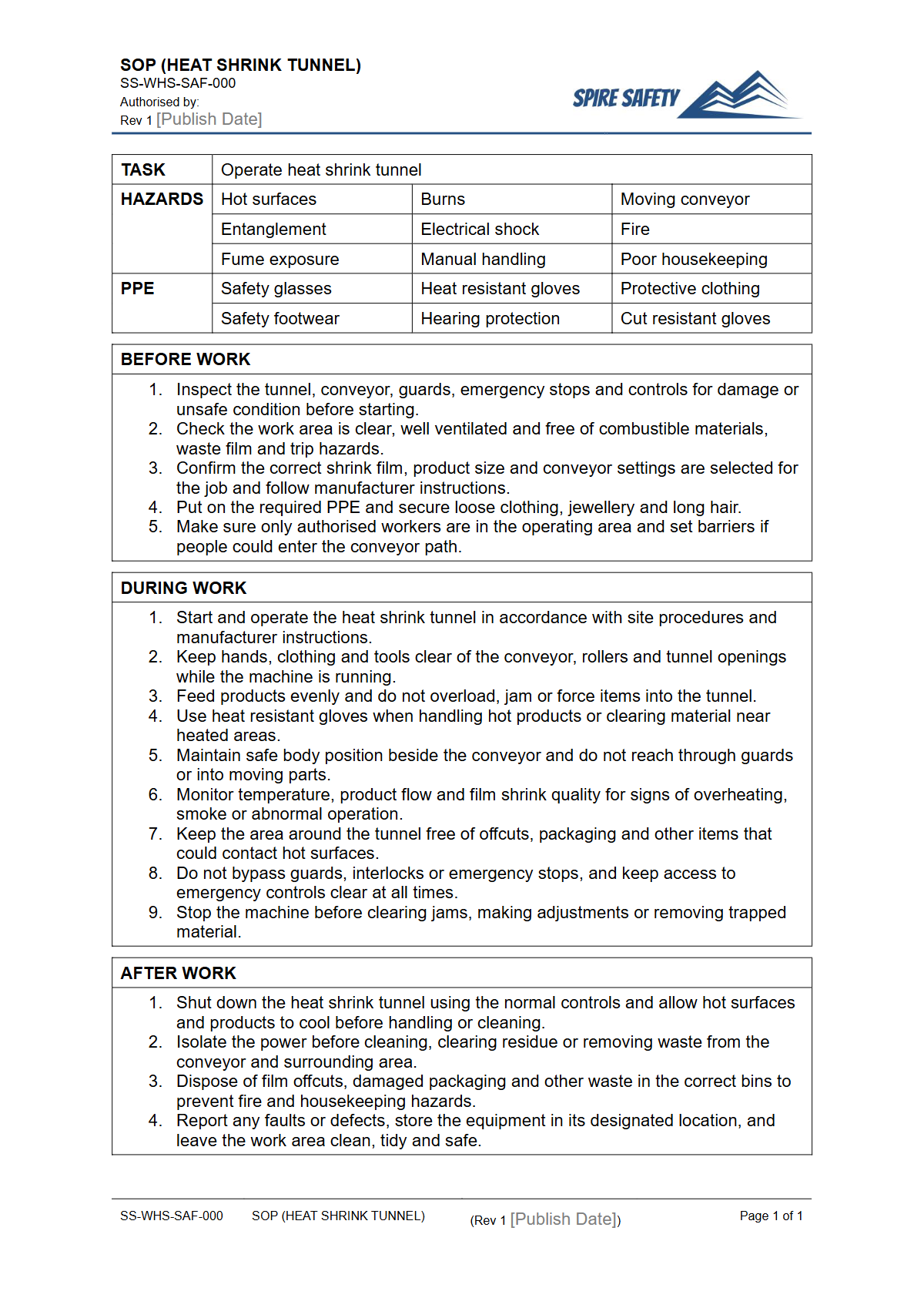
Effectively managing workplace risks is crucial, especially when dealing with machinery that combines heat, electricity, and moving parts. This Free Safe Operating Procedure (Heat Shrink Tunnel) Template provides a structured starting point for your organisation to document safe work methods.
An SOP is a fundamental tool that outlines step-by-step instructions to help workers perform their tasks safely and consistently. Using this template helps standardise your approach to operating heat shrink tunnels, reducing the risk of burns, entanglement, and other common injuries associated with packaging lines.
This document is designed to be adapted to your specific operational environment. It guides you in identifying hazards, implementing risk controls, and defining clear protocols for pre-start checks, operation, and shutdown.
Heat shrink tunnels are often part of a larger production line, so it's important to consider how they interact with other equipment. For related machinery, you might find our FREE Conveyer System SOP (Safe Operating Procedure) Template a useful addition to your safety documentation.
Video walkthrough
How to use the Free Safe Operating Procedure (Heat Shrink Tunnel) Template
You can download this template in both DOCX for easy editing and PDF for straightforward distribution. The key to its effectiveness lies in customisation.
It is essential that you adapt the content to reflect the specific make and model of your heat shrink tunnel, your workplace layout, and the products you handle. Generic procedures are not sufficient to manage unique site-specific risks.
Important: We have provided a comprehensive framework, but you must conduct your own risk assessment and consult with your workers to complete this document. To use the template effectively:
- Download the DOCX file.
- Review the document with supervisors and experienced operators.
- Add details specific to your equipment, including emergency stop locations, specific temperature settings, and conveyor speeds.
- Incorporate your organisation’s branding and emergency contact information.
- Train all relevant workers on the finalised SOP and keep records of this training.
A well-drafted SOP is a critical component of a robust safety framework. Integrating this procedure into your broader WHS management systems ensures it is consistently applied, reviewed, and improved over time, helping to foster a strong safety culture.
When to use a Heat Shrink Tunnel SOP
A Safe Operating Procedure for a heat shrink tunnel should be a living document, used actively throughout the equipment's lifecycle. It is not a "set and forget" document. It must be readily accessible and used as a primary reference in several key situations, including:
- Worker Training and Induction: Before any employee operates the heat shrink tunnel for the first time.
- Refresher Training: As part of regular competency reviews to ensure standards are maintained.
- Task Reference: As a quick guide for operators to confirm correct procedures, especially for non-routine tasks like clearing a film jam.
- Incident Investigation: To determine if procedural deviations contributed to an accident or near miss.
- Process Audits: When supervisors or safety officers are observing work practices to verify correct procedure is being followed.
The SOP should be formally reviewed and updated following any changes to the equipment, the process, or relevant WHS legislation. It should also be considered alongside procedures for other common industrial equipment, such as the process detailed in our Free Air Compressor SOP (Safe Operating Procedure) Template.
Who should use this template?
The development and use of a heat shrink tunnel SOP involves people at all levels of an organisation. While the Person Conducting a Business or Undertaking (PCBU) holds ultimate responsibility for providing safe work procedures, the practical implementation requires collaboration.
- WHS Managers and Safety Officers use this template to build and standardise safety documentation across the business.
- Supervisors and Team Leaders use the final SOP to train their teams and monitor day-to-day operational safety.
- Operators and Workers must be consulted during the drafting process and use the SOP as their guide for safe operation. Their input is invaluable for identifying practical hazards.
- Maintenance Personnel refer to the SOP for lockout/tagout and safe shutdown procedures before performing work.
Ensuring that these documented procedures are followed correctly is a key part of maintaining a safe workplace. This can be verified through processes like WHS compliance auditing, which formally assesses the effectiveness of your safety systems against established benchmarks.
Key Hazards to Address
When customising this template, pay close attention to the primary hazards associated with heat shrink tunnels. These include:
- Thermal Hazards: Burns from direct contact with the tunnel's heating elements, hot surfaces, or exposure to hot air exhaust.
- Mechanical Hazards: Entanglement or crushing injuries from moving parts, such as the conveyor belt, sealing mechanisms, or film feed rollers.
- Electrical Hazards: Risk of electric shock from faulty wiring, control panels, or improper maintenance procedures.
- Manual Handling: Strains and sprains from lifting and moving heavy products onto or off the conveyor.
The principles for controlling these risks, particularly those related to heat, are applicable to other types of machinery. For example, similar hazard management strategies are covered in our Safe Operating Procedure (Deep Fryer - Standard Operation) template.
By systematically addressing each of these points in your SOP, you create a comprehensive guide that helps protect your team. Find more templates and safety guides in our extensive free WHS resources library to support your safety management efforts.
Common mistakes
Common mistakes to avoid
- Using a generic template without adding site-specific details for the exact make and model of the tunnel.
- Failing to consult with operators who use the equipment daily, missing practical insights into risks.
- Neglecting to include procedures for non-standard tasks like clearing jams, cleaning, and maintenance.
- Not providing adequate training on the finalised SOP or verifying operator competency.
Legal references
Legal considerations
The following legal requirements may be relevant to this type of work.
- Work Health and Safety Act (Harmonised) — Provides the primary duties for protecting workers and other people from work health and safety risks.
- Work Health and Safety Regulations (Harmonised) — Sets out requirements supporting the management of workplace hazards and risks.
The following codes may be relevant to this type of work.
- Managing WHS Risks Code of Practice — Provides practical guidance on identifying hazards, assessing risks and applying effective controls.
- Work Health and Safety Consultation, Cooperation and Coordination Code of Practice — Provides practical guidance on consulting workers and coordinating with other duty holders.
- Managing the Work Environment and Facilities Code of Practice — Provides practical guidance on safe work environments, workplace facilities and related controls.
Did you know
Heat and Speed
Most industrial heat shrink tunnels operate at temperatures between 150°C and 220°C. The combination of high heat and conveyor speed is precisely controlled to shrink the film without damaging the product inside.
FAQ
Frequently asked questions
01What are the main hazards of using a heat shrink tunnel?
02Is this heat shrink tunnel SOP template enough for WHS compliance?
03How often should a Safe Operating Procedure be reviewed?
04Who is responsible for writing a Safe Operating Procedure?
Share this resource
Free Safe Operating Procedure (Heat Shrink Tunnel) Template
Browse Categories
How To Use It
- 1Download and open in Word or PDF.
- 2Replace the placeholders with your business details.
- 3Get it reviewed by a WHS specialist before rollout.
Need it customised?
Our WHS consultants can adapt this template to your site, run a gap analysis, or audit what you already have in place.
Book a Free Consultation WHS consulting servicesor call 1300 156 382
Related templates
- Free Safe Operating Procedure (Heat Stress Monitor) Template
- Free Safe Operating Procedure (Heat Treatment Blanket) Template
- Free Safe Operating Procedure (Hedge Hand Trimming) Template
- Free Safe Operating Procedure (Hedge Trimmer) Template
- Free Safe Operating Procedure (HEPA Vacuum) Template
- Free Safe Operating Procedure (Herbicide Mixing) Template