
Free Safe Operating Procedure (Deep Fryer - Standard Operation) Template
Download our free Safe Operating Procedure (Deep Fryer - Standard Operation) template. This customisable DOCX and PDF helps you manage WHS risks.
Free Safe Operating Procedure (Deep Fryer - Standard Operation) Template
DOCX • 153 KB + PDF
Updated Oct 2026
No signup required
Purpose of the Free Safe Operating Procedure (Deep Fryer - Standard Operation) Template
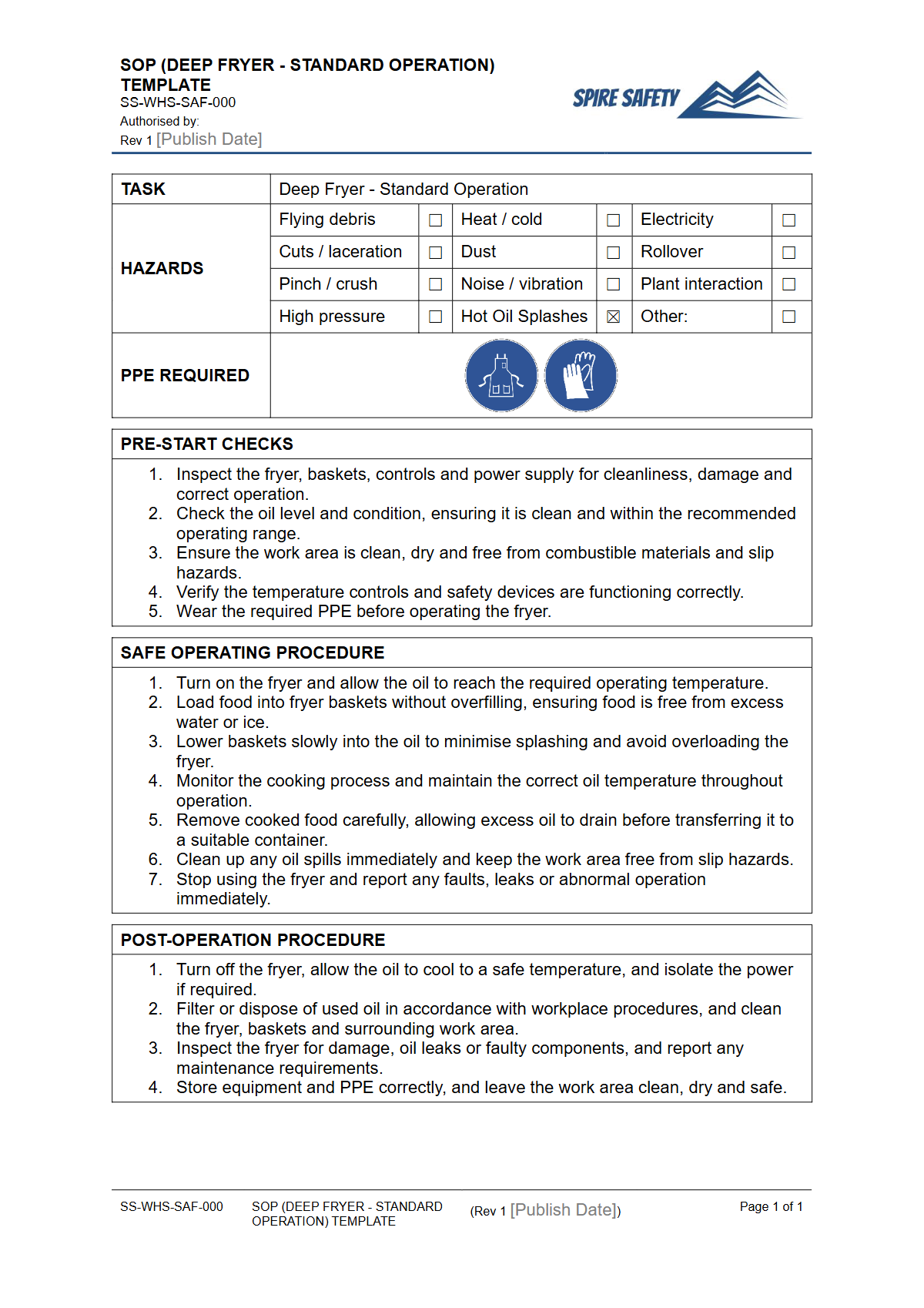
Operating a commercial deep fryer presents significant workplace health and safety risks, including severe burns from hot oil, slips from spills, and the potential for serious fires. This Free Safe Operating Procedure (Deep Fryer - Standard Operation) Template provides a structured framework for documenting the required safety steps to control these hazards.
It is designed to help businesses, particularly in the hospitality and food service industries, establish and communicate a clear, step-by-step process for the safe use of standard deep fryers. Implementing a formal SOP demonstrates a commitment to worker safety and forms a critical part of a proactive risk management strategy.
This document serves as a foundational tool to guide workers, reduce the likelihood of incidents, and ensure operational tasks are performed consistently and safely. It covers key stages of operation, from pre-start checks and heating to cooking, filtering, and end-of-day cleaning procedures.
Using a standardised procedure helps formalise training and ensures all staff, regardless of experience level, are aware of the mandatory safety controls. It is an essential component within a broader WHS management system, helping you meet your duty of care obligations under Australian WHS legislation.
Video walkthrough
How to use the Free Safe Operating Procedure (Deep Fryer - Standard Operation) Template
This Safe Operating Procedure template is provided as a starting point. To make it effective and relevant to your workplace, you must customise it thoroughly.
Download the DOCX file and edit it to reflect your specific operational context. Your customisation should include details such as the make and model of your deep fryer, the specific type of cooking oil used, your kitchen layout, and the location of emergency equipment like fire extinguishers (Class F) and first aid kits.
You must consult with your workers during this process. The people who operate the equipment daily have invaluable practical knowledge of the tasks and their associated risks.
Once customised, the SOP should be used as a primary training document for all new staff and for regular refresher training. Keep a printed, accessible copy near the equipment for easy reference.
Please note: we provide this template to help you document your safe work process; it is your responsibility to ensure the final document is accurate for your workplace and is effectively implemented.
When to use a Safe Operating Procedure
An SOP for a deep fryer should be used consistently as the standard for the task. It is not a document to be filed away; it is an active tool for daily risk management. It must be integrated into your workplace activities at several key points:
- Worker Induction: Before a worker is permitted to operate the deep fryer for the first time, they must be trained on the contents of the SOP.
- Refresher Training: Schedule periodic reviews of the SOP with all relevant staff to reinforce safe practices and address any complacency.
- After an Incident: If a burn, spill, fire, or near miss occurs involving the deep fryer, the SOP should be reviewed as part of the investigation to identify any gaps or weaknesses.
- During Audits: The existence, adequacy, and implementation of SOPs are key items checked during internal or external WHS compliance audits.
- When Processes Change: If you introduce a new deep fryer model, change the type of oil used, or alter the kitchen layout, the SOP must be reviewed and updated accordingly.
Who should use this Safe Operating Procedure
Responsibility for the use and implementation of a deep fryer SOP extends across multiple levels of an organisation:
- Persons Conducting a Business or Undertaking (PCBUs): Business owners and directors are ultimately responsible for ensuring a safe system of work is in place, which includes providing and implementing an effective SOP.
- Managers and Supervisors: Kitchen managers and supervisors have a direct duty to ensure workers are trained on the SOP and follow it consistently. They are also responsible for enforcing the procedures and correcting unsafe behaviour.
- Workers: Kitchen staff, cooks, and anyone tasked with using the deep fryer must follow the steps outlined in the finalised SOP. They also have a responsibility to report any hazards or issues they identify with the equipment or the procedure itself.
Developing robust safety documentation can be complex. If you need assistance integrating this SOP or developing a more comprehensive safety framework, engaging with a WHS consulting firm can provide expert guidance.
For organisations seeking to formalise their entire safety framework, our ISO 45001 consulting services can help you build a system that meets an internationally recognised standard. You can also explore our free WHS resources library for other templates that may be useful in your workplace.
Common mistakes
Common mistakes to avoid
- Using a generic template without customising it for the specific fryer model and kitchen environment.
- Failing to adequately train workers on the SOP, assuming they will simply read and follow it.
- Neglecting to include specific, safe procedures for filtering or changing hot oil—one of the highest-risk tasks.
- Not including clear, accessible emergency procedures for both oil fires (requiring a Class F extinguisher) and burns.
Legal references
Legal considerations
The following legal requirements may be relevant to this type of work.
- Work Health and Safety Act (Harmonised) — Provides the primary duties for protecting workers and other people from work health and safety risks.
- Work Health and Safety Regulations (Harmonised) — Sets out requirements supporting the management of workplace hazards and risks.
The following codes may be relevant to this type of work.
- Managing WHS Risks Code of Practice — Provides practical guidance on identifying hazards, assessing risks and applying effective controls.
- Work Health and Safety Consultation, Cooperation and Coordination Code of Practice — Provides practical guidance on consulting workers and coordinating with other duty holders.
- Managing the Work Environment and Facilities Code of Practice — Provides practical guidance on safe work environments, workplace facilities and related controls.
Did you know
Hot Oil Hazards
Cooking oil in a deep fryer can exceed 190°C. A splash at this temperature causes severe, third-degree burns almost instantly, requiring immediate and specialised medical attention.
Fire Risk
The autoignition temperature of most vegetable oils is around 320°C. If a fryer's thermostat fails, the oil can overheat and spontaneously ignite without any external spark or flame.
FAQ
Frequently asked questions
01What is a Safe Operating Procedure for a deep fryer?
02Is using this deep fryer SOP template enough for WHS compliance?
03How often should a deep fryer SOP be reviewed?
04Who is responsible for creating a deep fryer SOP?
Share this resource
Free Safe Operating Procedure (Deep Fryer - Standard Operation) Template
Browse Categories
How To Use It
- 1Download and open in Word or PDF.
- 2Replace the placeholders with your business details.
- 3Get it reviewed by a WHS specialist before rollout.
Need it customised?
Our WHS consultants can adapt this template to your site, run a gap analysis, or audit what you already have in place.
Book a Free Consultation WHS consulting servicesor call 1300 156 382
Related templates
- Free Safe Operating Procedure (Defibrillator Operation) Template
- Free Safe Operating Procedure (Degreasing Bay) Template
- Free Safe Operating Procedure (Dehumidifier) Template
- Free Safe Operating Procedure (Deli Counter Cleaning) Template
- Free Safe Operating Procedure (Deli Scale Cleaning) Template
- Free Safe Operating Procedure (Demolition Hammer) Template