
Free Safe Operating Procedure (Deli Scale Cleaning) Template
Establish clear, safe steps for cleaning deli scales to prevent contamination and protect workers.
Free Safe Operating Procedure (Deli Scale Cleaning) Template
DOCX • 126 KB + PDF
Updated Oct 2026
No signup required
Purpose of the Free Safe Operating Procedure (Deli Scale Cleaning) Template
Maintaining hygiene in a food preparation environment is non-negotiable. Deli scales, with their direct contact with various food products, can become a significant source of cross-contamination if not cleaned and sanitised correctly.
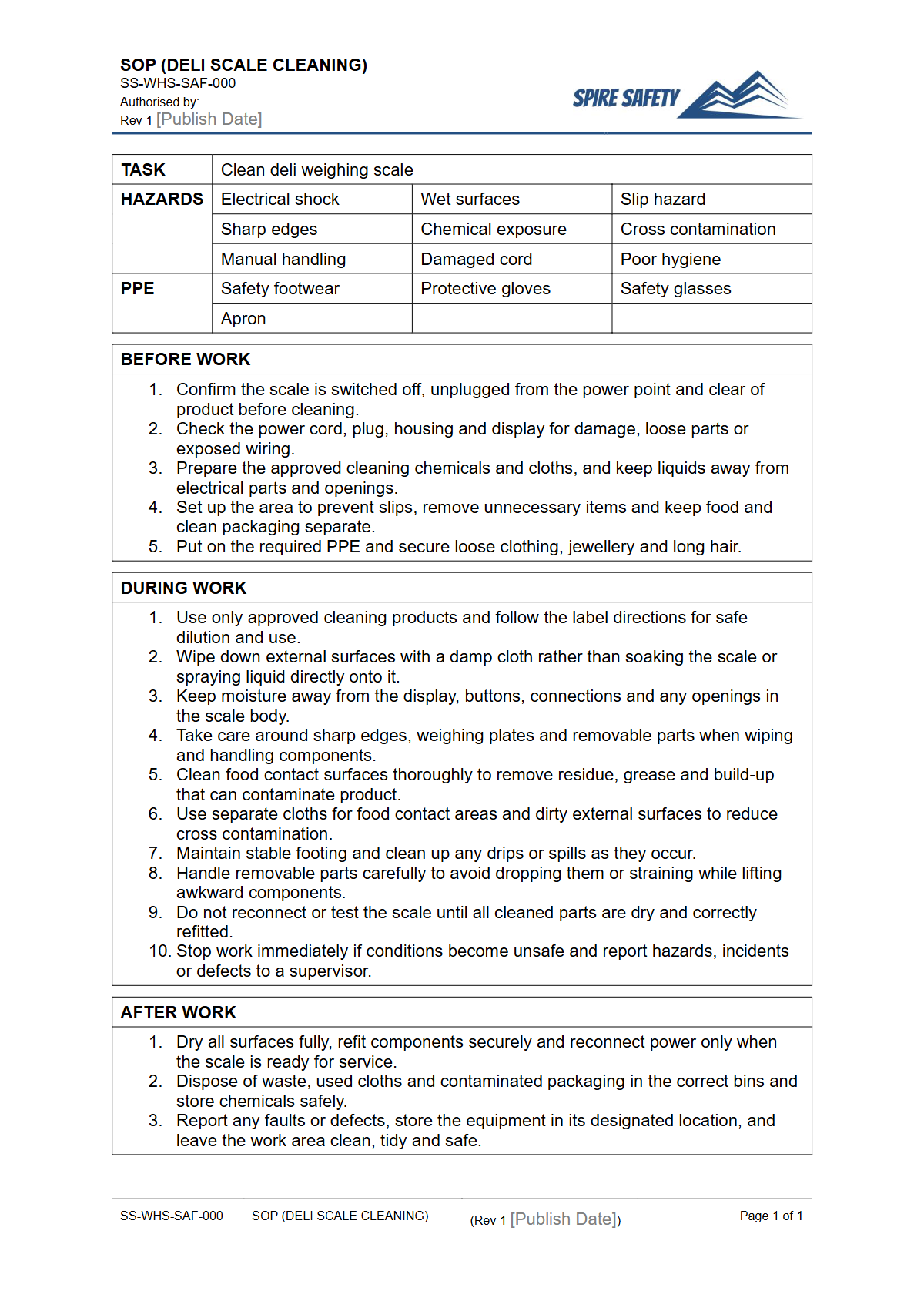
This Free Safe Operating Procedure (Deli Scale Cleaning) Template provides a structured framework for documenting a safe, repeatable cleaning process. Its purpose is to help your business standardise procedures, minimise food safety risks, and protect workers from common hazards associated with the task.
A documented SOP helps control risks such as electrical shock from powered equipment, cuts from sharp components, musculoskeletal injuries from awkward postures, and skin or respiratory irritation from cleaning chemicals. Implementing this procedure is a key part of developing robust WHS management systems that demonstrate a commitment to both food safety and worker wellbeing.
It ensures every team member follows the same approved steps, reducing variability and improving overall safety outcomes.
Video walkthrough
How to use the Free Safe Operating Procedure (Deli Scale Cleaning) Template
This template is designed to be a practical starting point. It can be easily adapted to suit the specific make and model of the deli scales used in your workplace, along with the approved cleaning chemicals you have on site. Follow these steps to implement it effectively:
- Download: Choose your preferred format, DOCX for easy editing or PDF for straightforward printing.
- Customise: This is the most critical step. Review every section and update it with details specific to your equipment, workplace layout, and the cleaning agents you use. Include brand names of chemicals, specific PPE requirements, and emergency contact details.
- Consult: Discuss the draft procedure with the workers who will be performing the task. Their direct experience is invaluable for identifying practical challenges and ensuring the SOP is workable and effective.
- Train: Provide formal training to all relevant employees on the finalised SOP. Ensure they understand the steps, the hazards, and the control measures. Keep records of this training.
- Review: Schedule regular reviews of the SOP (e.g., annually or after any incident) to ensure it remains current.
Note: This document is a template aligned with Australian WHS practice, not a universal, ready-to-use solution. We've created a solid foundation, but you must customise it to reflect the unique risks and operational realities of your specific workplace.
For expert assistance in tailoring safety documentation, consider our WHS consulting services.
When to use it
A Safe Operating Procedure for deli scale cleaning should be an integrated part of your daily operations. It is not just a document for auditors but a live tool for active risk management.
Use this SOP for daily or post-shift cleaning routines to ensure consistency. It is also essential during the induction and training of new employees, providing them with clear, unambiguous instructions from day one.
The SOP should also be referenced during regular safety meetings or toolbox talks to reinforce correct procedures. While this SOP focuses on scales, a comprehensive hygiene program covers all equipment.
For larger machinery in food production environments, our Conveyer System SOP provides a useful reference point for developing similar procedures.
Who should use it
This SOP is intended for any person responsible for cleaning, supervising, or managing food preparation areas. This includes:
- Deli assistants and food handling staff
- Butchers and kitchen hands
- Supervisors and team leaders
- Business owners of cafes, restaurants, bakeries, and supermarkets
- Work Health and Safety (WHS) managers and representatives
Essentially, anyone with a duty of care to ensure a safe working environment and hygienic food handling should be familiar with and help enforce this procedure. Some maintenance tasks involve specialised tools; if your facility uses compressed air for cleaning certain equipment, you might also need to refer to our Free Air Compressor SOP Template.
Key Safety Considerations
When customising your SOP, pay special attention to these areas:
- Electrical Safety: Always confirm the device is switched off and unplugged from the wall outlet before any cleaning begins.
- Chemical Safety: Ensure Safety Data Sheets (SDS) for all cleaning chemicals are available. The SOP should specify the correct dilution, application method, and required Personal Protective Equipment (PPE) like gloves and safety glasses.
- Sharp Edges: Identify any sharp components or edges on the scale and specify safe handling techniques to prevent cuts and lacerations.
- Manual Handling: If the scale or its parts are heavy, outline safe lifting procedures to prevent strains and sprains.
Regularly verifying that these procedures are being followed is a key part of maintaining safety standards. A formal WHS compliance auditing program can help identify gaps between documented procedures and actual practice on the floor. To see more templates like this, you can browse our complete free WHS resources library.
Common mistakes
Common mistakes to avoid
- Forgetting to disconnect the scale from the power source before cleaning.
- Using abrasive scrubbers or steel wool, which can scratch surfaces and create crevices for bacteria to grow.
- Spraying cleaning fluid directly onto the display or into electrical components, causing damage.
- Failing to properly rinse food-safe sanitiser off surfaces, potentially contaminating food.
Legal references
Legal considerations
The following legal requirements may be relevant to this type of work.
- Work Health and Safety Act (Harmonised) — Provides the primary duties for protecting workers and other people from work health and safety risks.
- Work Health and Safety Regulations (Harmonised) — Sets out requirements supporting the management of workplace hazards and risks.
The following codes may be relevant to this type of work.
- Managing WHS Risks Code of Practice — Provides practical guidance on identifying hazards, assessing risks and applying effective controls.
- Work Health and Safety Consultation, Cooperation and Coordination Code of Practice — Provides practical guidance on consulting workers and coordinating with other duty holders.
- Managing the Work Environment and Facilities Code of Practice — Provides practical guidance on safe work environments, workplace facilities and related controls.
Did you know
The 'Danger Zone'
Food safety authorities identify the temperature range between 5°C and 60°C as the 'danger zone,' where food-poisoning bacteria can grow and multiply most rapidly on unclean surfaces.
Chemical Safety Data
Under Australian WHS law, your business must hold a Safety Data Sheet (SDS) for every hazardous chemical used in the workplace, and it must be readily accessible to workers.
FAQ
Frequently asked questions
01What are the main hazards when cleaning a deli scale?
02How often should a commercial deli scale be cleaned and sanitised?
03Can I use any household cleaner on a deli scale?
04Does this Safe Operating Procedure cover blade sharpening?
Share this resource
Free Safe Operating Procedure (Deli Scale Cleaning) Template
Browse Categories
How To Use It
- 1Download and open in Word or PDF.
- 2Replace the placeholders with your business details.
- 3Get it reviewed by a WHS specialist before rollout.
Need it customised?
Our WHS consultants can adapt this template to your site, run a gap analysis, or audit what you already have in place.
Book a Free Consultation WHS consulting servicesor call 1300 156 382
Related templates
- Free Safe Operating Procedure (Demolition Hammer) Template
- Free Safe Operating Procedure (Dense Media Plant) Template
- Free Safe Operating Procedure (Dent Puller) Template
- Free Safe Operating Procedure (Depot Gate Check) Template
- Free Safe Operating Procedure (Depot Yard Inspection) Template
- Free Safe Operating Procedure (Descaling Equipment) Template