
Free Safe Operating Procedure (Descaling Equipment) Template
Clearly define the steps for safely operating descaling equipment to prevent chemical burns and other injuries. Download our free template to get started.
Free Safe Operating Procedure (Descaling Equipment) Template
DOCX • 126 KB + PDF
Updated Oct 2026
No signup required
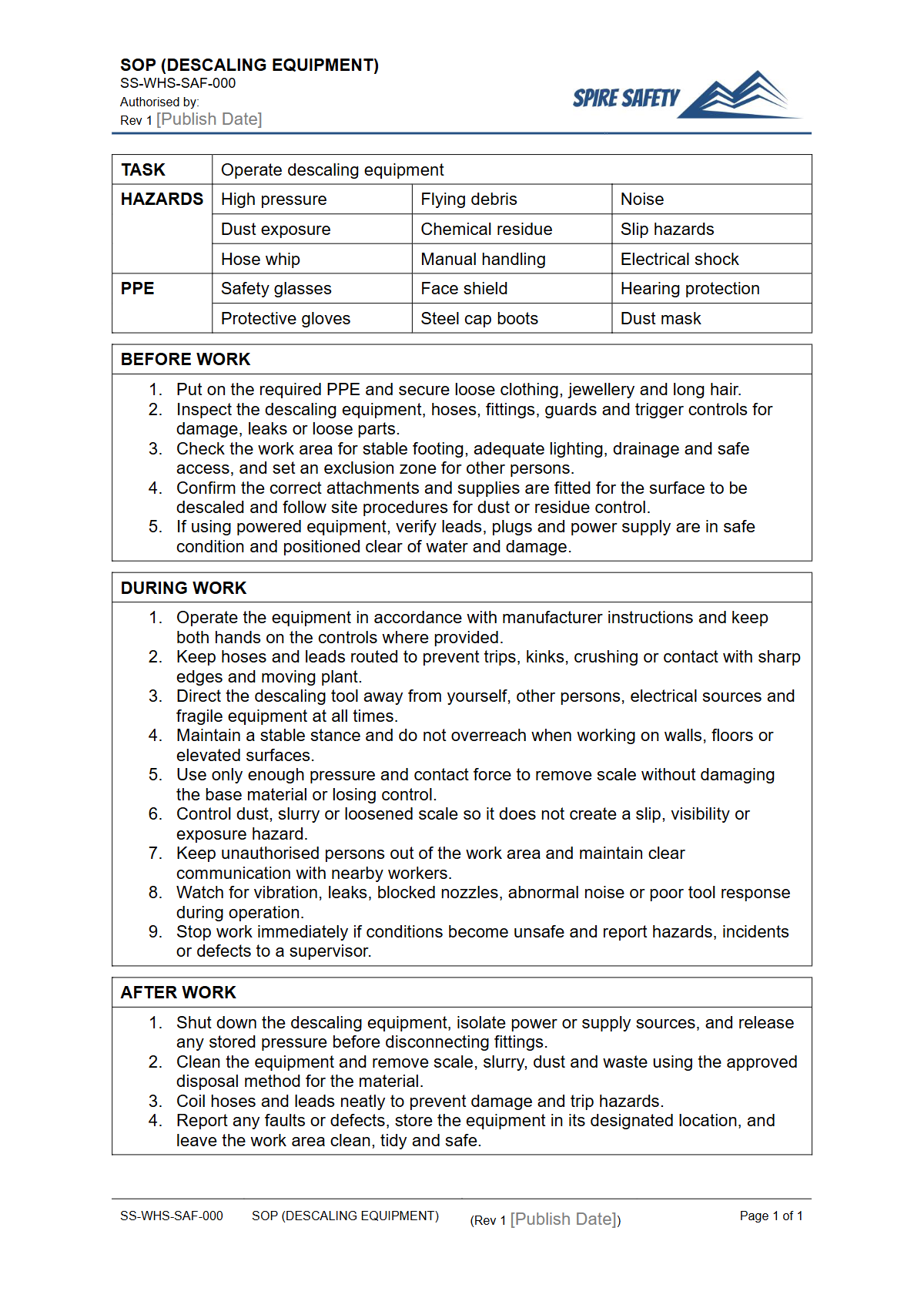
Purpose of the Free Safe Operating Procedure (Descaling Equipment) Template
Descaling equipment is essential for maintaining the efficiency and longevity of boilers, heat exchangers, and other systems prone to scale build-up. However, the process introduces significant workplace hazards.
This Free Safe Operating Procedure (Descaling Equipment) Template provides a structured framework for documenting the required steps to perform this task safely. Using a detailed SOP helps control risks such as chemical exposure from acidic or alkaline descalers, high-pressure spray, thermal burns from hot surfaces or fluids, and electrical hazards.
Implementing a specific SOP for this task formalises your risk management process and demonstrates a commitment to worker safety. It serves as a critical training tool for new employees and a vital reference for experienced technicians.
A well-defined procedure is a cornerstone of effective WHS management systems, ensuring that safety protocols are consistently applied and understood by everyone involved.
Video walkthrough
How to use the Free Safe Operating Procedure (Descaling Equipment) Template
This Free Safe Operating Procedure (Descaling Equipment) Template is designed as a comprehensive starting point, not a finished document. You must adapt it to the unique circumstances of your workplace, including the specific equipment being serviced, the chemicals used, and the operational environment.
Begin by reviewing the manufacturer's operating manual for the descaling unit and the Safety Data Sheet (SDS) for all chemical products. Incorporate this information into the template, adding site-specific details for pre-operational checks, personal protective equipment (PPE) requirements, and emergency procedures.
A critical step in customisation is conducting a thorough risk assessment for the task. This will help identify all potential hazards and establish effective control measures.
Often, descaling tasks involve other pressurised systems, so referencing procedures like our free Air Compressor SOP can provide additional context for managing associated risks. The goal is to create a practical, step-by-step guide that your team can follow to carry out the job safely every time.
Important Note: This is a template only. As we are not present on your site, we cannot know the specific hazards, equipment, or chemicals in use.
It is the responsibility of the Person Conducting a Business or Undertaking (PCBU) to ensure this document is fully customised and made specific to the workplace before implementation. If you need assistance, consider engaging professional WHS consulting services.
What is included in the template?
Our template is provided in both DOCX and PDF formats and includes sections to document:
- Required Personal Protective Equipment (PPE)
- Pre-operational safety checks and equipment inspection
- Step-by-step operating instructions
- Post-operational procedures (including cleaning, flushing, and storage)
- Potential hazards and risk controls
- Emergency response actions
When to use it
This Safe Operating Procedure should be used whenever descaling activities are performed. It is essential for both routine preventative maintenance and corrective actions to remove scale build-up. Common applications include:
- Cleaning industrial boilers and water heaters
- Maintaining cooling towers and HVAC systems
- Servicing heat exchangers and chillers
- Flushing industrial pipework and closed-loop systems
- Descaling large commercial kitchen equipment like dishwashers and steamers
In many industrial facilities, descaling is part of a larger maintenance program for complex machinery. Integrating this SOP with others, such as a FREE Conveyer System SOP for the surrounding production line, helps create a holistic approach to safe maintenance work.
Who should use it
This SOP is intended for use by all personnel involved in the descaling process. Primary users include:
- Maintenance Technicians and Fitters
- Facilities Management Staff
- Service Engineers
- Apprentices and Trainees (under direct supervision)
Supervisors and managers should also use this document to oversee the work, conduct toolbox talks, and verify operator competency. Furthermore, the procedure serves as critical evidence during safety reviews and audits, demonstrating that formal processes are in place.
These processes can be validated through regular WHS compliance auditing to ensure they remain effective and are being followed correctly.
By standardising the procedure for descaling, you reduce the likelihood of incidents and create a safer, more predictable work environment. You can find more templates to support your safety management framework in our free WHS resources library.
Common mistakes
Common mistakes to avoid
- Using the wrong type of descaling chemical for the equipment's materials, causing corrosion and damage.
- Failing to adequately flush the system after descaling, leaving residual chemicals that can contaminate processes or cause harm.
- Neglecting to wear appropriate Personal Protective Equipment (PPE), especially chemical-resistant gloves and safety glasses or goggles.
- Not properly isolating all energy sources (electrical, thermal, pressure) before commencing work.
Legal references
Legal considerations
The following legal requirements may be relevant to this type of work.
- Work Health and Safety Act (Harmonised) — Provides the primary duties for protecting workers and other people from work health and safety risks.
- Work Health and Safety Regulations (Harmonised) — Sets out requirements supporting the management of workplace hazards and risks.
The following codes may be relevant to this type of work.
- Managing WHS Risks Code of Practice — Provides practical guidance on identifying hazards, assessing risks and applying effective controls.
- Work Health and Safety Consultation, Cooperation and Coordination Code of Practice — Provides practical guidance on consulting workers and coordinating with other duty holders.
- Managing the Work Environment and Facilities Code of Practice — Provides practical guidance on safe work environments, workplace facilities and related controls.
Did you know
Limescale's Impact
Just 1.5mm of limescale build-up in a heating system can reduce its energy efficiency by up to 15%, increasing operational costs and carbon footprint.
Acid Safety
Many descaling agents are acidic. Even 'food-safe' acids like citric acid or vinegar can cause serious eye irritation or damage if handled without appropriate eye protection.
FAQ
Frequently asked questions
01What are the main hazards associated with descaling equipment?
02Is a Safe Work Method Statement (SWMS) required for descaling?
03How often should an SOP for descaling equipment be reviewed?
04Can this template be used for descaling commercial coffee machines?
Share this resource
Free Safe Operating Procedure (Descaling Equipment) Template
Browse Categories
How To Use It
- 1Download and open in Word or PDF.
- 2Replace the placeholders with your business details.
- 3Get it reviewed by a WHS specialist before rollout.
Need it customised?
Our WHS consultants can adapt this template to your site, run a gap analysis, or audit what you already have in place.
Book a Free Consultation WHS consulting servicesor call 1300 156 382
Related templates
- Free Safe Operating Procedure (Dewatering Pump) Template
- Free Safe Operating Procedure (Dewatering Screen) Template
- Free Safe Operating Procedure (Diamond Core Drill) Template
- Free Safe Operating Procedure (Diaphragm Pump) Template
- Free Safe Operating Procedure (Diesel Refuelling) Template
- Free Safe Operating Procedure (Diesel Transfer Tank) Template