
Free Safe Operating Procedure (Diaphragm Pump) Template
Download our free Safe Operating Procedure (Diaphragm Pump) template to manage workplace risks.
Free Safe Operating Procedure (Diaphragm Pump) Template
DOCX • 126 KB + PDF
Updated Oct 2026
No signup required
Purpose of the Free Safe Operating Procedure (Diaphragm Pump) Template
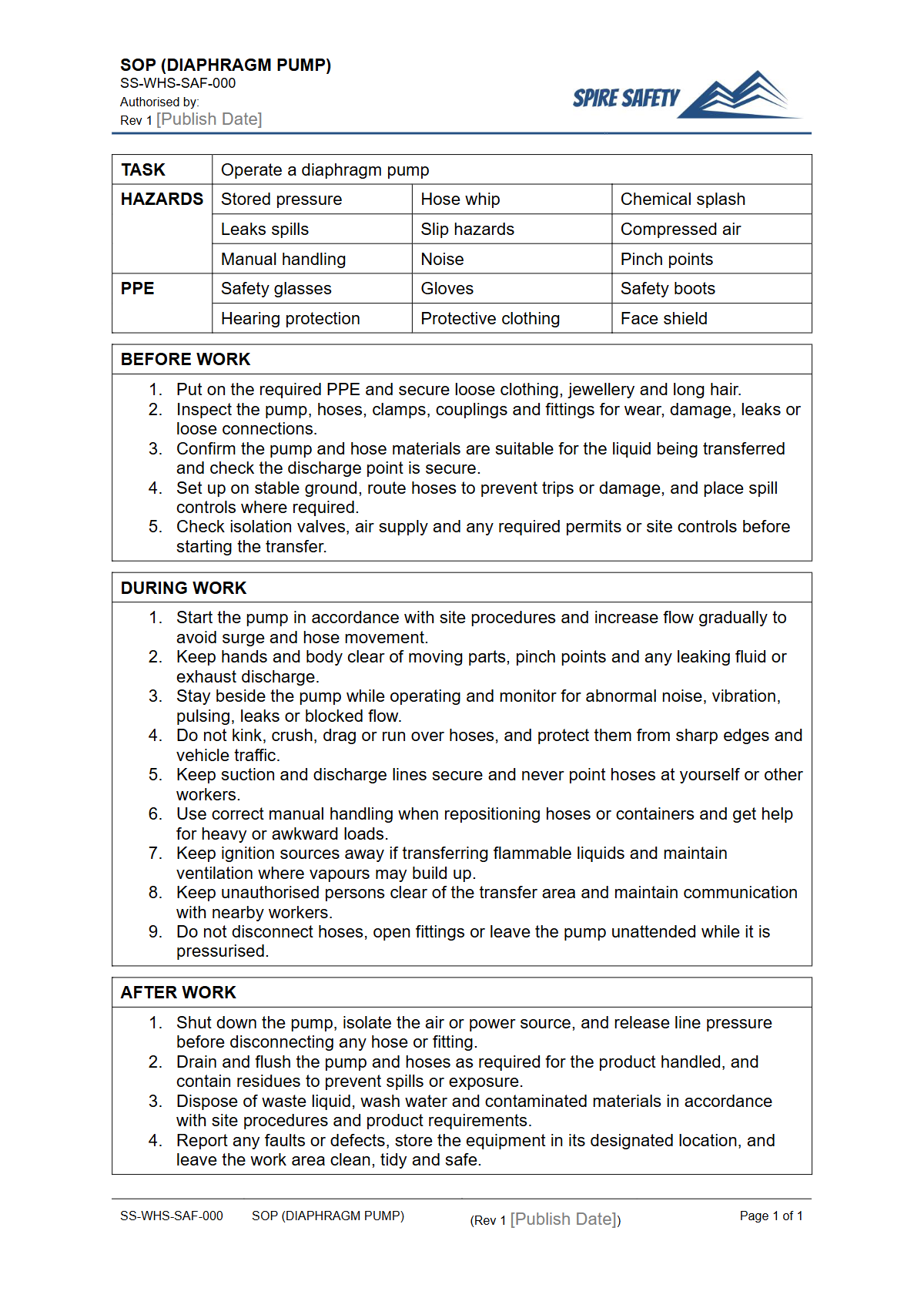
Operating diaphragm pumps, particularly air-operated double-diaphragm (AODD) pumps, introduces specific workplace hazards that must be controlled. This Free Safe Operating Procedure (Diaphragm Pump) Template provides a structured starting point for your organisation to formalise safe work practices.
An SOP is a fundamental risk control measure, detailing step-by-step instructions to ensure tasks are performed safely and consistently. It helps in managing risks such as high-pressure fluid injection, exposure to hazardous chemicals, manual handling injuries during setup, and noise from the pump's operation.
By documenting pre-start checks, operational steps, shutdown procedures, and emergency responses, this SOP helps meet your primary duty of care under Australian WHS laws. It serves as a critical training tool and a reference for competent operators.
Since many diaphragm pumps are powered by compressed air, it is also important to manage the risks associated with that equipment. Our Free Air Compressor SOP (Safe Operating Procedure) Template can be used to document these related procedures.
What's included in the template?
This template is designed to be comprehensive and easy to customise. It includes sections for:
- Required Personal Protective Equipment (PPE)
- Associated hazards and risk control measures
- Step-by-step instructions for pre-operational checks
- Procedures for starting, operating, and stopping the pump
- Instructions for clearing blockages and performing minor maintenance
- Emergency shutdown and response protocols
- A section for operator sign-off and review scheduling
Video walkthrough
How to use the Free Safe Operating Procedure (Diaphragm Pump) Template
This document is provided in DOCX format for easy editing and a PDF for straightforward distribution. It is not a complete, ready-to-use document.
To be effective, it must be adapted to the specific context of your workplace.
Important: We have provided a structured foundation based on common industry practices, but you must customise this template. Your final SOP must reflect the specific make and model of your diaphragm pump, the types of fluids being transferred, the work environment, and your organisation's existing safety protocols. Always consult the manufacturer's operating manual and conduct a site-specific risk assessment before finalising the document.
A thorough review process is crucial for ensuring the SOP is robust and covers all foreseeable risks. Integrating your SOPs into a cycle of regular WHS compliance auditing helps verify that documented procedures are being followed correctly in practice and remain effective over time.
When to use it
A Safe Operating Procedure for a diaphragm pump should be used in several key situations. It is an essential document for inducting and training new operators, ensuring they understand the correct and safe way to use the equipment from the outset.
It also serves as a valuable tool for refresher training for experienced workers, reinforcing safe behaviour and communicating any updates to procedures.
The SOP should be readily accessible near the work area for quick reference during operation. It is particularly important before starting the pump, as it guides operators through critical pre-start safety checks.
Furthermore, the SOP is a vital reference during maintenance, incident investigations, and process reviews. Like other equipment-specific procedures, such as those in our FREE Boom Pump SOP Template, it should be treated as a living document, reviewed periodically and updated whenever processes or equipment change.
Who should use it
The development and use of a diaphragm pump SOP involves personnel at multiple levels of an organisation. While operators are the primary end-users, their supervisors and managers have a direct responsibility to ensure the SOP is implemented, understood, and followed.
Persons Conducting a Business or Undertaking (PCBUs) are responsible for ensuring safe systems of work are in place, which includes providing resources like SOPs. Supervisors and Managers must ensure workers are trained on the SOP and that work is conducted in accordance with it.
Operators are responsible for following the procedures outlined in the SOP to protect their own health and safety and that of others. These responsibilities are all key components of effective WHS management systems, which provide the framework for managing safety across the entire business.
Effectively managing plant and equipment safety involves creating consistent documentation for all relevant machinery. Just as you would document procedures for moving materials with pumps, you should also formalise procedures for other equipment, as shown in our FREE Conveyer System SOP Template. Standardising your approach helps build a stronger safety culture.
If this resource is helpful, you may find other useful documents in our complete free WHS resources library, which contains a wide range of templates, checklists, and guides to support your safety management efforts.
Common mistakes
Common mistakes to avoid
- Using a generic SOP without customising it for the specific pump model and workplace.
- Failing to account for the chemical compatibility of the pump's materials with the fluid being transferred.
- Neglecting to train operators on the finalised SOP and verify their understanding.
- Not including clear procedures for troubleshooting common issues like blockages or pressure loss.
Legal references
Legal considerations
The following legal requirements may be relevant to this type of work.
- Work Health and Safety Act (Harmonised) — Provides the primary duties for protecting workers and other people from work health and safety risks.
- Work Health and Safety Regulations (Harmonised) — Sets out requirements supporting the management of workplace hazards and risks.
The following codes may be relevant to this type of work.
- Managing WHS Risks Code of Practice — Provides practical guidance on identifying hazards, assessing risks and applying effective controls.
- Work Health and Safety Consultation, Cooperation and Coordination Code of Practice — Provides practical guidance on consulting workers and coordinating with other duty holders.
- Managing the Work Environment and Facilities Code of Practice — Provides practical guidance on safe work environments, workplace facilities and related controls.
Did you know
Self-Priming Power
Diaphragm pumps are highly valued in many industries because they are self-priming and can run dry for extended periods without sustaining damage, a feature that would destroy many other types of pumps.
Shear-Sensitive Fluids
The gentle pumping action of a diaphragm pump makes it ideal for handling shear-sensitive fluids like paints, food products, and biological materials, as it minimises damage to the fluid's structure during transfer.
FAQ
Frequently asked questions
01What hazards are associated with operating a diaphragm pump?
02Is a Safe Operating Procedure a legal requirement in Australia?
03How often should a diaphragm pump SOP be reviewed?
04Can this template be used for any type of diaphragm pump?
Share this resource
Free Safe Operating Procedure (Diaphragm Pump) Template
Browse Categories
How To Use It
- 1Download and open in Word or PDF.
- 2Replace the placeholders with your business details.
- 3Get it reviewed by a WHS specialist before rollout.
Need it customised?
Our WHS consultants can adapt this template to your site, run a gap analysis, or audit what you already have in place.
Book a Free Consultation WHS consulting servicesor call 1300 156 382
Related templates
- Free Safe Operating Procedure (Diesel Refuelling) Template
- Free Safe Operating Procedure (Diesel Transfer Tank) Template
- Free Safe Operating Procedure (Differential Oil Change) Template
- Free Safe Operating Procedure (Digital Thermometer) Template
- Free Safe Operating Procedure (Dining Aid Cleaning) Template
- Free Safe Operating Procedure (Dining Room Cleaning) Template