
Free Safe Operating Procedure (Dining Room Cleaning) Template
Ensure your hospitality team follows safe work practices with our free dining room cleaning template.
Free Safe Operating Procedure (Dining Room Cleaning) Template
DOCX • 126 KB + PDF
Updated Oct 2026
No signup required
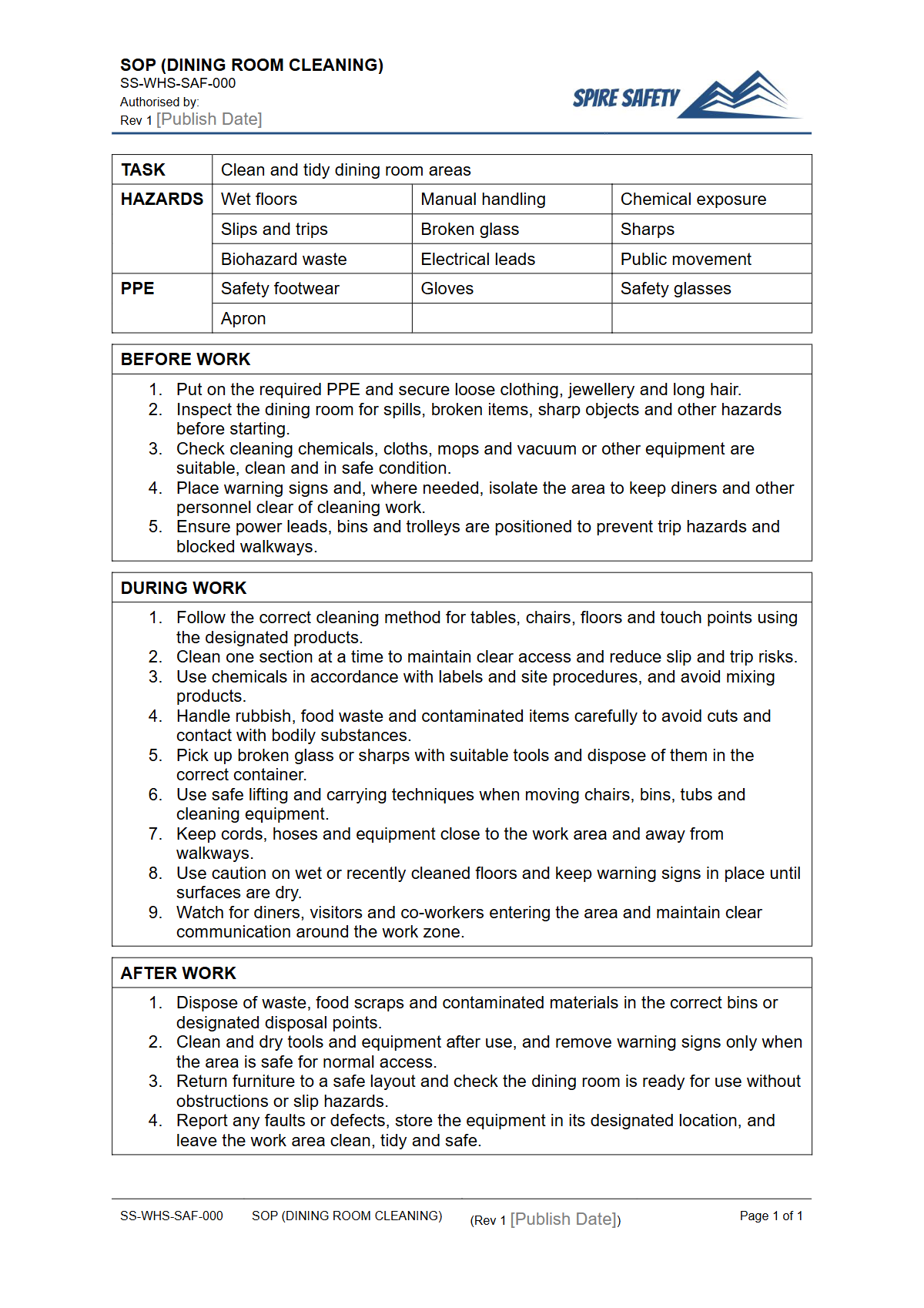
Establishing clear, safe, and efficient cleaning processes is vital in any hospitality setting. This Free Safe Operating Procedure (Dining Room Cleaning) Template provides a structured framework for documenting the safe steps required to clean a dining area.
Using a standardised procedure helps manage risks to workers, such as slips from wet floors or exposure to cleaning chemicals, while ensuring a consistently high standard of hygiene. It serves as a practical tool to meet your work health and safety obligations.
Video walkthrough
Purpose of the Free Safe Operating Procedure (Dining Room Cleaning) Template
A Safe Operating Procedure (SOP) for dining room cleaning formally documents a sequence of tasks to be performed safely and correctly. The primary purpose is to control identified hazards and reduce the risk of injury.
By outlining specific instructions for everything from preparing the area to handling waste, this SOP ensures every worker understands the expected safety standards. It acts as a critical control measure within your overall WHS management systems, demonstrating a proactive approach to risk management.
It helps standardise performance, improve efficiency, and provides a clear reference for training and supervision.
How to use the Free Safe Operating Procedure (Dining Room Cleaning) Template
This template is a starting point designed for customisation. Your dining room, equipment, and cleaning agents are unique, so you must adapt this document to reflect your specific operational environment.
Download the DOCX file and methodically work through each section, consulting with the workers who actually perform the tasks.
Important: This is a generic template. We are not familiar with your specific site, equipment, or personnel.
You MUST customise this document to align with your workplace's unique risks and control measures. A generic, non-customised SOP may not be sufficient to meet your WHS duties.
If you require assistance in tailoring procedures or conducting risk assessments, our WHS consulting team can provide expert support.
Key Sections to Customise
- Personal Protective Equipment (PPE): Specify the exact PPE required, such as brand or type of chemical-resistant gloves and enclosed, non-slip footwear.
- Hazardous Chemicals: List all cleaning products used by name. Reference their corresponding Safety Data Sheets (SDS) and detail specific handling precautions (e.g., dilution rates, ventilation requirements).
- Equipment: Detail the make and model of equipment like vacuum cleaners, floor polishers, or cleaning carts, including pre-operational safety checks.
- Step-by-Step Procedure: Modify the sequence of tasks to match your workflow. This includes steps for setting up 'wet floor' signs, clearing tables, cleaning surfaces, vacuuming, mopping, and waste disposal.
- Emergency Response: Outline procedures for specific emergencies, such as chemical spills, first aid for chemical contact, or responding to a slip and fall incident.
When to use this Safe Operating Procedure
A well-developed SOP is a versatile document used throughout the employment lifecycle. It's not just a piece of paper to be filed away; it's an active tool for maintaining a safe workplace.
It forms a key part of your safety documentation, which can be reviewed during formal safety reviews.
Key applications include:
- Worker Training and Induction: Use the SOP as a foundational training document for new employees to ensure they learn the correct, safe method from day one.
- Refresher Training: Periodically review the SOP with experienced staff to reinforce safe work habits and communicate any updates to the procedure.
- Workplace Inspections: Supervisors can use the SOP as a checklist during inspections to verify that cleaning tasks are being performed as required.
- Incident Investigations: If an incident occurs, the SOP serves as a benchmark to determine if the established procedure was followed and whether the procedure itself is adequate.
- Compliance Verification: It provides documented evidence of the safe work systems you have in place, which is essential for internal and external audits. Engaging professionals for WHS compliance auditing can help verify the effectiveness of your implemented procedures.
Who Should Implement this SOP
Responsibility for the SOP extends across different roles within an organisation. A collaborative approach ensures the procedure is both practical and effectively implemented.
- Business Owners and Managers: They are ultimately responsible for providing a safe workplace. They must ensure that resources are allocated for developing, implementing, and reviewing SOPs as part of their duty of care.
- Supervisors: Front-line supervisors are responsible for training workers on the SOP, ensuring it is consistently followed, and providing feedback for its improvement.
- Workers: The cleaning staff and hospitality team members are the primary users. They must be trained on the procedure, understand it, and follow it every time they perform the task. Their feedback is crucial for keeping the SOP relevant and practical.
- WHS Representatives: They play a key role in the consultation process, helping to review the SOP and ensuring it adequately addresses the risks identified by workers.
By properly documenting your procedures, you build a stronger safety culture and a more resilient organisation. You can explore our free WHS resources library for more templates and guides to support your safety management efforts.
Common mistakes
Common mistakes to avoid
- Using a generic template without customising it for the specific workplace, chemicals, and equipment.
- Failing to adequately train workers on the procedure and confirm their understanding before they start the task.
- Not reviewing or updating the SOP after an incident, near miss, or when new cleaning agents are introduced.
- Storing cleaning chemicals improperly or failing to make Safety Data Sheets (SDS) easily accessible to workers.
Legal references
Legal considerations
The following legal requirements may be relevant to this type of work.
- Work Health and Safety Act (Harmonised) — Provides the primary duties for protecting workers and other people from work health and safety risks.
- Work Health and Safety Regulations (Harmonised) — Sets out requirements supporting the management of workplace hazards and risks.
The following codes may be relevant to this type of work.
- Managing WHS Risks Code of Practice — Provides practical guidance on identifying hazards, assessing risks and applying effective controls.
- Work Health and Safety Consultation, Cooperation and Coordination Code of Practice — Provides practical guidance on consulting workers and coordinating with other duty holders.
- Managing the Work Environment and Facilities Code of Practice — Provides practical guidance on safe work environments, workplace facilities and related controls.
Did you know
Slips, Trips and Falls
Slips, trips and falls are a leading cause of serious injuries in the Australian hospitality industry. Implementing clear procedures for managing wet floors and housekeeping is a critical control measure.
Chemical Safety
Under WHS laws, you must have a Safety Data Sheet (SDS) readily accessible for every hazardous chemical used in the workplace, including common cleaning products.
FAQ
Frequently asked questions
01What should be included in an SOP for cleaning?
02How often should Safe Operating Procedures be reviewed?
03Is a Safe Operating Procedure a legal requirement in Australia?
04What are the main hazards in cleaning a dining room?
Share this resource
Free Safe Operating Procedure (Dining Room Cleaning) Template
Browse Categories
How To Use It
- 1Download and open in Word or PDF.
- 2Replace the placeholders with your business details.
- 3Get it reviewed by a WHS specialist before rollout.
Need it customised?
Our WHS consultants can adapt this template to your site, run a gap analysis, or audit what you already have in place.
Book a Free Consultation WHS consulting servicesor call 1300 156 382
Related templates
- Free Safe Operating Procedure (Dining Room Reset) Template
- Free Safe Operating Procedure (Dirty Utility Cleaning) Template
- Free Safe Operating Procedure (Disability Van Loading) Template
- Free Safe Operating Procedure (Disease Plant Removal) Template
- Free Safe Operating Procedure (Dishwasher Glasswasher Operation) Template
- Free Safe Operating Procedure (Dispatch Area Cleanup) Template