
Free Safe Operating Procedure (Disease Plant Removal) Template
Manage the risks of removing diseased plants with our structured procedure. Download your free Safe Operating Procedure template to get started today.
Free Safe Operating Procedure (Disease Plant Removal) Template
DOCX • 126 KB + PDF
Updated Oct 2026
No signup required
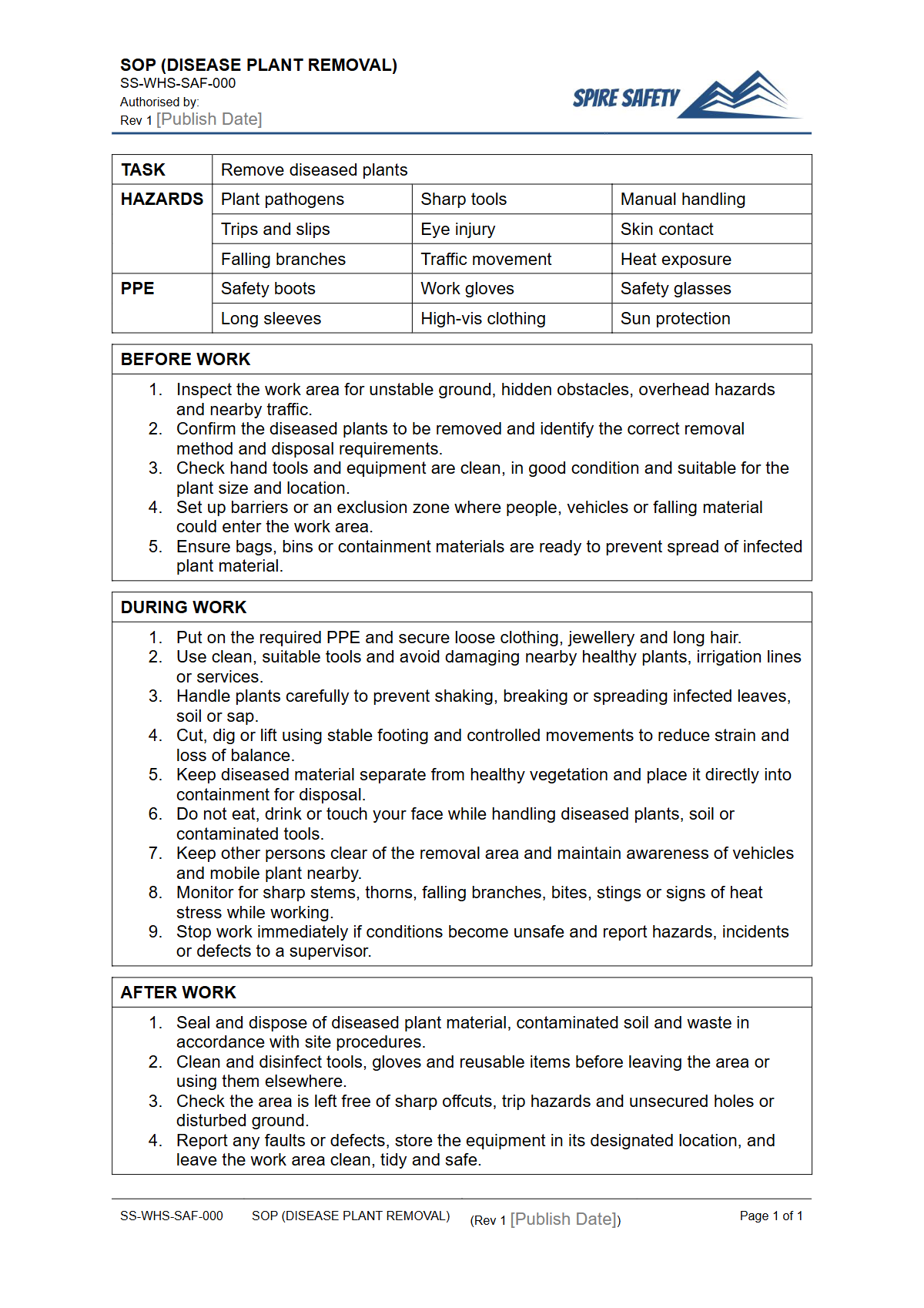
Purpose of the Free Safe Operating Procedure (Disease Plant Removal) Template
Removing diseased plants is a critical task in agriculture, horticulture, and land management to maintain plant health and prevent widespread outbreaks. However, this activity carries inherent risks, including exposure to biological hazards like fungal spores, bacteria, and viruses, as well as ergonomic strains from manual handling and potential injuries from tools.
This Free Safe Operating Procedure (Disease Plant Removal) Template provides a structured framework to identify these hazards and implement effective control measures.
Using a documented SOP ensures that a consistent, safe method is followed every time the task is performed. It serves as a vital tool for worker training, induction, and supervision, helping to meet your duty of care under Australian WHS laws.
This procedure should form one part of your overall safety framework, which can be strengthened by implementing comprehensive WHS management systems that integrate all aspects of workplace safety.
Video walkthrough
How to use the Free Safe Operating Procedure (Disease Plant Removal) Template
This downloadable document is a starting point designed to be adapted to your specific operational needs. Effective customisation is essential for ensuring the procedure is relevant and robust.
We have created this template to align with Australian WHS principles, but you must review and modify it to reflect the unique conditions of your workplace. This includes the specific plant types, diseases encountered, tools used, and the worksite environment.
To implement this Safe Operating Procedure effectively:
- Consult: Engage with your workers who perform the task. Their firsthand experience is invaluable for identifying practical risks and effective controls.
- Customise: Fill in the blank sections with details specific to your site. This includes specifying the required PPE, tool maintenance schedules, sterilisation agents, and emergency procedures. For complex sites, engaging external expertise through WHS consulting can provide valuable insight.
- Train: Ensure all relevant personnel are thoroughly trained on the finalised SOP before they undertake the work. Keep a record of this training.
- Review: Schedule regular reviews of the SOP (e.g., annually) and update it immediately following any incident or change in process, equipment, or legislation.
When to use it
This Safe Operating Procedure should be used whenever workers are required to identify, handle, remove, and dispose of plants suspected or confirmed to be infected with a disease. It is applicable across various sectors, including commercial farms, nurseries, botanical gardens, council parks, and land care operations.
It is particularly important during seasonal clean-ups, disease surveillance activities, or in response to a detected biosecurity threat.
Implementing task-specific SOPs is a cornerstone of good safety management, especially in agriculture where tasks vary widely. For example, similar procedural discipline is required when operating machinery, as outlined in our FREE Planter SOP Template. Using SOPs for all high-risk tasks creates a culture of safety and procedural clarity.
Who should use it
This template is designed for use by Persons Conducting a Business or Undertaking (PCBUs), farm and site managers, horticulturalists, and team leaders. They are responsible for customising the SOP and ensuring it is properly implemented and enforced.
It provides them with a clear document for managing the task and training their teams.
Workers and contractors who will be performing the plant removal must be trained on the content of the final, site-specific SOP. They must understand the risks involved, the control measures required, and the correct steps to follow to complete the job safely. Regular reviews of procedural effectiveness, which can be supported by formal WHS compliance auditing, ensure the SOP remains a living and effective document. This approach complements other machinery-specific procedures, such as our FREE Seed Drill SOP (Safe Operating Procedure) Template. For more templates covering a wide range of tasks and equipment, browse our full free WHS resources library.
Common mistakes
Common mistakes to avoid
- Forgetting to sterilise tools between working on different plants, inadvertently spreading the disease.
- Using inadequate or incorrect Personal Protective Equipment (PPE) for the specific biological or chemical hazard.
- Improperly disposing of infected plant material, such as composting it, which can create a new source of contamination.
- Failing to customise the generic SOP template to account for site-specific conditions, plant types, and tools.
Legal references
Legal considerations
The following legal requirements may be relevant to this type of work.
- Work Health and Safety Act (Harmonised) — Provides the primary duties for protecting workers and other people from work health and safety risks.
- Work Health and Safety Regulations (Harmonised) — Sets out requirements supporting the management of workplace hazards and risks.
The following codes may be relevant to this type of work.
- Managing WHS Risks Code of Practice — Provides practical guidance on identifying hazards, assessing risks and applying effective controls.
- Work Health and Safety Consultation, Cooperation and Coordination Code of Practice — Provides practical guidance on consulting workers and coordinating with other duty holders.
- Managing the Work Environment and Facilities Code of Practice — Provides practical guidance on safe work environments, workplace facilities and related controls.
Did you know
Biosecurity on Site
Plant diseases can spread rapidly via contaminated tools, clothing, and soil moved between locations. A simple boot wash station and tool sterilisation protocol are two of the most effective biosecurity controls in any horticultural or agricultural setting.
Spore Inhalation
Fungal spores from diseased plants can be a significant respiratory hazard, potentially causing allergic reactions, asthma attacks, or serious lung infections like Aspergillosis in susceptible individuals. This is why respiratory protection is often critical.
FAQ
Frequently asked questions
01What hazards are involved in removing diseased plants?
02Does this SOP cover the use of chemicals like fungicides?
03How often should a Safe Operating Procedure for disease plant removal be reviewed?
04Is a Safe Operating Procedure a legal requirement in Australia?
Share this resource
Free Safe Operating Procedure (Disease Plant Removal) Template
Browse Categories
How To Use It
- 1Download and open in Word or PDF.
- 2Replace the placeholders with your business details.
- 3Get it reviewed by a WHS specialist before rollout.
Need it customised?
Our WHS consultants can adapt this template to your site, run a gap analysis, or audit what you already have in place.
Book a Free Consultation WHS consulting servicesor call 1300 156 382
Related templates
- Free Safe Operating Procedure (Dishwasher Glasswasher Operation) Template
- Free Safe Operating Procedure (Dispatch Area Cleanup) Template
- Free Safe Operating Procedure (Dispatch Documentation) Template
- Free Safe Operating Procedure (Dispatch Load Check) Template
- Free Safe Operating Procedure (Display Stand Setup) Template
- Free Safe Operating Procedure (Disposable Apron Use) Template