
Free Safe Operating Procedure (Disposable Apron Use) Template
Formalise workplace hygiene protocols with our free Safe Operating Procedure for disposable apron use.
Free Safe Operating Procedure (Disposable Apron Use) Template
DOCX • 126 KB + PDF
Updated Oct 2026
No signup required
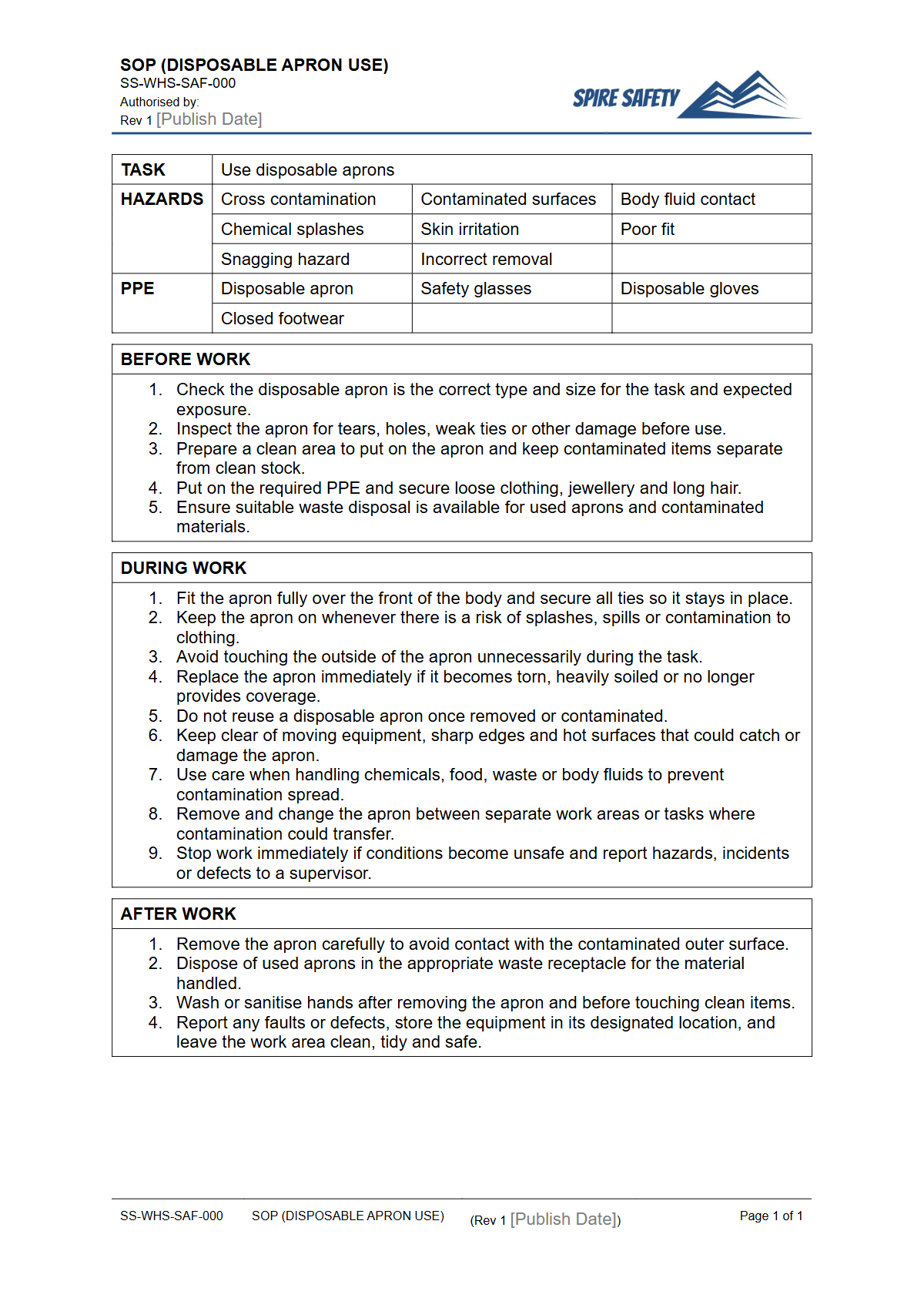
Purpose of the Free Safe Operating Procedure (Disposable Apron Use) Template
Proper personal protective equipment (PPE) use is fundamental to workplace safety, particularly in industries where hygiene and contamination control are critical. This Free Safe Operating Procedure (Disposable Apron Use) Template provides a structured starting point for businesses to document the correct methods for selecting, wearing, removing, and disposing of single-use aprons.
Formalising this process helps prevent cross-contamination, protect employees from splashes of non-hazardous and hazardous substances, and ensures a consistent standard of practice across all staff.
A Safe Operating Procedure (SOP) is a key document that outlines a specific task's hazards and control measures in a clear, step-by-step format. Integrating this procedure into your operational framework demonstrates a commitment to managing risks.
For organisations looking to build a more robust safety culture, individual SOPs form the building blocks of comprehensive WHS management systems, ensuring that safety is embedded in every routine task.
Video walkthrough
How to use the Free Safe Operating Procedure (Disposable Apron Use) Template
This template is available for download as a DOCX file, allowing for easy editing and customisation, as well as a print-ready PDF. To effectively use this resource, you should adapt it to the unique context of your work environment.
A generic procedure is a starting point, not a final solution.
Important: We have provided a framework aligned with Australian WHS principles. However, you must customise this document to reflect the specific tasks, types of aprons used, chemicals handled, and disposal facilities present in your workplace.
We strongly recommend you consult with your workers during this process; their direct experience is invaluable for creating a practical and effective SOP that people will actually follow. Once customised, the SOP should be used as a tool for training new employees and for regular refresher training with existing staff.
When to use a Disposable Apron
Disposable aprons are a control measure used to protect a worker's clothing and body from contamination or soiling. They also prevent the transfer of microorganisms or contaminants from a worker's uniform to a product or surface. Common situations requiring their use include:
- Food preparation and handling to prevent cross-contamination between raw and cooked foods.
- Cleaning and janitorial tasks involving detergents, disinfectants, or waste.
- Healthcare and aged care settings during patient interaction to prevent the spread of infection.
- Laboratory work where protection against minor splashes of non-hazardous materials is needed.
- Manufacturing or processing environments where product purity is essential.
The decision to use an apron should be based on a risk assessment of the task. For tasks involving more significant chemical or biological hazards, a higher level of PPE, such as a chemical-resistant gown or overalls, may be required.
Who Should Use This Safe Operating Procedure
This SOP is designed for any person conducting a task that requires the use of a disposable apron as a control measure. This includes, but is not limited to:
- Kitchen hands, chefs, and food service staff.
- Cleaners and maintenance personnel.
- Healthcare assistants, nurses, and aged care workers.
- Laboratory technicians and assistants.
- Childcare educators.
Supervisors and managers also have a crucial role. They are responsible for ensuring the SOP is implemented correctly, that workers are adequately trained in the procedure, and that sufficient supplies of appropriate aprons are always available.
Regular reviews and checks, sometimes as part of a formal WHS compliance auditing program, ensure the procedure remains effective and is consistently followed.
If you require assistance tailoring this document or implementing wider safety protocols, engaging with specialist WHS consulting can provide expert guidance. For more procedural documents and safety tools, feel free to browse our complete free WHS resources library.
Common mistakes
Common mistakes to avoid
- Reusing aprons that are designated for single use.
- Incorrect removal (doffing), leading to contamination of hands, skin, or uniform.
- Storing clean aprons in a contaminated area before use.
- Failing to select the right apron material for the specific hazard (e.g., using a standard PE apron for tasks involving oils).
Legal references
Legal considerations
The following legal requirements may be relevant to this type of work.
- Work Health and Safety Act (Harmonised) — Provides the primary duties for protecting workers and other people from work health and safety risks.
- Work Health and Safety Regulations (Harmonised) — Sets out requirements supporting the management of workplace hazards and risks.
The following codes may be relevant to this type of work.
- Managing WHS Risks Code of Practice — Provides practical guidance on identifying hazards, assessing risks and applying effective controls.
- Work Health and Safety Consultation, Cooperation and Coordination Code of Practice — Provides practical guidance on consulting workers and coordinating with other duty holders.
- Managing the Work Environment and Facilities Code of Practice — Provides practical guidance on safe work environments, workplace facilities and related controls.
Did you know
Cross-Contamination Risk
A single instance of improper PPE removal can transfer contaminants from the equipment to skin or clothing, completely defeating its protective purpose. The removal process is as critical as the wearing of it.
Material Matters
Not all disposable aprons are equal. Polyethylene (PE) is common for general low-risk use, while materials like cast polyethylene (CPE) or vinyl may offer better resistance to specific oils, fats, or chemicals.
FAQ
Frequently asked questions
01What's the difference between a SWMS and a SOP for disposable aprons?
02How often should we review our disposable apron SOP?
03Is this template suitable for medical or clinical environments?
04What should be included in training for disposable apron use?
Share this resource
Free Safe Operating Procedure (Disposable Apron Use) Template
Browse Categories
How To Use It
- 1Download and open in Word or PDF.
- 2Replace the placeholders with your business details.
- 3Get it reviewed by a WHS specialist before rollout.
Need it customised?
Our WHS consultants can adapt this template to your site, run a gap analysis, or audit what you already have in place.
Book a Free Consultation WHS consulting servicesor call 1300 156 382
Related templates
- Free Safe Operating Procedure (Disposable Gown Use) Template
- Free Safe Operating Procedure (Dissolved Oxygen Meter) Template
- Free Safe Operating Procedure (Dock Crane) Template
- Free Safe Operating Procedure (Dock Fender Inspection) Template
- Free Safe Operating Procedure (Dock Ladder Inspection) Template
- Free Safe Operating Procedure (Dock Leveller) Template