
Free Safe Operating Procedure (Dock Crane) Template
Streamline your dockside safety with our free Safe Operating Procedure (Dock Crane) template. Download this user-friendly guide to get started today.
Free Safe Operating Procedure (Dock Crane) Template
DOCX • 126 KB + PDF
Updated Oct 2026
No signup required
Purpose of the Free Safe Operating Procedure (Dock Crane) Template
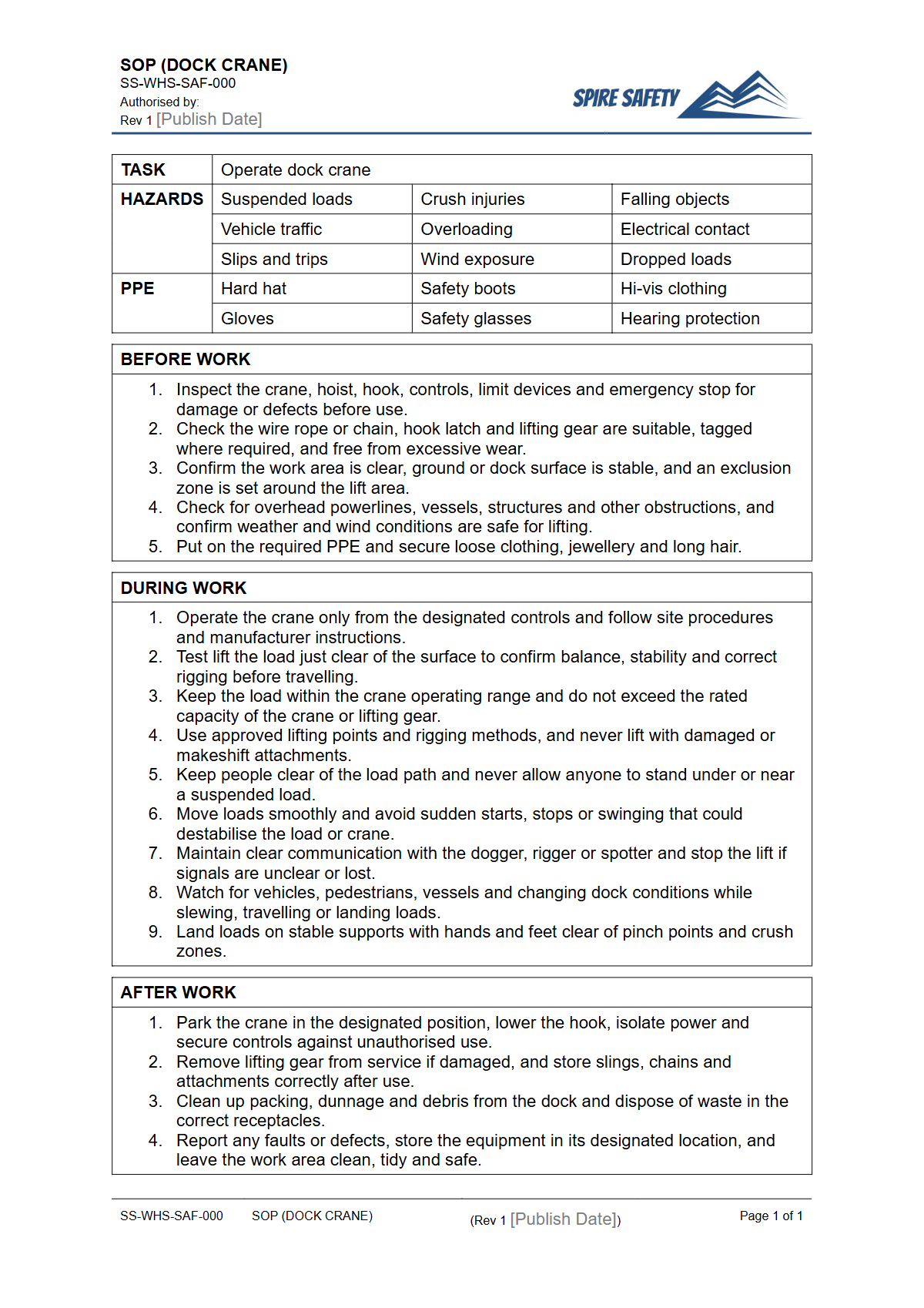
Operating a dock crane involves significant risks, including dropped loads, structural failure, and collisions. This free Safe Operating Procedure (Dock Crane) template provides a structured framework for documenting the required steps to perform this task safely.
Its purpose is to help your organisation standardise processes, control identified hazards, and provide a clear, consistent reference for workers. By implementing a detailed Safe Operating Procedure (SOP), you establish a benchmark for safe work performance and create a vital training tool for new and existing operators.
A well-defined SOP is a cornerstone of effective risk management. It formalises the pre-operational checks, load handling techniques, and shutdown procedures necessary to minimise the likelihood of incidents.
Integrating this procedure into your broader WHS management systems ensures that safety protocols are systematically applied, reviewed, and improved over time, contributing to a stronger safety culture across your port or terminal operations.
Video walkthrough
How to use the Free Safe Operating Procedure (Dock Crane) Template
This template is provided in both DOCX and PDF formats to suit your needs. The DOCX file is fully editable, allowing you to tailor the content to the specific models of dock cranes, lifting attachments, and environmental conditions at your workplace.
The PDF version is a read-only document, ideal for quick reference or distribution once your customised procedure is finalised.
To effectively use this resource:
- Download: Choose the DOCX format to begin customisation.
- Customise: This is the most critical step. We cannot stress this enough: you must consult with crane operators, riggers, and supervisors to adapt this template. Add details specific to your site, including crane load charts, unique hazards, signal person communication protocols, and emergency contacts.
- Review and Approve: Have a competent person, such as a WHS manager or senior leader, review and approve the final document.
- Train: Ensure all relevant workers are trained on the contents of the finalised SOP. Training records should be maintained as evidence of competency.
- Implement: Make the SOP readily accessible to all operators and associated personnel at the point of work.
The principles outlined can be applied to other high-risk plant. For example, if your site also uses mobile lifting equipment, you might find our FREE Telehandler SOP Template useful as a comparative guide for developing consistent documentation.
When should this Safe Operating Procedure be used?
A dock crane SOP is a critical document that should be referenced consistently. It is not just a form to be filed away. Use it:
- Before every operation: As a guide for pre-start inspections and operational planning.
- During worker training: As the primary training document for new or transitioning operators, riggers, and doggers.
- For incident investigations: To compare the established procedure against the actions that led to a near miss or incident.
- During safety reviews: As a basis for periodic reviews and continuous improvement of workplace safety practices. Regular reviews are essential for ensuring procedures remain relevant, a process often scrutinised during WHS compliance auditing.
By integrating the SOP into these key activities, you ensure it remains a living document that actively contributes to a safer working environment. The same approach should be taken for other critical tasks, such as managing materials moved by cranes; a FREE Conveyer System SOP can help formalise those adjacent processes.
Who should use this document?
This Safe Operating Procedure is intended for a range of personnel within an organisation that operates dock cranes. Key users include:
- Persons Conducting a Business or Undertaking (PCBUs): To meet their primary duty of care by providing and maintaining safe systems of work.
- Managers and Supervisors: To enforce safe work practices, conduct training, and oversee crane operations.
- WHS/HSE Professionals: To develop, implement, and review safety documentation as part of the overall safety management system.
- Crane Operators: As a direct reference guide for performing their duties safely and correctly.
- Riggers, Doggers, and Signal Persons: To understand their roles and responsibilities within the lifting operation.
Documenting procedures for all high-risk plant is crucial. Sites that use heavy earthmoving equipment for maintenance or construction should also formalise their procedures using resources like our FREE Dozer SOP Template to ensure comprehensive risk management.
For more guidance, explore our complete free WHS resources library to find templates for other plant and equipment.
Common mistakes
Common mistakes to avoid
- Using a generic SOP without customising it for specific crane models and site conditions.
- Failing to include detailed emergency and rescue procedures for potential scenarios.
- Not involving experienced operators and riggers in the development and review process.
- Forgetting to schedule and conduct regular reviews, rendering the document outdated.
Legal references
Legal considerations
The following legal requirements may be relevant to this type of work.
- Work Health and Safety Act (Harmonised) — Provides the primary duties for protecting workers and other people from work health and safety risks.
- Work Health and Safety Regulations (Harmonised) — Sets out requirements supporting the management of workplace hazards and risks.
The following codes may be relevant to this type of work.
- Managing WHS Risks Code of Practice — Provides practical guidance on identifying hazards, assessing risks and applying effective controls.
- Work Health and Safety Consultation, Cooperation and Coordination Code of Practice — Provides practical guidance on consulting workers and coordinating with other duty holders.
- Managing the Work Environment and Facilities Code of Practice — Provides practical guidance on safe work environments, workplace facilities and related controls.
Did you know
Crane Categories
Dock cranes, also known as portainer or container cranes, are a type of gantry crane. Their operation requires a High Risk Work Licence (HRWL) in Australia, specifically a 'bridge and gantry crane' (CB) class licence.
Leading Cause of Fatalities
According to Safe Work Australia, being hit by a moving or falling object is one of the leading causes of workplace fatalities. Properly executed lifting plans and SOPs are a primary control measure to prevent these incidents.
FAQ
Frequently asked questions
01What is a Safe Operating Procedure (SOP) for a dock crane?
02Is this dock crane SOP template enough for WHS compliance?
03How often should a dock crane SOP be reviewed?
04Who is responsible for training workers on the dock crane SOP?
Share this resource
Free Safe Operating Procedure (Dock Crane) Template
Browse Categories
How To Use It
- 1Download and open in Word or PDF.
- 2Replace the placeholders with your business details.
- 3Get it reviewed by a WHS specialist before rollout.
Need it customised?
Our WHS consultants can adapt this template to your site, run a gap analysis, or audit what you already have in place.
Book a Free Consultation WHS consulting servicesor call 1300 156 382
Related templates
- Free Safe Operating Procedure (Dock Fender Inspection) Template
- Free Safe Operating Procedure (Dock Ladder Inspection) Template
- Free Safe Operating Procedure (Dock Leveller) Template
- Free Safe Operating Procedure (Dock Line Handling) Template
- Free Safe Operating Procedure (Dockside Waste Cleanup) Template
- Free Safe Operating Procedure (Dog Park Cleaning) Template