
Free Safe Operating Procedure (Dock Line Handling) Template
Streamline your maritime safety with our free Safe Operating Procedure for dock line handling.
Free Safe Operating Procedure (Dock Line Handling) Template
DOCX • 126 KB + PDF
Updated Oct 2026
No signup required
Purpose of the Free Safe Operating Procedure (Dock Line Handling) Template
Handling dock lines and mooring ropes is a high-risk activity fundamental to maritime operations. This task exposes workers to significant hazards, including line snap-back, crushing, entanglement, and manual handling injuries.
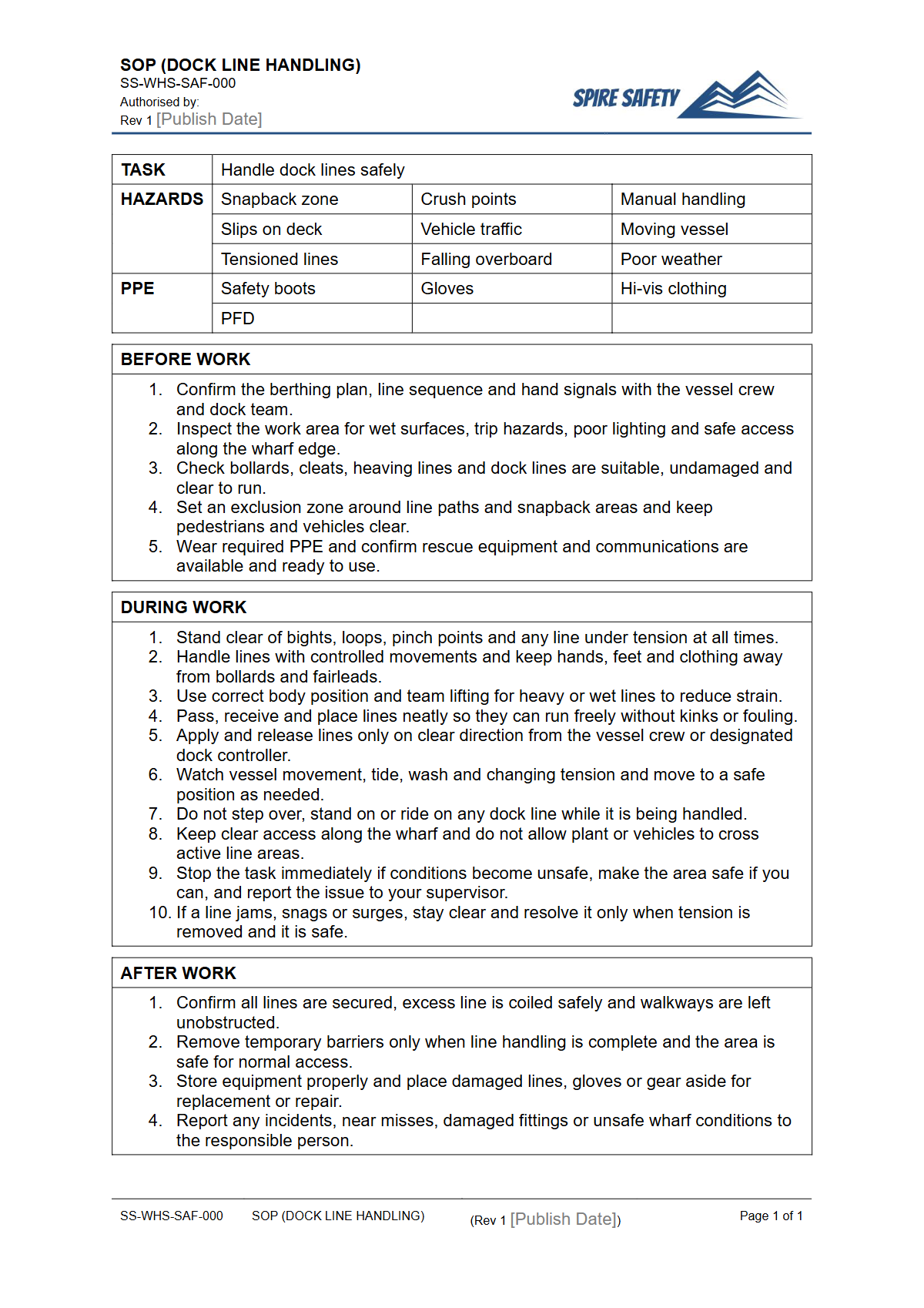
Our Free Safe Operating Procedure (Dock Line Handling) Template provides a structured framework for documenting the required steps to perform this task safely. By clearly defining procedures, equipment checks, and responsibilities, this SOP helps organisations meet their duty of care and reduce the risk of serious incidents.
A well-developed SOP is a critical element of effective WHS management systems, ensuring consistency and safety in all mooring operations.
Video walkthrough
How to use the Free Safe Operating Procedure (Dock Line Handling) Template
This template is available in both DOCX and PDF formats for your convenience. The DOCX file is fully editable, allowing you to tailor the content to the specific vessels, equipment, and environmental conditions at your workplace.
To use it effectively, consult with vessel masters, deckhands, and other relevant personnel to ensure the procedure reflects your actual on-the-ground practices. It is crucial to incorporate site-specific details, such as communication protocols, designated snap-back zones, and emergency response actions.
Once customised, consider engaging a third party for WHS compliance auditing to verify that your documented procedures are robust and effectively implemented.
Important: This document is a template and not a complete Safe Operating Procedure. We provide it as a starting point, and you must adapt it to the specific hazards and control measures relevant to your workplace.
Its effectiveness depends on its correct customisation, implementation, and ongoing review.
When to use this Safe Operating Procedure
A formal SOP for dock line handling should be used as a primary reference tool in several situations. It is essential for inducting new employees and for providing refresher training to experienced crew to ensure safe work habits are maintained.
It should also be referenced during pre-start meetings or toolbox talks before any mooring or unmooring operation begins. In the event of an incident or near-miss, the SOP serves as a benchmark for investigation and review.
Documenting procedures for all high-risk activities is a cornerstone of workplace safety; you may also need a FREE Conveyer System SOP (Safe Operating Procedure) Template for other machinery used in port operations.
Who should use it
This Safe Operating Procedure is intended for use by a range of personnel within a maritime or port environment. Persons Conducting a Business or Undertaking (PCBUs), such as port operators or shipping companies, are responsible for ensuring safe systems of work are in place.
WHS Managers and Supervisors will use this template to develop, implement, and review safety protocols. Vessel Masters, Officers, and Dock Foremen are responsible for enforcing the procedure on a day-to-day basis.
Finally, Deckhands, Linesmen, and all workers directly involved in handling the lines must be trained in and follow the SOP to protect their own health and safety and that of their colleagues. If your organisation needs assistance defining these roles and responsibilities, our WHS consulting services can provide expert guidance.
Key Elements of a Dock Line Handling SOP
A comprehensive SOP for this task should cover several critical areas to be effective. It must start with a risk assessment that identifies all potential hazards.
The procedure should then detail step-by-step instructions for pre-use equipment checks, handling techniques for different types of lines, and clear communication methods between the ship and shore. It must also explicitly define no-go areas, such as snap-back zones and the bight of the line.
Finally, the SOP should outline the required Personal Protective Equipment (PPE) and the emergency procedures to follow in case of equipment failure or injury. Documenting procedures for all key equipment, including maintenance tools, is vital; for example, you may also require a Free Air Compressor SOP (Safe Operating Procedure) Template for your workshop.
Continuous Review and Improvement
A Safe Operating Procedure is a living document that requires periodic review to remain effective. It should be assessed at least annually, or more frequently if there are changes to equipment, personnel, or operating conditions.
Feedback from the workers who use the procedure every day is invaluable for making practical improvements. This commitment to continuous improvement helps foster a proactive safety culture where risks are managed before they can cause harm. For more tools to build your safety system, explore our complete free WHS resources library.
Common mistakes
Common mistakes to avoid
- Failing to conduct pre-use inspections of mooring lines, winches, and bollards for wear or damage.
- Standing within the 'bight' (a loop or slack part) of a line or in identified snap-back zones.
- Using poor handling techniques, such as wrapping a line around a hand or back to gain leverage.
- Inadequate communication between vessel and shore personnel during mooring and unmooring.
Legal references
Legal considerations
The following legal requirements may be relevant to this type of work.
- Work Health and Safety Act (Harmonised) — Provides the primary duties for protecting workers and other people from work health and safety risks.
- Work Health and Safety Regulations (Harmonised) — Sets out requirements supporting the management of workplace hazards and risks.
The following codes may be relevant to this type of work.
- Managing WHS Risks Code of Practice — Provides practical guidance on identifying hazards, assessing risks and applying effective controls.
- Work Health and Safety Consultation, Cooperation and Coordination Code of Practice — Provides practical guidance on consulting workers and coordinating with other duty holders.
- Managing the Work Environment and Facilities Code of Practice — Provides practical guidance on safe work environments, workplace facilities and related controls.
Did you know
Snap-Back Speed
A synthetic mooring line that fails under tension can snap back at speeds exceeding 700 km/h, releasing immense energy similar to an explosion.
Line of Fire
The area a mooring line might travel through if it breaks is known as the 'snap-back zone'. Standing in this zone is one of the most dangerous actions during mooring operations.
FAQ
Frequently asked questions
01What are the primary hazards associated with dock line handling?
02Is an SOP legally required for handling mooring lines in Australia?
03How often should our Dock Line Handling Safe Operating Procedure be reviewed?
04What PPE should be specified in a dock line handling SOP?
Share this resource
Free Safe Operating Procedure (Dock Line Handling) Template
Browse Categories
How To Use It
- 1Download and open in Word or PDF.
- 2Replace the placeholders with your business details.
- 3Get it reviewed by a WHS specialist before rollout.
Need it customised?
Our WHS consultants can adapt this template to your site, run a gap analysis, or audit what you already have in place.
Book a Free Consultation WHS consulting servicesor call 1300 156 382
Related templates
- Free Safe Operating Procedure (Dockside Waste Cleanup) Template
- Free Safe Operating Procedure (Dog Park Cleaning) Template
- Free Safe Operating Procedure (Door Alarm Testing) Template
- Free Safe Operating Procedure (Door Closer Adjustment) Template
- Free Safe Operating Procedure (Door Glass Cleaning) Template
- Free Safe Operating Procedure (Door Hinge Lubrication) Template