
Free Safe Operating Procedure (Door Hinge Lubrication) Template
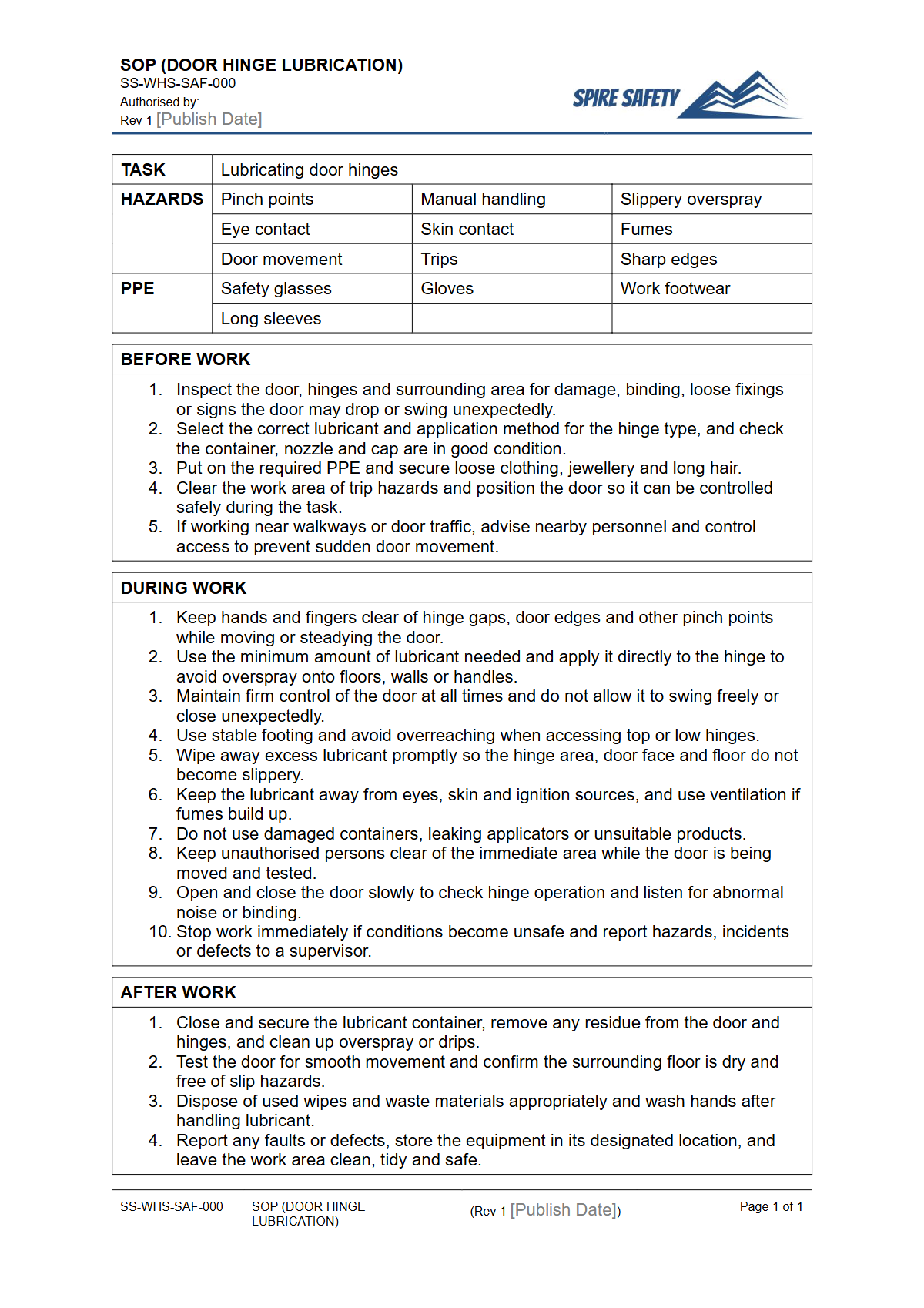
Download our free Safe Operating Procedure for door hinge lubrication. This template provides a solid foundation for your workplace safety documentation.
Free Safe Operating Procedure (Door Hinge Lubrication) Template
DOCX • 126 KB + PDF
Updated Oct 2026
No signup required
Purpose of the Free Safe Operating Procedure (Door Hinge Lubrication) Template
Even seemingly minor maintenance tasks carry inherent risks. This Free Safe Operating Procedure (Door Hinge Lubrication) Template provides a structured framework to ensure this common task is performed safely and consistently across your organisation.
An SOP formalises the process, helping to control hazards such as pinch points from the door mechanism, skin or eye exposure to lubricants, and slip risks from spills. By documenting the required steps, personal protective equipment (PPE), and safety controls, you create a clear, auditable record of your safe system of work.
Implementing a formal SOP helps standardise worker behaviour, simplifies training, and demonstrates a commitment to proactive safety management. It transforms an ad-hoc task into a controlled process, which is a fundamental principle of effective workplace health and safety.
Similar to how specific procedures are vital for operating machinery, as outlined in our free Air Compressor SOP template, applying the same diligence to maintenance tasks reduces the likelihood of injury.
Video walkthrough
How to use the Free Safe Operating Procedure (Door Hinge Lubrication) Template
This template is a starting point designed for easy customisation. After downloading the DOCX or PDF file, you must adapt it to reflect the specific circumstances of your workplace.
A generic procedure is not sufficient; it must account for your unique environment, equipment, and the specific products you use. Integrating customised SOPs is a key component of building effective WHS management systems.
Follow these steps to implement the SOP:
- Consult your team: Involve the workers who perform the task. Their direct experience is invaluable for identifying practical hazards and effective controls.
- Identify specifics: Document the types of doors and hinges, the exact lubricants used (and reference their Safety Data Sheets), and the tools required.
- Define PPE: Specify the mandatory PPE, such as safety glasses and chemical-resistant gloves, based on a risk assessment of the lubricants and task.
- Review and approve: Have a competent person, such as a manager or WHS representative, review and approve the final document before it is issued.
Important: We have developed this document as a guide. It is the responsibility of the Person Conducting a Business or Undertaking (PCBU) to ensure that all procedures are tailored to the specific risks of your site.
We encourage you to adapt this template thoroughly to create a site-specific and effective Safe Operating Procedure.
What is in the Door Hinge Lubrication SOP?
Our template prompts you to detail all critical safety components of the task. It includes sections for identifying high-risk activities, pre-operational checks, step-by-step instructions for safely performing the lubrication, and post-task cleanup.
It also contains fields for listing required PPE, potential hazards, and emergency procedures, ensuring a comprehensive approach aligned with Australian WHS principles.
When to Use This Safe Operating Procedure
A Safe Operating Procedure for door hinge lubrication should be used as a central part of your maintenance and safety program. It serves as a primary training document for new employees or for workers assigned the task for the first time.
It should also be readily accessible in the work area for reference at any time.
Furthermore, the SOP is a critical tool during safety audits and reviews. Regular internal WHS compliance auditing should verify that the documented procedure is being followed correctly in practice.
It should be reviewed and updated after any incident, when new types of lubricants are introduced, or as part of a scheduled periodic review to ensure it remains current and effective.
Who Should Use This Safe Operating Procedure
This SOP is intended for use by several key roles within a business. Maintenance personnel and facilities staff are the primary end-users, as it guides their actions while performing the task.
Supervisors and team leaders should use it to induct new staff, conduct toolbox talks, and monitor safe work practices. WHS managers and officers will use the SOP as part of the overall risk management framework, ensuring that controls for identified hazards are documented and implemented.
For organisations without dedicated safety personnel, a business owner or manager takes on this responsibility. If you need assistance formalising your procedures and defining roles, consider engaging external WHS consulting support to ensure your systems are robust. Just as you would for more complex equipment covered in resources like our free Circular Saw SOP, establishing clear procedures for all tasks is essential for maintaining a safe workplace. You can find more templates like this one in our comprehensive free WHS resources library.
Common mistakes
Common mistakes to avoid
- Using the wrong type of lubricant for the hinge material or its environment (e.g., indoor vs. outdoor).
- Failing to clean dirt and old grease from the hinge before applying new lubricant, which reduces its effectiveness.
- Not using appropriate PPE, such as gloves or safety glasses, when handling chemical lubricants.
- Neglecting to clean up any drips or spills immediately, creating a serious slip and fall hazard.
Legal references
Legal considerations
The following legal requirements may be relevant to this type of work.
- Work Health and Safety Act (Harmonised) — Provides the primary duties for protecting workers and other people from work health and safety risks.
- Work Health and Safety Regulations (Harmonised) — Sets out requirements supporting the management of workplace hazards and risks.
The following codes may be relevant to this type of work.
- Managing WHS Risks Code of Practice — Provides practical guidance on identifying hazards, assessing risks and applying effective controls.
- Work Health and Safety Consultation, Cooperation and Coordination Code of Practice — Provides practical guidance on consulting workers and coordinating with other duty holders.
- Managing the Work Environment and Facilities Code of Practice — Provides practical guidance on safe work environments, workplace facilities and related controls.
Did you know
Squeak Prevention
Regular lubrication not only silences annoying squeaks but also prevents wear and tear from metal-on-metal friction, significantly extending the life of the hinge and preventing premature failure.
Lubricant Choice Matters
The type of lubricant is critical. Graphite or silicone-based sprays are great for indoor hinges, while a thicker white lithium grease is often better for outdoor hinges exposed to weather.
FAQ
Frequently asked questions
01What should be included in a Safe Operating Procedure for door hinge lubrication?
02Is this template suitable for all types of lubricants?
03Why is an SOP necessary for a simple task like lubricating a door hinge?
04How often should we review this SOP?
Share this resource
Free Safe Operating Procedure (Door Hinge Lubrication) Template
Browse Categories
How To Use It
- 1Download and open in Word or PDF.
- 2Replace the placeholders with your business details.
- 3Get it reviewed by a WHS specialist before rollout.
Need it customised?
Our WHS consultants can adapt this template to your site, run a gap analysis, or audit what you already have in place.
Book a Free Consultation WHS consulting servicesor call 1300 156 382
Related templates
- Free Safe Operating Procedure (Door Seal Cleaning) Template
- Free Safe Operating Procedure (Door Track Cleaning) Template
- Free Safe Operating Procedure (Dough Divider) Template
- Free Safe Operating Procedure (Dough Mixer) Template
- Free Safe Operating Procedure (Dough Moulder) Template
- Free Safe Operating Procedure (Dough Rounder) Template