
Free Safe Operating Procedure (Door Track Cleaning) Template
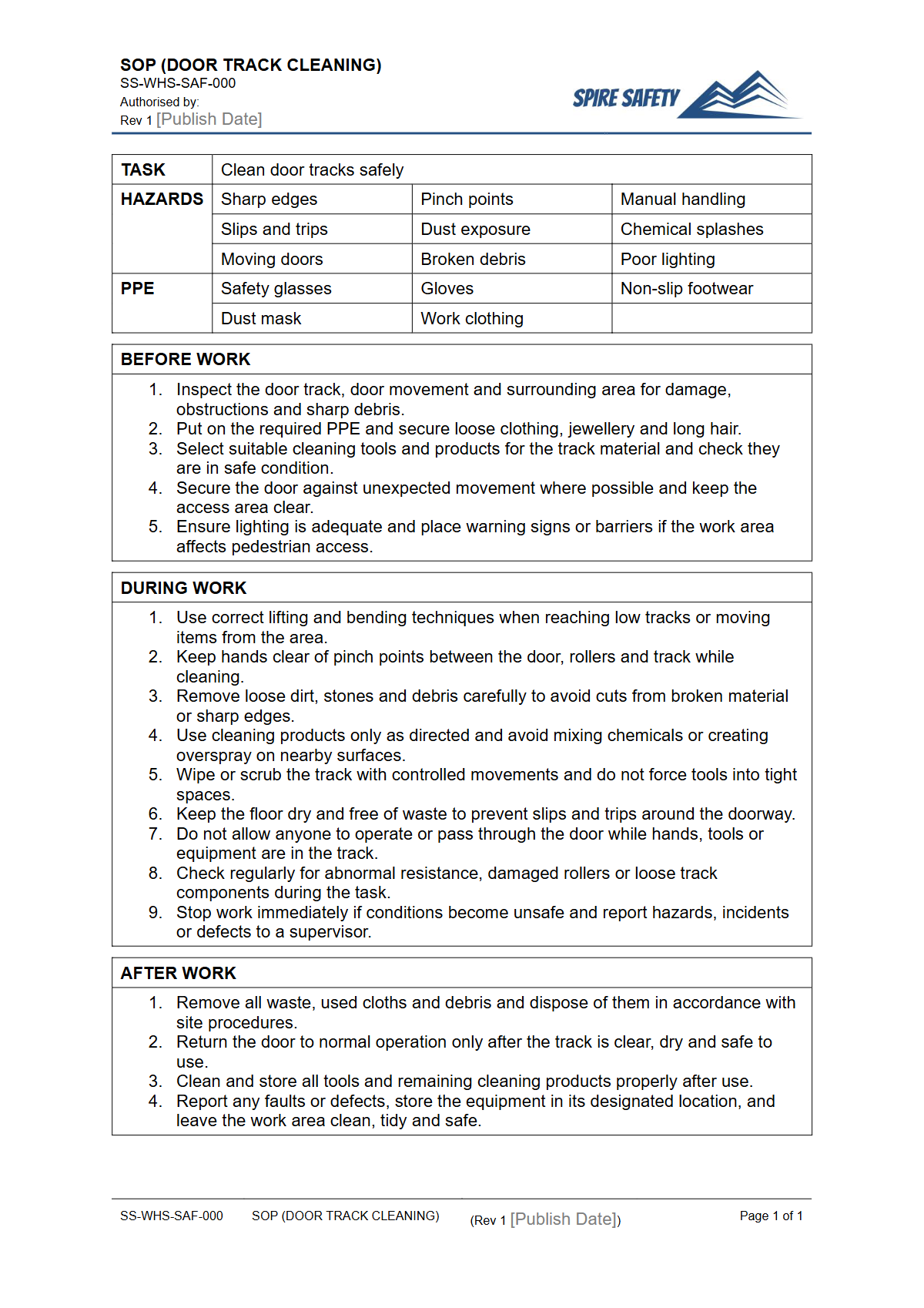
Download our free Safe Operating Procedure (Door Track Cleaning) Template. This structured document helps you outline risks and controls for the task.
Free Safe Operating Procedure (Door Track Cleaning) Template
DOCX • 126 KB + PDF
Updated Oct 2026
No signup required
Purpose of the Free Safe Operating Procedure (Door Track Cleaning) Template
This Free Safe Operating Procedure (Door Track Cleaning) Template provides a structured starting point for documenting a safe system of work for maintaining industrial, commercial, or residential door tracks. A documented SOP offers clear, step-by-step instructions to guide workers, ensuring the task is performed consistently and safely every time.
It is a fundamental tool for managing risks associated with cleaning tasks, which can include slips from cleaning solutions, manual handling injuries from awkward postures, exposure to hazardous chemicals, and interaction with moving parts or other vehicles.
By formally identifying hazards and outlining specific control measures, this Safe Operating Procedure helps a Person Conducting a Business or Undertaking (PCBU) meet their primary duty of care. An effective SOP is a cornerstone of robust WHS management systems, demonstrating a commitment to proactive safety management rather than reactive responses to incidents.
It helps standardise training and provides a clear benchmark for performance and supervision.
In busy industrial settings like warehouses or workshops, cleaning door tracks can also introduce risks from other site traffic. The procedure must account for the interaction with mobile plant, a risk management principle also critical when developing a safe operating procedure for a telehandler, where awareness of people and surroundings is paramount.
This template prompts you to consider these broader environmental hazards beyond the immediate task.
Video walkthrough
How to use the Free Safe Operating Procedure (Door Track Cleaning) Template
Our Free Safe Operating Procedure (Door Track Cleaning) Template is available in both DOCX and PDF formats. The DOCX file is fully editable, allowing you to tailor it to your specific operational needs.
The PDF version is useful for easy distribution and printing once your procedure is finalised. It's crucial to remember that this document is a template, not a finished product.
For it to be effective, it must be adapted to your unique work environment.
Note: We have developed this resource to align with Australian WHS standards and practices. However, you must customise it to reflect the specific equipment (e.g., roller doors, sectional doors), cleaning agents, tools, environment, and personnel at your workplace.
We are not liable for any incidents that may arise from the use of this template.
To implement it correctly, follow these steps:
- Download the DOCX template.
- Consult with workers and supervisors who perform or oversee the door track cleaning task.
- Conduct a risk assessment to identify all potential hazards specific to your site.
- Detail the step-by-step procedure, including pre-operational checks, cleaning methods, and post-task cleanup.
- Specify the required Personal Protective Equipment (PPE), such as gloves, safety glasses, or non-slip footwear.
- Incorporate details from the Safety Data Sheets (SDS) for any chemicals used.
- Have the final SOP reviewed and approved by a competent person.
- Train all relevant workers on the finalised SOP and keep records of their training.
When detailing the tools used for cleaning, you may need separate procedures for them. For instance, if using compressed air to clear debris, it is vital to have a procedure that governs the safe use of the equipment itself, similar in principle to our Free Air Compressor SOP (Safe Operating Procedure) Template.
When to use a Safe Operating Procedure
An SOP for door track cleaning should be developed and implemented before any worker undertakes the task. It serves as a primary training document for new employees or those new to the task.
It should also be readily available in the work area as a reference guide for all workers.
Furthermore, the SOP is a critical document to review during incident investigations or after a near miss to identify if the procedure was followed and if it needs improvement. Regular reviews are also essential for maintaining relevance, especially when equipment is updated, new cleaning products are introduced, or work processes change.
These reviews can form part of your routine WHS compliance auditing schedule to ensure continuous improvement.
Who should use this Safe Operating Procedure
This SOP should be used by several key groups within an organisation:
- Persons Conducting a Business or Undertaking (PCBUs): To help fulfil their legal obligation to provide a safe work environment and safe systems of work.
- Managers and Supervisors: To train workers, enforce safe work practices, and monitor compliance with the documented procedure.
- Workers: As a clear guide on how to perform the door track cleaning task safely, understand the associated risks, and use the correct controls and PPE.
- WHS Representatives and Committees: As part of consultation and review processes to ensure risks are being managed effectively.
A specific SOP is a vital training tool for workers performing any designated task. Whether they are cleaning door tracks, operating fixed machinery as detailed in our FREE Conveyer System SOP (Safe Operating Procedure) Template, or performing other maintenance duties, a clear, documented procedure is proven to reduce risk. You can explore more procedural templates in our free WHS resources library.
Common mistakes
Common mistakes to avoid
- Using a generic template without customising it for site-specific hazards and equipment.
- Failing to consult with the workers who actually perform the cleaning task during its development.
- Neglecting to provide specific training on the finalised SOP to all relevant personnel.
- Not referencing Safety Data Sheets (SDS) for the correct use, storage, and first aid for cleaning chemicals.
Legal references
Legal considerations
The following legal requirements may be relevant to this type of work.
- Work Health and Safety Act (Harmonised) — Provides the primary duties for protecting workers and other people from work health and safety risks.
- Work Health and Safety Regulations (Harmonised) — Sets out requirements supporting the management of workplace hazards and risks.
The following codes may be relevant to this type of work.
- Managing WHS Risks Code of Practice — Provides practical guidance on identifying hazards, assessing risks and applying effective controls.
- Work Health and Safety Consultation, Cooperation and Coordination Code of Practice — Provides practical guidance on consulting workers and coordinating with other duty holders.
- Managing the Work Environment and Facilities Code of Practice — Provides practical guidance on safe work environments, workplace facilities and related controls.
Did you know
Slips, Trips, and Falls
According to Safe Work Australia, slips, trips, and falls are a leading cause of workplace injuries, often resulting from contaminated or wet floor surfaces—a common hazard during cleaning tasks.
FAQ
Frequently asked questions
01Is a Safe Operating Procedure legally required for cleaning door tracks?
02What are the main hazards of door track cleaning?
03How often should we review our door track cleaning SOP?
04Can I use this template for any type of door?
Share this resource
Free Safe Operating Procedure (Door Track Cleaning) Template
Browse Categories
How To Use It
- 1Download and open in Word or PDF.
- 2Replace the placeholders with your business details.
- 3Get it reviewed by a WHS specialist before rollout.
Need it customised?
Our WHS consultants can adapt this template to your site, run a gap analysis, or audit what you already have in place.
Book a Free Consultation WHS consulting servicesor call 1300 156 382
Related templates
- Free Safe Operating Procedure (Dough Divider) Template
- Free Safe Operating Procedure (Dough Mixer) Template
- Free Safe Operating Procedure (Dough Moulder) Template
- Free Safe Operating Procedure (Dough Rounder) Template
- Free Safe Operating Procedure (Dough Sheeter) Template
- Free Safe Operating Procedure (Dough Tray Handling) Template