
Free Safe Operating Procedure (Dough Rounder) Template
Download our free Dough Rounder Safe Operating Procedure template to standardise safe work practices. Get your DOCX and PDF copy to get started today.
Free Safe Operating Procedure (Dough Rounder) Template
DOCX • 126 KB + PDF
Updated Oct 2026
No signup required
Purpose of the Free Safe Operating Procedure (Dough Rounder) Template
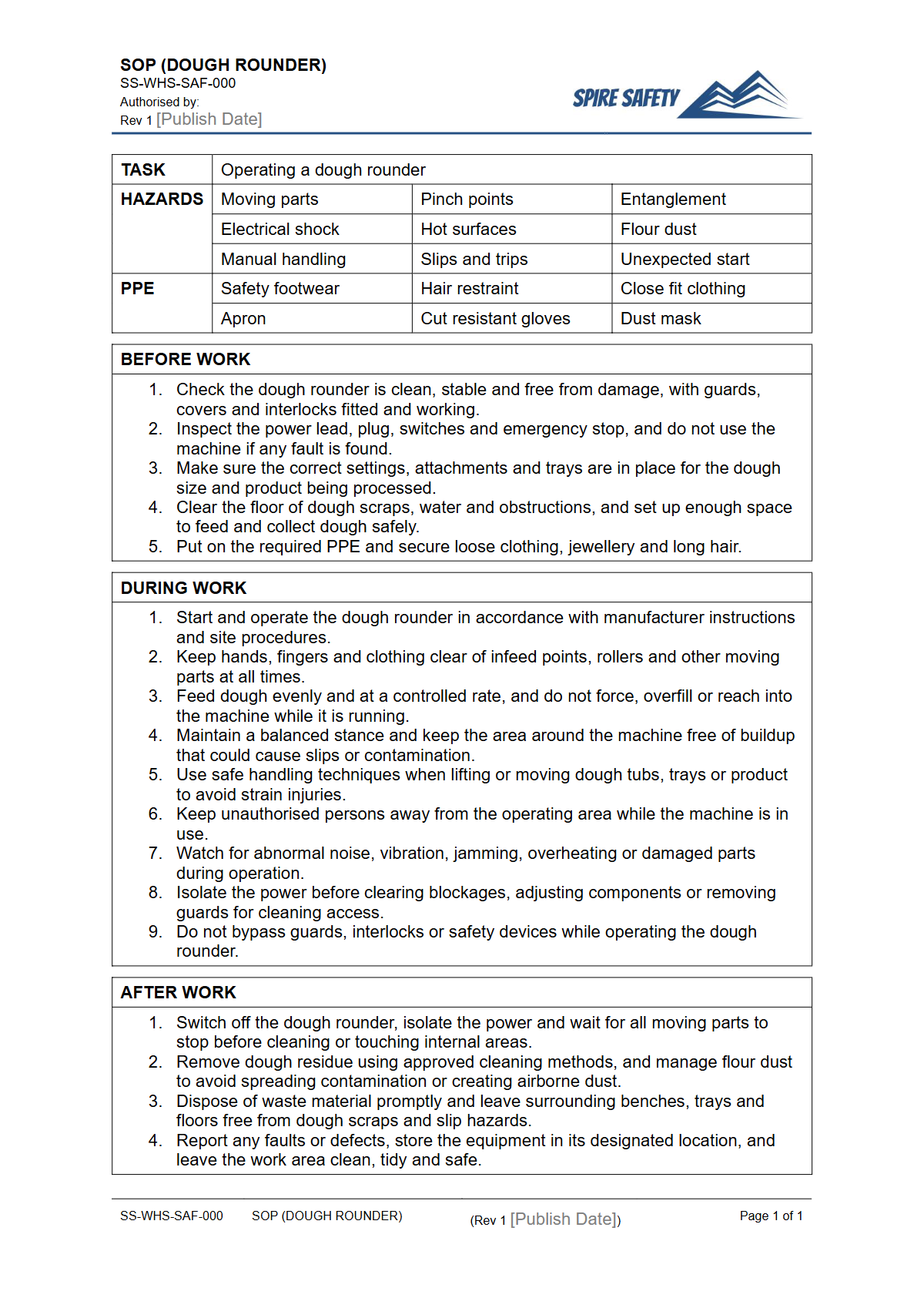
Operating a dough rounder, like any specialised food processing machinery, introduces specific risks into the workplace. This free Safe Operating Procedure (Dough Rounder) Template provides a structured framework for documenting the safest way to perform this task.
An SOP is a fundamental administrative control that helps your organisation meet its duty of care under Australian WHS laws by clearly outlining step-by-step instructions for workers. It aims to prevent injuries such as entanglement in moving parts, crushing, and ergonomic strains from manual handling.
By implementing a clear SOP, you standardise the correct, safe method for all operators, which is crucial for training new staff, ensuring consistency, and reducing the likelihood of incidents. This document serves as a vital component of your overall safety management system, demonstrating a proactive approach to risk management in a commercial kitchen or bakery environment.
It covers key stages including pre-operational checks, operation, cleaning, and maintenance, ensuring all aspects of the machine's lifecycle are considered.
Video walkthrough
How to use the Free Safe Operating Procedure (Dough Rounder) Template
This document is a template, not a finished product. To use it effectively, you must adapt it to the specific context of your workplace.
Start by downloading the DOCX file and reviewing it with the supervisors and experienced operators who use the dough rounder daily. Their input is invaluable for ensuring the procedure is practical and reflects the real-world application and environment of your business.
This consultative process is a key principle of effective workplace safety.
Key Customisation Steps
Your customisation should focus on several key areas. First, identify the exact make and model of your dough rounder and insert its specific details, including the location and function of all safety guards, interlocks, and emergency stop buttons.
Detail the specific types of personal protective equipment (PPE) required, such as non-slip footwear or hair nets, based on your own WHS compliance auditing and risk assessments.
Outline your site-specific lockout/tagout procedures for cleaning and maintenance to prevent unexpected start-up. Finally, review and approve the document internally before training all relevant workers.
Remember to schedule regular reviews to keep the SOP current.
Important: We have provided a comprehensive starting point based on established safety principles, but we cannot know the specific hazards of your individual workplace. You must customise this template with your own site-specific details, equipment models, and processes to ensure it is effective and suitable for your organisation.
When to use a Dough Rounder SOP
A Safe Operating Procedure for a dough rounder should be a living document integrated into your daily operations. Its primary use is as a direct reference for workers before and during the operation of the equipment to reinforce safe work habits.
It is an essential tool during the induction and training of new employees, providing a clear, authoritative guide to follow.
The SOP should also be consulted during routine safety inspections and observations. In the unfortunate event of a near miss or incident involving the dough rounder, the SOP becomes a critical document for the investigation process to determine if procedures were followed and whether they need to be improved.
Integrating SOPs into your broader WHS management systems ensures they are used consistently for training, auditing, and continuous improvement.
Who should use it
This Safe Operating Procedure is intended for use by several groups within a food production or hospitality business. Primarily, it is for the operators—the kitchen hands, bakers, or production staff who physically use the dough rounder each day.
It provides them with the knowledge to perform their job safely. Supervisors and managers must also use the SOP to train their teams, monitor for correct application, and enforce safe work standards.
WHS Officers or Safety Managers will use the SOP as evidence of a control measure during risk assessments and audits. They are also typically responsible for managing the review and update process.
For many food businesses, related equipment like mixers and conveyors also require documented procedures; you can use resources like our conveyer system SOP as a starting point for those assets.
Finally, maintenance personnel should refer to the SOP, particularly the sections on isolation, de-energisation, and cleaning, before commencing any servicing work. In some facilities, maintenance teams may also require procedures for other plant, such as an air compressor SOP, to ensure safety across all site equipment.
This template, along with many others for different types of plant and equipment, can be found in our free WHS resources library. If your facility has a maintenance workshop, ensuring procedures are in place for common tools is also important, and a circular saw SOP can help manage risks associated with those tasks.
Common mistakes
Common mistakes to avoid
- Using the template 'as-is' without customising it for the specific make and model of the dough rounder.
- Failing to train all operators on the contents of the SOP and verify their understanding before they use the machine.
- Not making the SOP easily accessible to workers at or near the equipment.
- Forgetting to review and update the SOP after a near miss, incident, or change in process.
Legal references
Legal considerations
The following legal requirements may be relevant to this type of work.
- Work Health and Safety Act (Harmonised) — Provides the primary duties for protecting workers and other people from work health and safety risks.
- Work Health and Safety Regulations (Harmonised) — Sets out requirements supporting the management of workplace hazards and risks.
The following codes may be relevant to this type of work.
- Managing WHS Risks Code of Practice — Provides practical guidance on identifying hazards, assessing risks and applying effective controls.
- Work Health and Safety Consultation, Cooperation and Coordination Code of Practice — Provides practical guidance on consulting workers and coordinating with other duty holders.
- Managing the Work Environment and Facilities Code of Practice — Provides practical guidance on safe work environments, workplace facilities and related controls.
Did you know
Machine Guarding
Inadequate machine guarding is one of the most frequently identified safety breaches in manufacturing and food processing environments, often leading to serious and preventable injuries.
Ergonomic Risks
Repetitive tasks in bakeries are a leading cause of musculoskeletal disorders. A well-designed SOP can help standardise workflows to minimise awkward postures and strenuous movements.
FAQ
Frequently asked questions
01What are the main hazards associated with using a dough rounder?
02Is a Safe Operating Procedure a legal requirement in Australia?
03How often should I review my dough rounder SOP?
04Can I use this template for my dough sheeter or mixer?
Share this resource
Free Safe Operating Procedure (Dough Rounder) Template
Browse Categories
How To Use It
- 1Download and open in Word or PDF.
- 2Replace the placeholders with your business details.
- 3Get it reviewed by a WHS specialist before rollout.
Need it customised?
Our WHS consultants can adapt this template to your site, run a gap analysis, or audit what you already have in place.
Book a Free Consultation WHS consulting servicesor call 1300 156 382
Related templates
- Free Safe Operating Procedure (Dough Sheeter) Template
- Free Safe Operating Procedure (Dough Tray Handling) Template
- Free Safe Operating Procedure (Drain Cleaning Machine) Template
- Free Safe Operating Procedure (Drain Grate Cleaning) Template
- Free Safe Operating Procedure (Drain Inlet Cleaning) Template
- Free Safe Operating Procedure (Drain Outfall Check) Template