
Free Safe Operating Procedure (Drain Grate Cleaning) Template
Effectively manage the risks of manual handling and hazardous substances with our free drain grate cleaning template. Download this structured starting point.
Free Safe Operating Procedure (Drain Grate Cleaning) Template
DOCX • 126 KB + PDF
Updated Oct 2026
No signup required
Purpose of the Free Safe Operating Procedure (Drain Grate Cleaning) Template
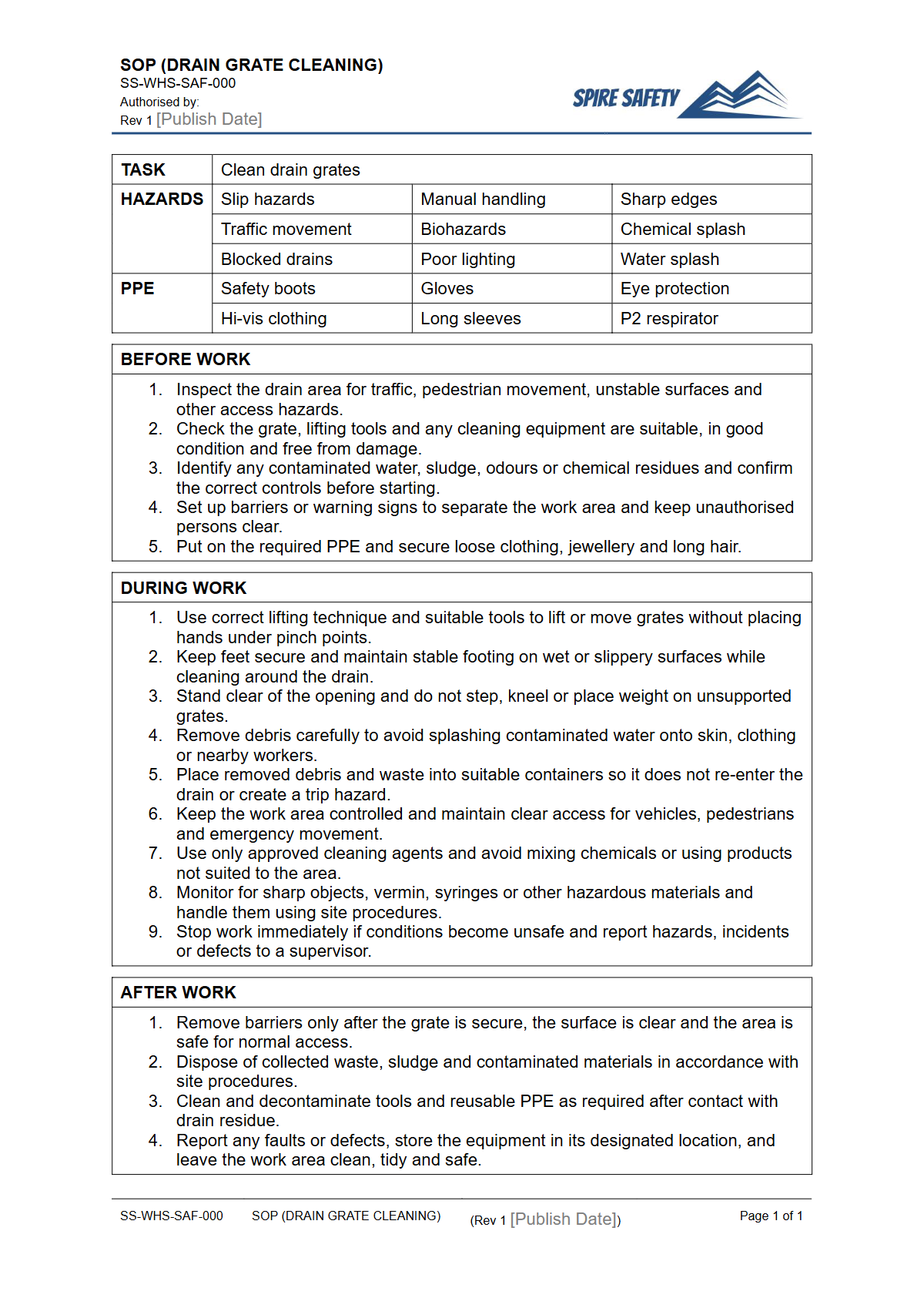
This Free Safe Operating Procedure (Drain Grate Cleaning) Template provides a structured framework for documenting the steps required to clean drain grates safely and efficiently. The task, while seemingly simple, involves significant hazards including manual handling risks from heavy grates, exposure to biological or chemical contaminants, slips, trips, and falls, and potential interaction with traffic.
Using a formal SOP helps organisations control these risks by ensuring a consistent and safe method is followed every time. It serves as a vital training tool for workers and a key piece of evidence demonstrating how your business manages its WHS obligations.
A well-drafted Safe Operating Procedure is a fundamental component of proactive safety management. It formalises risk controls identified during a risk assessment process and integrates them into day-to-day operations.
This template helps you clearly define required personal protective equipment (PPE), pre-operational checks, the step-by-step cleaning process, and post-task clean-up. Integrating SOPs like this one into your broader safety framework strengthens your operational discipline and helps build a positive safety culture.
These procedures are essential elements within comprehensive WHS management systems, providing auditable proof of your commitment to worker safety.
Video walkthrough
How to use the Free Safe Operating Procedure (Drain Grate Cleaning) Template
This DOCX and PDF template is designed as a starting point. It is not a finished, universally applicable document.
To use it effectively, you must conduct a specific risk assessment for the drain cleaning tasks at your own site. Identify the unique hazards associated with your grates (e.g., weight, hinge mechanism), location (e.g., public footpath, factory floor), and the types of debris or substances likely to be present.
You should then customise the template by adding, removing, or modifying sections to reflect these site-specific findings and your chosen control measures.
Important: We have populated this document with common steps and general safety advice, but every workplace is different. You must ensure the final SOP accurately reflects your equipment, environment, and the specific types of drains being cleaned.
Involve the workers who actually perform the task in the customisation process; their practical experience is invaluable for creating a procedure that is both safe and workable. Once finalised, ensure all relevant workers are trained on the SOP and that their understanding is verified before they begin work.
When to use this Safe Operating Procedure
A Safe Operating Procedure for drain grate cleaning should be used whenever a worker is required to manually lift, move, or clean debris from stormwater or industrial drainage grates. This applies across various industries, including facility management, civil construction, local government works, landscaping, and manufacturing.
It is particularly important for routine maintenance schedules and for non-routine clean-ups after events like storms or industrial spills. Using an SOP ensures that even infrequent tasks are performed with the same level of safety diligence as daily ones.
This procedure should also be reviewed and referenced during incident investigations, site safety inspections, and worker training sessions. If your operations involve other groundwork tasks, you might also find our FREE Trencher SOP Template useful for standardising related procedures.
Establishing clear written procedures for all high-risk tasks helps maintain consistent safety standards across your entire operation.
Who should use this Safe Operating Procedure
This template is intended for use by Persons Conducting a Business or Undertaking (PCBUs), WHS managers, supervisors, and team leaders. These individuals are responsible for ensuring safe systems of work are developed, implemented, and monitored.
They will use the template to create a site-specific document that directs workers on how to perform the task safely. The final, customised SOP is for the workers and operators who carry out the drain cleaning.
They must be trained in its contents and are expected to follow the prescribed steps to protect their health and safety and that of others.
For organisations looking to standardise procedures for various types of equipment, this template can be used alongside others like our FREE Air Compressor SOP Template. Periodically, the effectiveness of your SOPs should be evaluated. This can be done through direct observation, worker consultation, and as part of a formal audit process.
Engaging a professional for independent WHS compliance auditing can provide valuable external perspective on the robustness of your safety documentation.
Review and Improvement
Safe Operating Procedures are living documents. They should be reviewed regularly—typically annually, or whenever there is a change in the workplace.
This includes the introduction of new equipment, changes to the work environment, or after an incident or near miss occurs. Regular reviews ensure the SOP remains relevant and effective at controlling risks. If you need help developing or reviewing your safety documentation to ensure it aligns with current best practice, consider engaging specialist WHS consulting support.
Feel free to browse our full free WHS resources library for more templates and checklists to support your safety management system.
Common mistakes
Common mistakes to avoid
- Using poor manual handling techniques, such as twisting the back while lifting a heavy grate.
- Failing to properly barricade the work area from pedestrian or vehicle traffic.
- Using improper tools (e.g., a screwdriver instead of a proper grate lifter), leading to slips and injuries.
- Neglecting to check for hazardous atmospheres or substances before clearing a blockage.
Legal references
Legal considerations
The following legal requirements may be relevant to this type of work.
- Work Health and Safety Act (Harmonised) — Provides the primary duties for protecting workers and other people from work health and safety risks.
- Work Health and Safety Regulations (Harmonised) — Sets out requirements supporting the management of workplace hazards and risks.
The following codes may be relevant to this type of work.
- Managing WHS Risks Code of Practice — Provides practical guidance on identifying hazards, assessing risks and applying effective controls.
- Work Health and Safety Consultation, Cooperation and Coordination Code of Practice — Provides practical guidance on consulting workers and coordinating with other duty holders.
- Managing the Work Environment and Facilities Code of Practice — Provides practical guidance on safe work environments, workplace facilities and related controls.
Did you know
A Heavy Burden
A standard cast iron gully grate (600x450mm) can weigh over 40kg. Lifting this weight incorrectly, especially from an awkward posture, places workers at significant risk of a serious musculoskeletal injury.
Hidden Dangers
Debris in drains isn't just leaves and dirt. It can contain sharp objects, hazardous chemicals, bacteria like Leptospirosis from animal urine, and other biological waste, making appropriate PPE essential.
FAQ
Frequently asked questions
01What are the main hazards when cleaning drain grates?
02What PPE is required for drain grate cleaning?
03How often should a Safe Operating Procedure be reviewed?
04Can a generic SOP be used for all drain cleaning tasks?
Share this resource
Free Safe Operating Procedure (Drain Grate Cleaning) Template
Browse Categories
How To Use It
- 1Download and open in Word or PDF.
- 2Replace the placeholders with your business details.
- 3Get it reviewed by a WHS specialist before rollout.
Need it customised?
Our WHS consultants can adapt this template to your site, run a gap analysis, or audit what you already have in place.
Book a Free Consultation WHS consulting servicesor call 1300 156 382
Related templates
- Free Safe Operating Procedure (Drain Inlet Cleaning) Template
- Free Safe Operating Procedure (Drain Outfall Check) Template
- Free Safe Operating Procedure (Drain Sediment Removal) Template
- Free Safe Operating Procedure (Drain Snake) Template
- Free Safe Operating Procedure (Drain Trap Cleaning) Template
- Free Safe Operating Procedure (Drainage Channel Check) Template