
Free Safe Operating Procedure (Drain Outfall Check) Template
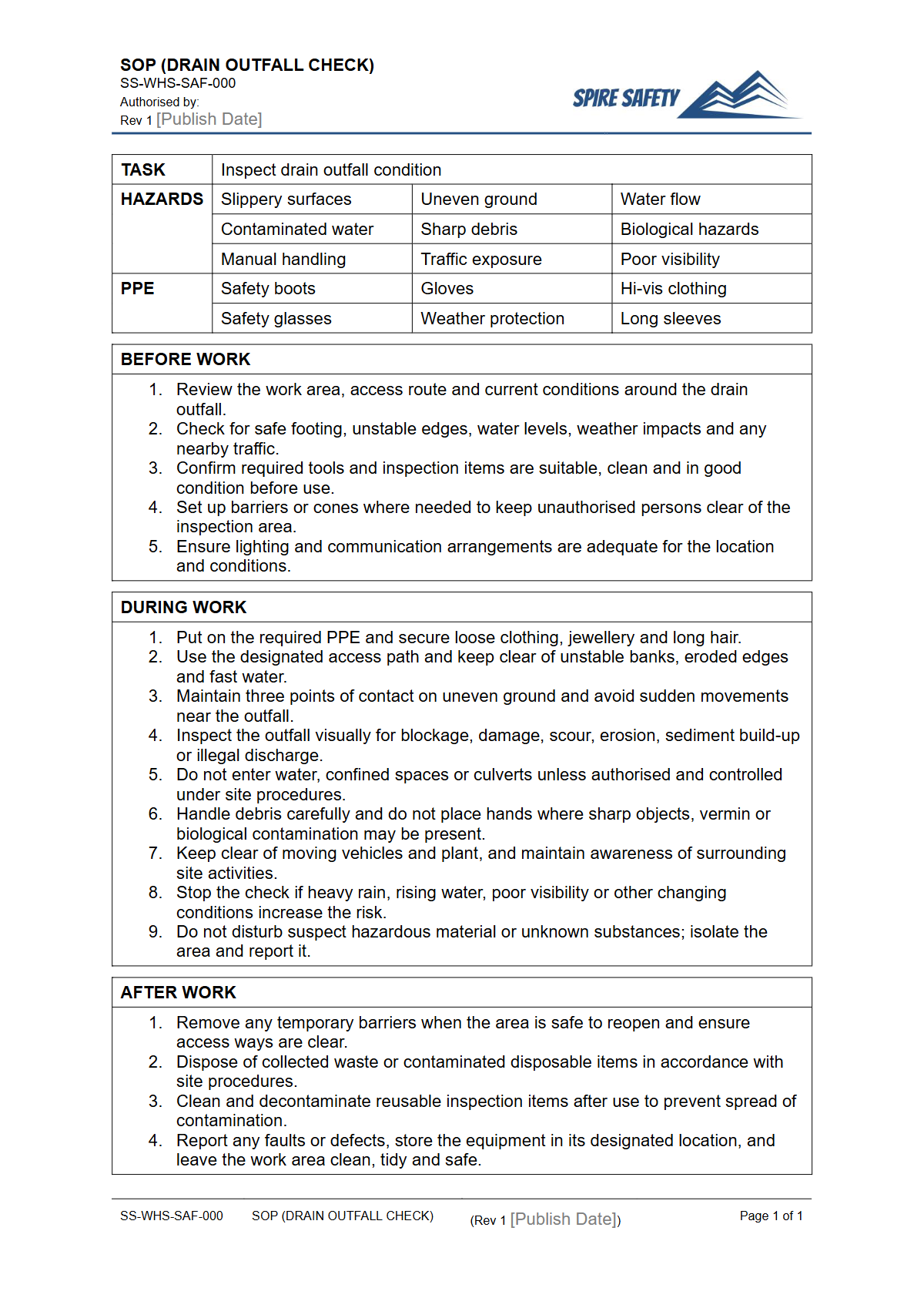
Download our free Safe Operating Procedure for drain outfall checks. This template helps document risks and controls for routine drain maintenance tasks.
Free Safe Operating Procedure (Drain Outfall Check) Template
DOCX • 126 KB + PDF
Updated Oct 2026
No signup required
Purpose of the Free Safe Operating Procedure (Drain Outfall Check) Template
Performing regular drain outfall checks is a critical task for maintaining site safety, preventing environmental contamination, and ensuring infrastructure longevity. Our Free Safe Operating Procedure (Drain Outfall Check) Template provides a structured starting point for organisations to document the required safety steps for this activity.
By standardising the process, you can effectively manage risks and train personnel on the correct methodology for inspecting and clearing drainage systems.
The primary purpose of this Safe Operating Procedure is to provide a clear, step-by-step guide for workers. It prompts you to identify all potential hazards associated with the task, such as slips on wet surfaces, falls into water, exposure to biological or chemical contaminants, hazardous manual tasks when lifting grates, and working near traffic.
The document then guides you to specify robust control measures to mitigate these risks. Integrating this SOP into your broader safety framework helps create a more consistent and safer work environment, forming a key part of your overall WHS management systems.
Video walkthrough
How to use the Free Safe Operating Procedure (Drain Outfall Check) Template
This SOP template is provided as a DOCX file for easy editing and a PDF for reference. To use it effectively, download the document and open it in a word processor.
Go through each section and replace the placeholder text with information that is specific to your worksite, equipment, and personnel. This includes detailing the exact location of drain outfalls, the specific tools to be used, and the personal protective equipment (PPE) required.
You should also detail the step-by-step process from pre-start checks to clean-up, including your site's emergency procedures. Just as our FREE Trencher SOP Template needs to be adapted for specific ground conditions and machine models, this drain check procedure must be tailored to your unique environment.
Important: This document is a template, not a finished product. You must adapt it to the specific hazards and unique environmental conditions of your workplace.
We recommend a consultation process with the workers who will actually be performing the task to ensure the procedure is practical and effective.
When to Use This SOP
A Safe Operating Procedure for drain outfall checks should be used consistently to ensure the task is always performed safely. It is not just a document for initial training but a practical tool for pre-work briefings and on-the-job reference. Key times to use this SOP include:
- Routine Inspections: As part of a scheduled preventative maintenance program (e.g., monthly, quarterly).
- Seasonal Checks: Before the start of a predicted wet season to ensure maximum drainage capacity and after the season to clear accumulated debris.
- Post-Event Checks: Following significant rainfall, storms, or floods to assess for damage and blockages.
- Reactive Maintenance: When a blockage or issue has been reported and requires investigation and clearing.
Regularly reviewing the execution of this SOP can also be a valuable input for your safety verification processes, such as during a WHS compliance auditing program, to ensure procedures remain effective and relevant.
Who Should Use It
This SOP is intended for any personnel tasked with inspecting, maintaining, or clearing drain outfalls. This can include a wide range of roles depending on the organisation, such as:
- Maintenance Teams
- Facilities Management Staff
- Groundskeepers and Landscaping Crews
- Civil Construction Workers
- Environmental Officers
- Site Supervisors
It is essential that anyone using this procedure is trained not only on the document itself but also on the practical skills required. This includes hazard identification, correct use of any equipment (like crowbars or grate lifters), and emergency response.
If tasks involve using machinery like high-pressure cleaners or industrial vacuums, operators must be competent in their use. For some cleaning tasks, workers may use equipment detailed in other procedures, such as our Free Air Compressor SOP for blowing out minor blockages.
Getting Further Support
Developing and implementing a complete suite of Safe Operating Procedures can be complex. If you need assistance tailoring this template to a particularly hazardous environment or integrating it into your existing safety system, engaging expert support is a practical step.
Professional WHS consulting can provide guidance and help ensure your documentation is robust and fit-for-purpose, helping you meet your duty of care. Explore our extensive free WHS resources library for more templates and guides to support your safety management efforts.
Common mistakes
Common mistakes to avoid
- Forgetting to check weather forecasts and tide times before starting work near waterways.
- Using the template without customising it for specific site hazards and access points.
- Failing to properly isolate the work area from vehicle or pedestrian traffic.
- Lifting heavy drain covers or grates alone, leading to manual handling injuries.
Legal references
Legal considerations
The following legal requirements may be relevant to this type of work.
- Work Health and Safety Act (Harmonised) — Provides the primary duties for protecting workers and other people from work health and safety risks.
- Work Health and Safety Regulations (Harmonised) — Sets out requirements supporting the management of workplace hazards and risks.
The following codes may be relevant to this type of work.
- Managing WHS Risks Code of Practice — Provides practical guidance on identifying hazards, assessing risks and applying effective controls.
- Work Health and Safety Consultation, Cooperation and Coordination Code of Practice — Provides practical guidance on consulting workers and coordinating with other duty holders.
- Managing the Work Environment and Facilities Code of Practice — Provides practical guidance on safe work environments, workplace facilities and related controls.
Did you know
Common Blockage Culprits
Debris like leaves, silt, and litter are common causes of drain blockages. However, fats, oils, and grease (FOG) from commercial kitchens can also solidify in pipes, causing major obstructions.
Environmental Impact
Blocked or damaged drain outfalls can release pollutants directly into natural waterways, harming aquatic ecosystems and potentially breaching environmental protection laws.
FAQ
Frequently asked questions
01What hazards are associated with checking drain outfalls?
02How often should drain outfall checks be performed?
03Is this SOP template compliant with Australian WHS laws?
04What PPE is needed for a drain outfall check?
Share this resource
Free Safe Operating Procedure (Drain Outfall Check) Template
Browse Categories
How To Use It
- 1Download and open in Word or PDF.
- 2Replace the placeholders with your business details.
- 3Get it reviewed by a WHS specialist before rollout.
Need it customised?
Our WHS consultants can adapt this template to your site, run a gap analysis, or audit what you already have in place.
Book a Free Consultation WHS consulting servicesor call 1300 156 382
Related templates
- Free Safe Operating Procedure (Drain Sediment Removal) Template
- Free Safe Operating Procedure (Drain Snake) Template
- Free Safe Operating Procedure (Drain Trap Cleaning) Template
- Free Safe Operating Procedure (Drainage Channel Check) Template
- Free Safe Operating Procedure (Drainage Channel Clean) Template
- Free Safe Operating Procedure (Drainage Outlet Check) Template