
Free Safe Operating Procedure (Drainage Channel Check) Template
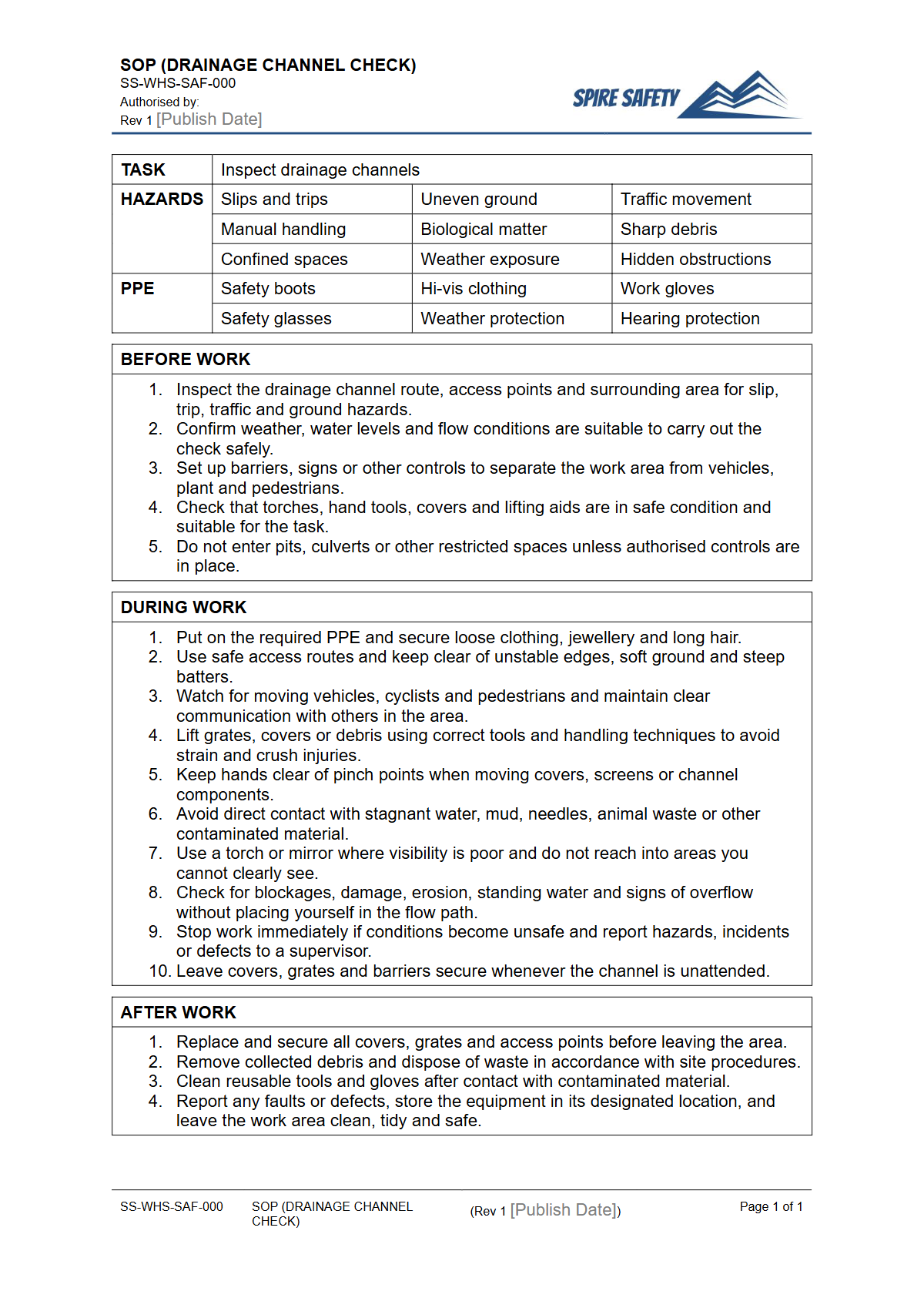
Formalise your safety protocols for maintaining drainage channels. Our free template helps you outline the risks and control measures for this task.
Free Safe Operating Procedure (Drainage Channel Check) Template
DOCX • 126 KB + PDF
Updated Oct 2026
No signup required
Purpose of the Free Safe Operating Procedure (Drainage Channel Check) Template
Regularly checking drainage channels is a critical maintenance task across construction, civil, and agricultural sectors. However, it comes with inherent risks.
This Free Safe Operating Procedure (Drainage Channel Check) Template provides a structured starting point for documenting a safe system of work for your team. It helps you formally identify hazards, assess risks, and implement effective control measures for tasks related to inspecting and clearing drains, culverts, and channels.
By using a documented SOP, you ensure that work is performed consistently and safely, every time.
A well-defined SOP is a fundamental component of proactive safety management. It serves as a training tool for new workers and a reference for experienced personnel, reinforcing safe work habits.
Systematically addressing risks—such as slips on wet or uneven ground, manual handling injuries from removing debris, exposure to contaminated water, or interaction with machinery—helps your organisation meet its primary duty of care. Integrating this procedure into your broader WHS management systems demonstrates a commitment to workplace health and safety.
Video walkthrough
How to use the Free Safe Operating Procedure (Drainage Channel Check) Template
This template is available for download in both DOCX and PDF formats. The DOCX version is fully editable, allowing you to tailor the content to your specific site conditions, equipment, and organisational procedures.
Simply download the file and open it in Microsoft Word or a compatible program to begin customisation. We recommend involving your workers in the process to ensure the SOP is practical and reflects how the work is actually done.
Please note: this document is a template and must be customised to your workplace. As we are not your PCBU (Person Conducting a Business or Undertaking), you are responsible for adapting this SOP to reflect the specific hazards, equipment, personnel, and control measures relevant to your site and tasks. For example, if clearing a channel involves mechanical digging, you would need to reference specific procedures like those found in our free Trencher SOP template.
When to conduct a drainage channel check
A drainage channel check should be integrated into your site's regular maintenance schedule. The frequency will depend on the location, environment, and purpose of the drainage system. Key times to conduct a check and use this SOP include:
- Routine Maintenance: As part of a scheduled preventative maintenance program (e.g., monthly or quarterly).
- Post-Weather Events: After heavy rainfall, storms, or high winds to check for blockages, damage, or erosion.
- Pre-Season Preparation: In agricultural settings, before planting or harvesting seasons to ensure proper field drainage.
- Before and During Construction: To manage water runoff and prevent flooding on a worksite. This is particularly important when earthmoving is involved, which may require other procedures like our free Grader SOP template.
Who should use this SOP?
This Safe Operating Procedure is designed for use by a range of personnel involved in site maintenance and safety management. It provides essential guidance for:
- Site Supervisors and Foremen: To induct workers, conduct pre-start meetings, and supervise the task to ensure it is performed according to the documented procedure.
- Maintenance Crews and Labourers: The workers physically performing the inspection and clearing tasks, who must understand the step-by-step process and associated safety controls.
- WHS Managers and Advisors: To use as a foundation for developing site-specific risk management documentation and for inclusion in the overall safety management system.
- Plant Operators: If machinery is required for clearing larger blockages, operators must be familiar with the SOP to understand the context of their work and how it interfaces with other personnel. You may need to cross-reference other SOPs for specific equipment, such as our free Scraper SOP template for bulk earthworks.
Ultimately, a robust SOP helps standardise safe work practices across your entire organisation. Regularly reviewing and updating your procedures, perhaps as part of formal WHS compliance auditing, ensures they remain relevant and effective.
Explore our complete free WHS resources library for more templates to support your safety systems.
Common mistakes
Common mistakes to avoid
- Failing to check for underground services (e.g., electrical, gas, water) before any ground disturbance.
- Ignoring confined space risks and attempting entry into large pipes or pits without a permit or proper training.
- Using incorrect equipment for the task, such as damaged ladders or un-rated lifting gear for grates.
- Neglecting to assess environmental factors like recent rainfall, which can affect ground stability and water flow.
Legal references
Legal considerations
The following legal requirements may be relevant to this type of work.
- Work Health and Safety Act (Harmonised) — Provides the primary duties for protecting workers and other people from work health and safety risks.
- Work Health and Safety Regulations (Harmonised) — Sets out requirements supporting the management of workplace hazards and risks.
The following codes may be relevant to this type of work.
- Managing WHS Risks Code of Practice — Provides practical guidance on identifying hazards, assessing risks and applying effective controls.
- Work Health and Safety Consultation, Cooperation and Coordination Code of Practice — Provides practical guidance on consulting workers and coordinating with other duty holders.
- Managing the Work Environment and Facilities Code of Practice — Provides practical guidance on safe work environments, workplace facilities and related controls.
Did you know
Flood Risk
According to the Insurance Council of Australia, floods are one of the most expensive natural disasters in the country. Properly maintained drainage channels are a first line of defence in mitigating localised flood damage to property and infrastructure.
Hidden Dangers
Many larger drainage systems can be classified as confined spaces. These environments pose significant risks, including toxic atmospheres, engulfment hazards, and oxygen deficiency, requiring strict entry permits and specialised training.
FAQ
Frequently asked questions
01What is a Safe Operating Procedure (SOP) for a drainage channel check?
02Why is an SOP necessary for checking drainage channels?
03What hazards should be included in a drainage channel check SOP?
04Can this template be used for all types of drainage systems?
Share this resource
Free Safe Operating Procedure (Drainage Channel Check) Template
Browse Categories
How To Use It
- 1Download and open in Word or PDF.
- 2Replace the placeholders with your business details.
- 3Get it reviewed by a WHS specialist before rollout.
Need it customised?
Our WHS consultants can adapt this template to your site, run a gap analysis, or audit what you already have in place.
Book a Free Consultation WHS consulting servicesor call 1300 156 382
Related templates
- Free Safe Operating Procedure (Drainage Channel Clean) Template
- Free Safe Operating Procedure (Drainage Outlet Check) Template
- Free Safe Operating Procedure (Drainage Outlet Clean) Template
- Free Safe Operating Procedure (Drainage Swale Cleaning) Template
- Free Safe Operating Procedure (Drill Bit Change) Template
- Free Safe Operating Procedure (Drill Mast Setup) Template