
Free Safe Operating Procedure (Drill Mast Setup) Template
Our free Safe Operating Procedure (Drill Mast Setup) template provides a solid foundation for documenting your high-risk work. Download the DOCX and PDF now.
Free Safe Operating Procedure (Drill Mast Setup) Template
DOCX • 126 KB + PDF
Updated Oct 2026
No signup required
Purpose of the Free Safe Operating Procedure (Drill Mast Setup) Template
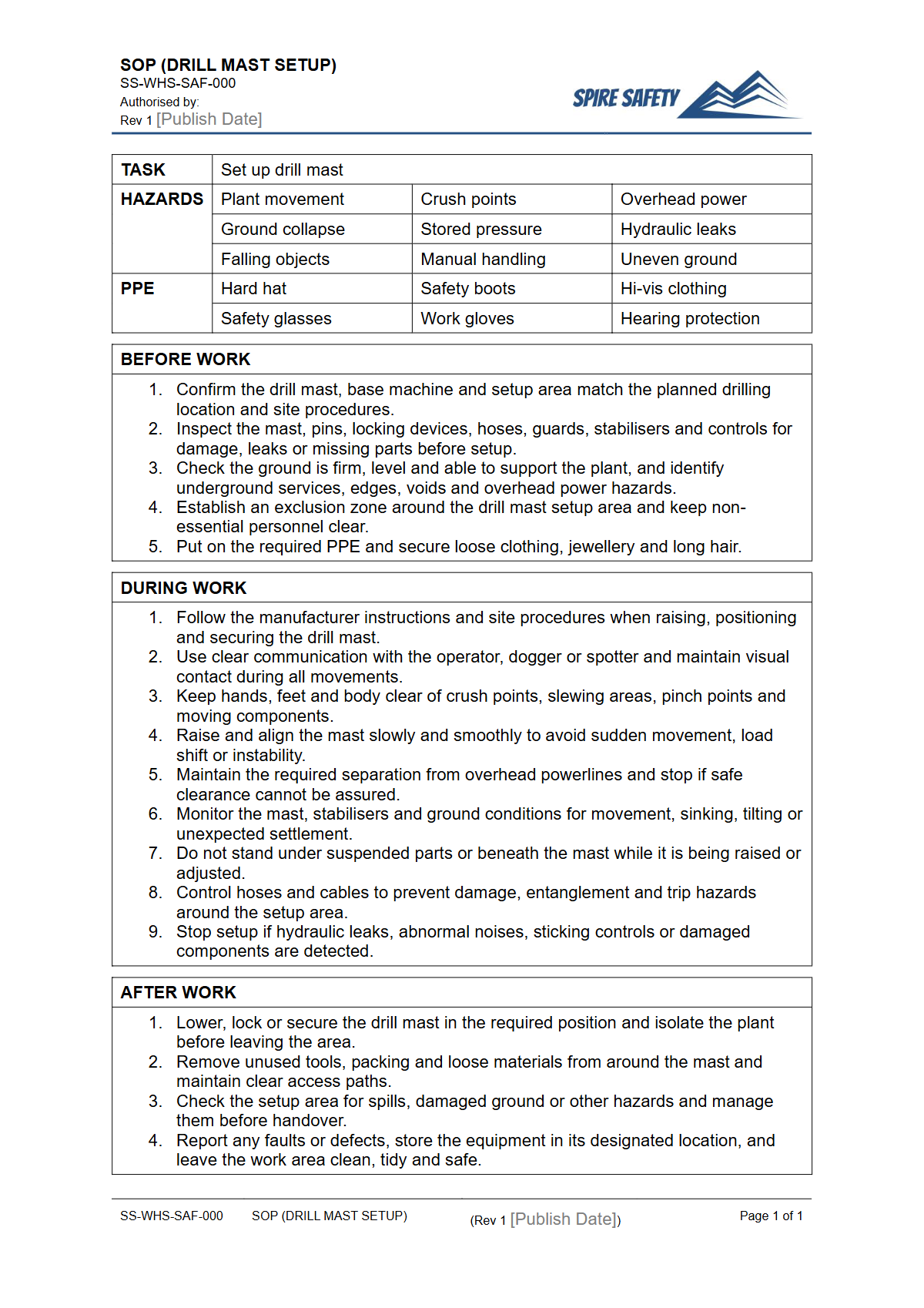
Setting up a drill mast is a high-risk activity common in construction, mining, and geotechnical sectors. This Free Safe Operating Procedure (Drill Mast Setup) Template provides a structured framework for documenting the required steps to perform this task safely.
Its purpose is to help your organisation control significant risks, including equipment instability, crushing hazards, and potential contact with overhead services. By clearly outlining the procedure, you establish a consistent, safe method for all workers to follow, forming a key part of your overall safety management.
Video walkthrough
How to use the Free Safe Operating Procedure (Drill Mast Setup) Template
This document is a template, not a finished procedure. To make it effective, you must conduct a site-specific risk assessment and tailor the content to your unique operational context.
This involves detailing the specific make and model of your drill rig, the ground conditions at your site, and the competencies required of your operators. Integrating this document into your broader safety framework is crucial for building robust and effective WHS management systems.
Please remember, we provide this template as a starting point. It is your organisation's responsibility to ensure the final document is comprehensive, reflects your specific work activities, and meets your legal obligations under Australian WHS laws.
When to use this Safe Operating Procedure
This SOP should be the primary reference document whenever a drill mast is being set up or dismantled. It is an essential tool for training new operators and conducting refresher courses for experienced personnel.
Furthermore, the procedure serves as a critical benchmark during safety observations and formal WHS compliance audits. In the unfortunate event of an incident or near-miss, this document will be fundamental to the investigation process, helping to identify any deviations from the established safe process.
Who Should Use This Procedure
The primary users of this SOP are the drill rig operators and their assistants (offsiders) who physically perform the setup. Supervisors and site managers must also use it to oversee the work, supports your compliance efforts, and verify that all safety controls are in place.
WHS advisors and trainers will use the document to develop training materials and assess worker competency. The principles of safe operation outlined are similar to those for other heavy equipment, such as the requirements detailed in a dozer SOP.
Key Components of the Drill Mast Setup SOP
Our template guides you through the essential elements of a comprehensive SOP. It includes sections for:
- Required Personal Protective Equipment (PPE).
- Pre-operational checks for the drill rig, support vehicles, and work area.
- A detailed, step-by-step guide to the setup process, from positioning the rig to raising the mast.
- Specific safety controls for managing identified hazards, like exclusion zones and spotter duties.
- Emergency procedures, including shutdown and communication protocols.
This structured format ensures no critical step is overlooked. While this SOP is for mast drills, you can find other specific procedures in our library, like our seed drill SOP for agricultural applications.
Review and Improvement
A Safe Operating Procedure is a living document that requires regular review to remain effective. It should be reviewed at least annually, or more frequently if there are changes to equipment, personnel, or the working environment.
Engaging your workers in the review process is vital, as they have direct experience with the task and can provide valuable feedback for improvement. For complex operations, engaging in specialist WHS consulting can provide an expert third-party perspective to ensure your procedures are robust and align with industry best practice.
By implementing and consistently following a detailed SOP for drill mast setup, your organisation can significantly reduce the risk of serious incidents. This template is one of many available in our free WHS resources library, designed to help Australian businesses improve their workplace health and safety practices.
Common mistakes
Common mistakes to avoid
- Failing to conduct a pre-start inspection of the rig and setup area.
- Not establishing clear exclusion zones for non-essential personnel during mast raising.
- Using a generic SOP without customising it for the specific rig, load, and ground conditions.
- Neglecting to check for overhead and underground services before positioning the mast.
Legal references
Legal considerations
The following legal requirements may be relevant to this type of work.
- Work Health and Safety Act (Harmonised) — Provides the primary duties for protecting workers and other people from work health and safety risks.
- Work Health and Safety Regulations (Harmonised) — Sets out requirements supporting the management of workplace hazards and risks.
The following codes may be relevant to this type of work.
- Managing WHS Risks Code of Practice — Provides practical guidance on identifying hazards, assessing risks and applying effective controls.
- Work Health and Safety Consultation, Cooperation and Coordination Code of Practice — Provides practical guidance on consulting workers and coordinating with other duty holders.
- Managing the Work Environment and Facilities Code of Practice — Provides practical guidance on safe work environments, workplace facilities and related controls.
Did you know
Ground Conditions are Key
Unstable or uneven ground is a leading cause of drill rig rollovers. A geotechnical assessment is often required before setting up heavy plant on potentially compromised surfaces.
The Human Factor
A significant percentage of incidents involving heavy machinery can be traced back to a failure to follow established procedures, highlighting the importance of clear SOPs and effective training.
FAQ
Frequently asked questions
01What hazards are associated with drill mast setup?
02How often should a Drill Mast Setup SOP be reviewed?
03Is a Safe Operating Procedure a legal requirement in Australia?
04Can I use this template for any type of drill rig?
Share this resource
Free Safe Operating Procedure (Drill Mast Setup) Template
Browse Categories
How To Use It
- 1Download and open in Word or PDF.
- 2Replace the placeholders with your business details.
- 3Get it reviewed by a WHS specialist before rollout.
Need it customised?
Our WHS consultants can adapt this template to your site, run a gap analysis, or audit what you already have in place.
Book a Free Consultation WHS consulting servicesor call 1300 156 382
Related templates
- Free Safe Operating Procedure (Drill Rod Breakout) Template
- Free Safe Operating Procedure (Drill Rod Handling) Template
- Free Safe Operating Procedure (Drip Line Flushing) Template
- Free Safe Operating Procedure (Drive Shaft Removal) Template
- Free Safe Operating Procedure (Driver Check In) Template
- Free Safe Operating Procedure (Driver Handover) Template