
Free Safe Operating Procedure (Drill Rod Handling) Template
Establish clear, safe work instructions for handling drill rods with our structured Safe Operating Procedure template. Download your free DOCX and PDF today.
Free Safe Operating Procedure (Drill Rod Handling) Template
DOCX • 126 KB + PDF
Updated Oct 2026
No signup required
Purpose of the Free Safe Operating Procedure (Drill Rod Handling) Template
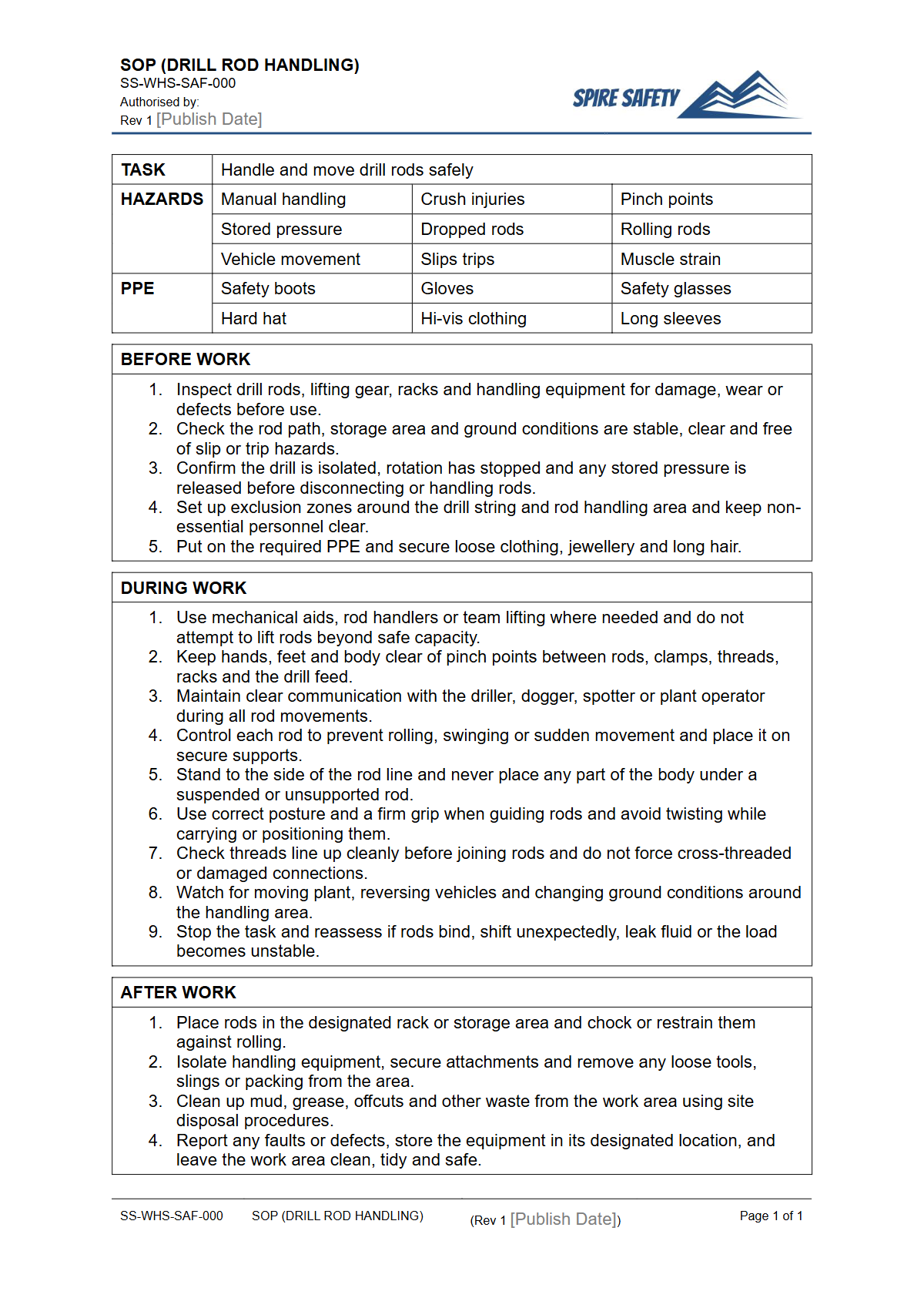
Drill rod handling is a high-risk activity common in mining, construction, and geotechnical industries. This free Safe Operating Procedure (Drill Rod Handling) Template provides a structured framework for documenting the safest method to perform this task.
Its primary purpose is to help your organisation minimise the risk of injury by establishing clear, step-by-step instructions for workers. By implementing a formal SOP, you can effectively manage hazards such as musculoskeletal injuries from lifting, crush and pinch point injuries, and slips, trips, and falls caused by awkward loads or greasy surfaces.
A well-developed SOP is a critical component of a proactive safety culture and demonstrates a commitment to worker wellbeing. It serves as a vital tool for training, competency assessment, and incident investigation.
Integrating this procedure is a key step in developing more comprehensive WHS management systems that systematically control operational risks.
Video walkthrough
How to use the Free Safe Operating Procedure (Drill Rod Handling) Template
To effectively use this Safe Operating Procedure (Drill Rod Handling) Template, download the DOCX file and begin customising it to your workplace. The document is pre-formatted with essential sections including required personal protective equipment (PPE), risk controls, and a sequential task breakdown.
Your task is to populate these sections with information specific to your site's equipment, ground conditions, and personnel roles. It is crucial that the final SOP reflects the actual work being performed.
This template is a starting point, not a finished product. We cannot stress this enough: you must customise this document to suit your specific needs. We recommend a competent person, such as a site supervisor or safety advisor, leads this process in consultation with the drillers and offsiders who perform the task daily.
Their direct input is invaluable for creating a practical and effective procedure. You can compare its structure with our free Seed Drill SOP to see how procedures are adapted for different machinery.
When to use this Safe Operating Procedure
This Safe Operating Procedure should be used whenever drill rods are handled, whether manually or with mechanical aids. It is applicable during all phases of drilling operations, including site setup, active drilling, and demobilisation.
Specific scenarios include loading and unloading rods from a truck or rod float, adding or removing rods from the drill string, moving rods to and from storage racks, and cleaning or maintenance tasks.
The SOP should be a core part of worker training and inductions for new team members. It also serves as an excellent resource for pre-start meetings and toolbox talks, allowing crews to review risks and controls before commencing work.
For tasks involving lifting equipment, the principles in this document should be cross-referenced with other relevant procedures, such as those found in a Telehandler SOP, to ensure integrated safety management.
Who should use this Safe Operating Procedure
This SOP is intended for all personnel directly involved in handling drill rods. This includes Drillers, Driller's Offsiders, and Trainees.
It provides them with a clear, authoritative guide on the expected standards of safe performance. Supervisors and site managers are also key users; they are responsible for ensuring the SOP is implemented, that workers are trained in its contents, and that work is conducted in accordance with the documented procedure.
Safety professionals and Health and Safety Representatives (HSRs) will also find the document useful for conducting workplace inspections, risk assessments, and incident investigations. The consistent application of the SOP across all crews helps standardise safe work practices and simplifies the process of regular WHS compliance auditing.
The principles of documenting safe work methods are transferable across many types of heavy equipment operations. For example, organisations that also use earthmoving equipment can apply a similar structured approach when developing similar procedures for dozers to manage their unique operational risks.
Ultimately, a robust SOP ensures every person on site understands their role in managing the hazards of a specific task. Whether it's a driller coordinating a lift or a supervisor verifying competency, the SOP is the central reference point.
This approach is just as important when creating a SOP for trencher operation or any other high-risk plant. Explore more templates in our free WHS resources library to build a consistent safety documentation system.
Common mistakes
Common mistakes to avoid
- Using the template without customising it for specific site equipment, ground conditions, and personnel.
- Failing to adequately train all relevant workers on the finalised SOP and verify their understanding.
- Neglecting to review and update the SOP after an incident, a change in process, or when new equipment is introduced.
- Poor communication and lack of coordination between the driller and offsider during joint handling operations.
Legal references
Legal considerations
The following legal requirements may be relevant to this type of work.
- Work Health and Safety Act (Harmonised) — Provides the primary duties for protecting workers and other people from work health and safety risks.
- Work Health and Safety Regulations (Harmonised) — Sets out requirements supporting the management of workplace hazards and risks.
The following codes may be relevant to this type of work.
- Managing WHS Risks Code of Practice — Provides practical guidance on identifying hazards, assessing risks and applying effective controls.
- Work Health and Safety Consultation, Cooperation and Coordination Code of Practice — Provides practical guidance on consulting workers and coordinating with other duty holders.
- Managing the Work Environment and Facilities Code of Practice — Provides practical guidance on safe work environments, workplace facilities and related controls.
Did you know
Weighty Issue
Hazardous manual tasks, such as lifting heavy drill rods, are a leading cause of musculoskeletal disorders. These injuries consistently account for a large proportion of serious workers' compensation claims in Australia.
FAQ
Frequently asked questions
01What is a Safe Operating Procedure for drill rod handling?
02Why is manual handling of drill rods considered a hazardous task?
03Does this template cover all types of drilling operations?
04Who is responsible for developing the drill rod handling SOP?
Share this resource
Free Safe Operating Procedure (Drill Rod Handling) Template
Browse Categories
How To Use It
- 1Download and open in Word or PDF.
- 2Replace the placeholders with your business details.
- 3Get it reviewed by a WHS specialist before rollout.
Need it customised?
Our WHS consultants can adapt this template to your site, run a gap analysis, or audit what you already have in place.
Book a Free Consultation WHS consulting servicesor call 1300 156 382
Related templates
- Free Safe Operating Procedure (Drip Line Flushing) Template
- Free Safe Operating Procedure (Drive Shaft Removal) Template
- Free Safe Operating Procedure (Driver Check In) Template
- Free Safe Operating Procedure (Driver Handover) Template
- Free Safe Operating Procedure (Driver Rest Break) Template
- Free Safe Operating Procedure (Driver Route Briefing) Template