
Free Safe Operating Procedure (Driver Rest Break) Template
Manage driver fatigue effectively with our free Safe Operating Procedure for driver rest breaks.
Free Safe Operating Procedure (Driver Rest Break) Template
DOCX • 126 KB + PDF
Updated Oct 2026
No signup required
Purpose of the Free Safe Operating Procedure (Driver Rest Break) Template
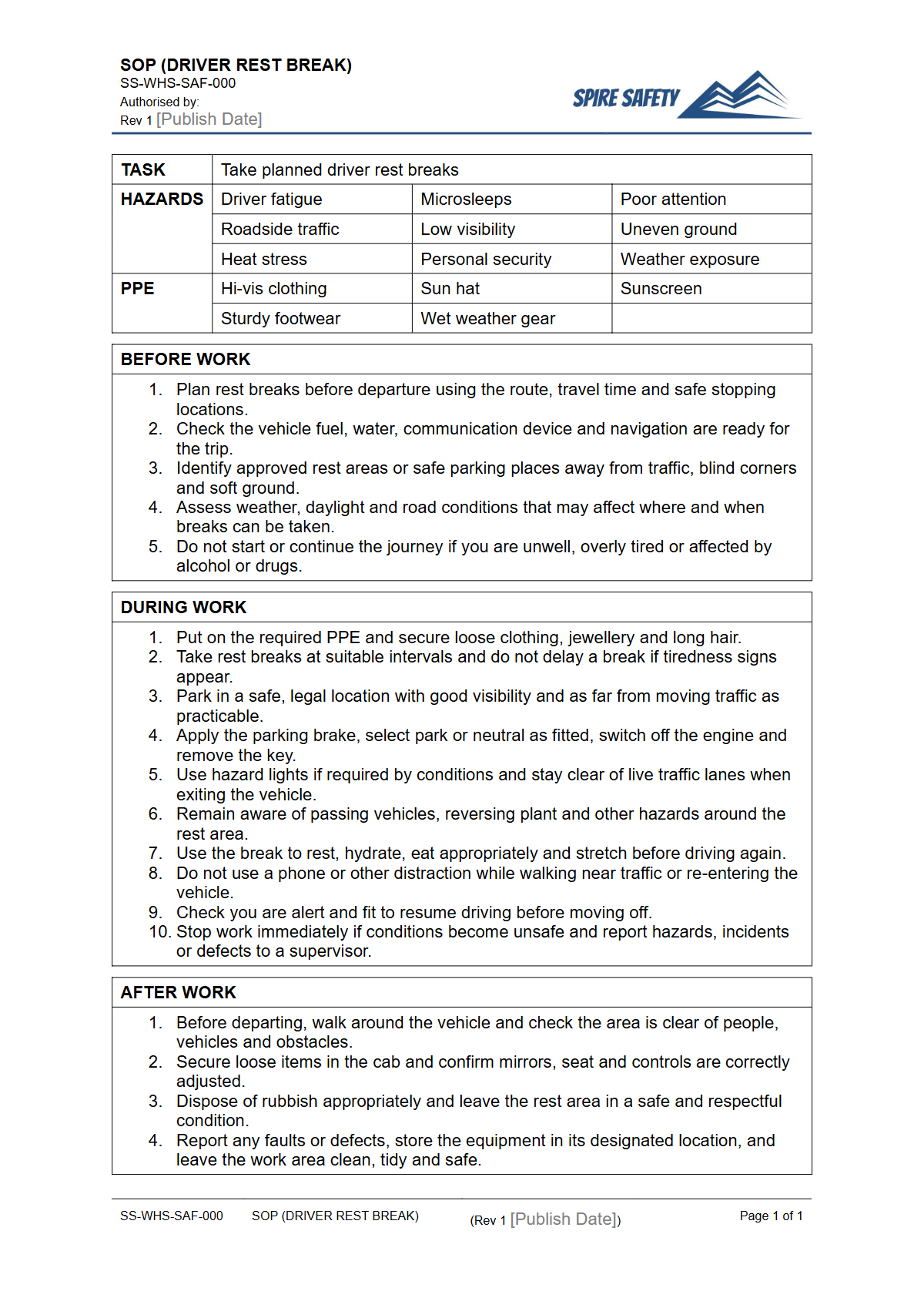
Managing driver fatigue is a critical part of any transport, logistics, or mobile plant operation. To help your organisation establish a formal process, Spire Safety offers this free Safe Operating Procedure (Driver Rest Break) Template.
This document provides a structured framework for defining responsibilities, scheduling breaks, and managing the risks associated with driver fatigue, helping you meet your duty of care obligations under Australian WHS legislation.
The primary purpose of this Safe Operating Procedure is to provide a clear, documented system for managing driver fatigue. It aims to minimise the risk of incidents caused by tired drivers by establishing mandatory rest periods and outlining procedures for journey planning and fatigue reporting.
A formalised SOP ensures that all personnel, from drivers to managers, understand their roles and responsibilities in preventing fatigue-related accidents.
Video walkthrough
How to use the Free Safe Operating Procedure (Driver Rest Break) Template
To implement this Safe Operating Procedure, simply download the DOCX or PDF file and integrate it into your existing safety management system. The template is designed as a comprehensive starting point aligned with Australian WHS principles.
Please note: We have created this template as a guide. You must customise it to address the specific vehicles, journey types, work schedules, and unique risks present in your workplace. A thorough customisation process is essential for ensuring the SOP is effective and practical for your operations. Integrating such procedures is a key component of robust WHS management systems that actively reduce risk.
When to use it
This SOP should be applied in any situation where workers operate vehicles for work purposes, particularly in high-risk scenarios. This includes long-haul road transport, multi-drop delivery routes, shift work involving driving, and the operation of mobile plant on construction or agricultural sites.
It is especially critical for work conducted at night, in monotonous conditions, or for extended durations, where the risk of fatigue is significantly higher. This applies equally to long-haul truck drivers and operators of heavy earthmoving equipment detailed in documents like our FREE Scraper SOP Template.
Who should use it
The responsibility for using and enforcing this SOP extends across multiple roles within an organisation.
- Drivers: Must understand and adhere to the specified rest break schedules and report any instances of fatigue.
- Supervisors and Schedulers: Are responsible for planning realistic journeys that allow for required breaks and for monitoring driver schedules.
- Managers: Must ensure the policy is implemented, resources are adequate, and that a culture of safety over delivery times is promoted.
- WHS Personnel: Should use this SOP as part of their framework for risk management and incident prevention.
Key Elements of an Effective Driver Rest Break SOP
Our template is structured to cover the essential components of a robust procedure, helping you build a comprehensive document for your workplace.
Risk Identification and Control
The first step is identifying factors that contribute to fatigue. This goes beyond just driving hours and includes shift timing, quality of rest away from home, monotonous routes, and even diet.
The SOP guides you in documenting these risks and implementing control measures, such as pre-start fitness-for-work checks and promoting healthy sleep habits. A similar systematic approach to risk is vital when creating procedures for other heavy equipment, such as our FREE Dozer SOP Template.
Roles and Responsibilities
A critical section that clearly defines who does what. It assigns specific duties to drivers for self-monitoring and reporting, to schedulers for creating compliant rosters, and to management for overall oversight and support.
Clearly defining these responsibilities is fundamental to the Chain of Responsibility (CoR) and is a key area of focus during a WHS compliance auditing process.
Procedure and Scheduling Standards
This section provides the operational details. It outlines minimum duration and frequency of breaks based on national standards, such as those in the Heavy Vehicle National Law (HVNL).
It also includes instructions for pre-journey planning, communication protocols, and procedures for what to do if a driver feels unfit to continue driving due to fatigue. Having clear procedures is as important for drivers as it is for operators of other heavy machinery, like those covered in our FREE Grader SOP Template.
Record Keeping and Review
Documenting compliance is essential. This SOP includes provisions for keeping records of driving hours, work diaries, and rest breaks.
It also establishes a schedule for reviewing the effectiveness of the SOP itself, ensuring it remains relevant and effective as your operations or regulations change. By implementing a detailed Safe Operating Procedure for driver rest breaks, your organisation demonstrates a proactive commitment to worker safety and legislative responsibilities.
Explore our complete free WHS resources library for more tools to enhance your safety management framework.
Common mistakes
Common mistakes to avoid
- Relying solely on drivers to self-manage fatigue without supportive schedules.
- Failing to account for non-driving work time, like loading and unloading, in total work hours.
- Poor record-keeping of driving hours and rest breaks, making compliance difficult to prove.
- Pressuring drivers to meet unrealistic deadlines, discouraging them from taking necessary breaks.
Legal references
Legal considerations
The following legal requirements may be relevant to this type of work.
- Work Health and Safety Act (Harmonised) — Provides the primary duties for protecting workers and other people from work health and safety risks.
- Work Health and Safety Regulations (Harmonised) — Sets out requirements supporting the management of workplace hazards and risks.
The following codes may be relevant to this type of work.
- Managing WHS Risks Code of Practice — Provides practical guidance on identifying hazards, assessing risks and applying effective controls.
- Work Health and Safety Consultation, Cooperation and Coordination Code of Practice — Provides practical guidance on consulting workers and coordinating with other duty holders.
- Managing the Work Environment and Facilities Code of Practice — Provides practical guidance on safe work environments, workplace facilities and related controls.
Did you know
Fatigue vs. Alcohol
Research shows that being awake for 17 hours has a similar effect on performance as having a blood alcohol concentration (BAC) of 0.05. Being awake for 24 hours is equivalent to a BAC of 0.10, double the legal limit.
The Danger of Microsleeps
A microsleep is an involuntary period of sleep that can last for a few seconds. At 100 km/h, a driver having a four-second microsleep will travel over 110 metres with no one in control of the vehicle.
FAQ
Frequently asked questions
01What are the minimum rest break requirements for heavy vehicle drivers in Australia?
02How does a Safe Operating Procedure for rest breaks differ from a fatigue management plan?
03Can a driver refuse to operate a vehicle if they feel fatigued?
04Who is responsible for monitoring driver fatigue?
Share this resource
Free Safe Operating Procedure (Driver Rest Break) Template
Browse Categories
How To Use It
- 1Download and open in Word or PDF.
- 2Replace the placeholders with your business details.
- 3Get it reviewed by a WHS specialist before rollout.
Need it customised?
Our WHS consultants can adapt this template to your site, run a gap analysis, or audit what you already have in place.
Book a Free Consultation WHS consulting servicesor call 1300 156 382
Related templates
- Free Safe Operating Procedure (Driver Route Briefing) Template
- Free Safe Operating Procedure (Driver Vehicle Handover) Template
- Free Safe Operating Procedure (Drone Ground Handling) Template
- Free Safe Operating Procedure (Drone Takeoff and Landing) Template
- Free Safe Operating Procedure (Drop Saw Mitre Saw Operation) Template
- Free Safe Operating Procedure (Drum Decanting) Template