
Free Safe Operating Procedure (Drop Saw Mitre Saw Operation) Template
Download our free Safe Operating Procedure (SOP) template for drop saw and mitre saw operation. A structured starting point for your workplace safety.
Free Safe Operating Procedure (Drop Saw Mitre Saw Operation) Template
DOCX • 158 KB + PDF
Updated Oct 2026
No signup required
Purpose of the Free Safe Operating Procedure (Drop Saw Mitre Saw Operation) Template
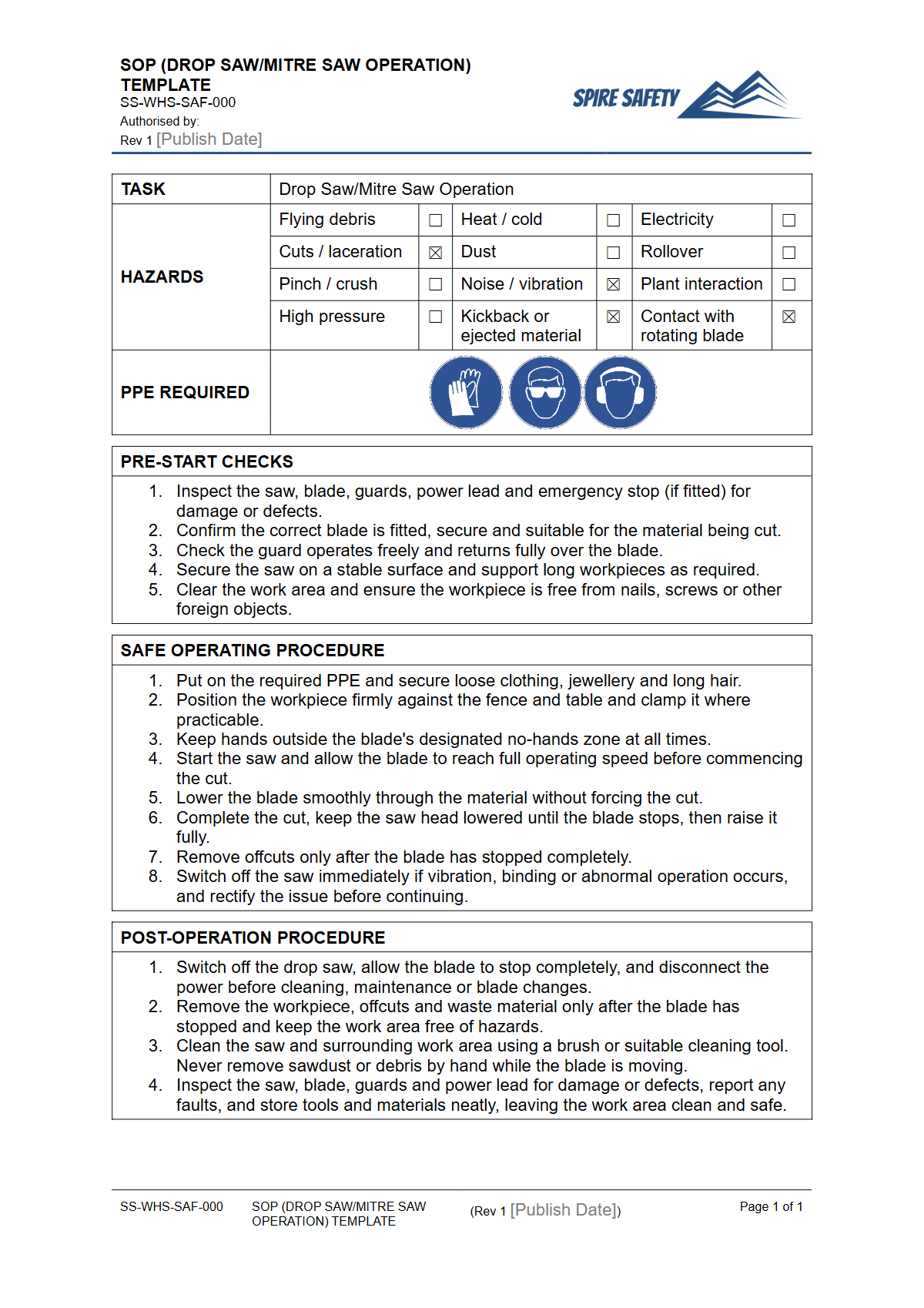
Operating a drop saw, also known as a mitre saw, introduces significant workplace hazards, including the risk of severe cuts, amputation, entanglement, and injuries from ejected material. This Free Safe Operating Procedure (Drop Saw Mitre Saw Operation) Template provides a structured framework to document a safe system of work.
It helps your organisation systematically address risks by outlining essential steps for pre-operational checks, safe operation, and post-use procedures. Implementing a clear SOP is a fundamental control measure that supports worker training, competency assessment, and demonstrates a commitment to meeting Work Health and Safety (WHS) obligations.
This document serves as a vital tool for standardising the process, ensuring every operator follows the same safety-focused steps. It assists in mitigating risks associated with the saw's high-speed blade, moving parts, and potential for kickback.
Properly implemented, it forms a key component of your risk management process for workshop equipment. For similar high-risk power tools, you may also find our free circular saw SOP template a useful addition to your safety documentation.
Video walkthrough
How to use the Free Safe Operating Procedure (Drop Saw Mitre Saw Operation) Template
This document is a template designed to be adapted to your specific operational context. To use this Safe Operating Procedure for drop saw and mitre saw operation effectively, a Person Conducting a Business or Undertaking (PCBU) or their representative should review and customise it.
This process involves adding details specific to the models of saws used on-site, the types of materials being cut, and the unique environmental conditions of your workshop. It is critical to consult with workers and health and safety representatives during this customisation process to ensure the SOP is practical and reflects on-the-ground realities.
Please note: This is a template and must be customised to your specific workplace, equipment, and local WHS regulations. We cannot guarantee it will cover all hazards or legal requirements for your site.
Once customised, the SOP should be formally approved, and all relevant personnel must be trained on its contents before it is put into practice. The SOP then becomes a live document used for inductions and ongoing supervision.
When to use it
A Safe Operating Procedure for a drop saw should be used as a primary training and reference document. It must be consulted before any worker operates the equipment for the first time.
It is a cornerstone of new employee inductions, task-specific training sessions, and refresher courses. The SOP should be readily accessible in the work area where the saw is located, allowing operators to refer to it as needed.
Furthermore, the SOP should be formally reviewed on a scheduled basis, typically annually, or whenever there is a change in circumstances. This includes after a near-miss or incident, the introduction of a new model of mitre saw, a change in the work process, or if monitoring reveals the procedure is ineffective. These reviews are an essential part of continuous improvement and can be verified through routine WHS compliance auditing.
Who should use it
This SOP is intended for several key roles within an organisation to ensure a multi-layered approach to safety. Each role has a distinct responsibility in the document's lifecycle, from development to enforcement.
Workers and Operators
Operators are the primary users of the SOP. They must read, understand, and follow the documented steps every time they use the drop saw.
It empowers them to complete the task safely and provides a clear guide for pre-start checks, operation, and shutdown. Following the SOP is a key part of a worker's responsibility to ensure their own safety and the safety of others.
Supervisors and Team Leaders
Supervisors use the SOP as a tool for training their team members, assessing competency, and conducting workplace inspections. They are responsible for ensuring that operators adhere to the specified procedures and for correcting any unsafe behaviour.
The SOP provides a clear, documented standard against which performance can be measured.
Managers and PCBUs
Managers and PCBUs are responsible for ensuring that safe systems of work are in place. By providing and enforcing the use of this SOP, they help fulfil their primary duty of care under WHS law.
This document is a critical piece of evidence demonstrating that the organisation has taken practicable steps to manage the risks associated with plant and equipment. Integrating such procedures into comprehensive WHS management systems is a hallmark of a mature safety culture. For other related documents, you can explore our full free WHS resources library.
Common mistakes
Common mistakes to avoid
- Operating the saw with the blade guard removed, tied back, or otherwise defeated.
- Making cuts on unstable or unsecured workpieces that can shift or vibrate.
- Placing hands or fingers within the 'no-go zone' close to the blade's path.
- Failing to perform pre-start safety checks on the saw's condition, guards, and emergency stop.
Legal references
Legal considerations
The following legal requirements may be relevant to this type of work.
- Work Health and Safety Act (Harmonised) — Provides the primary duties for protecting workers and other people from work health and safety risks.
- Work Health and Safety Regulations (Harmonised) — Sets out requirements supporting the management of workplace hazards and risks.
The following codes may be relevant to this type of work.
- Managing WHS Risks Code of Practice — Provides practical guidance on identifying hazards, assessing risks and applying effective controls.
- Work Health and Safety Consultation, Cooperation and Coordination Code of Practice — Provides practical guidance on consulting workers and coordinating with other duty holders.
- Managing the Work Environment and Facilities Code of Practice — Provides practical guidance on safe work environments, workplace facilities and related controls.
Did you know
Kickback Risk
Mitre saws can 'kick back', violently pushing the workpiece towards the operator. This is often caused by a warped board, cutting knotted wood, or attempting to cut material that pinches the blade.
Blade Speed
The blade on a typical mitre saw can spin at over 3,000 RPM, with the teeth reaching speeds of more than 250 km/h. This incredible speed is why guards and safe operating distances are non-negotiable.
FAQ
Frequently asked questions
01What is the difference between an SOP and a SWMS for a drop saw?
02How often should a drop saw SOP be reviewed?
03Is training required even if we have a detailed SOP?
04What PPE is required for operating a mitre saw?
Share this resource
Free Safe Operating Procedure (Drop Saw Mitre Saw Operation) Template
Browse Categories
How To Use It
- 1Download and open in Word or PDF.
- 2Replace the placeholders with your business details.
- 3Get it reviewed by a WHS specialist before rollout.
Need it customised?
Our WHS consultants can adapt this template to your site, run a gap analysis, or audit what you already have in place.
Book a Free Consultation WHS consulting servicesor call 1300 156 382
Related templates
- Free Safe Operating Procedure (Drum Decanting) Template
- Free Safe Operating Procedure (Drum Handler) Template
- Free Safe Operating Procedure (Drum Lifter) Template
- Free Safe Operating Procedure (Drum Pump) Template
- Free Safe Operating Procedure (Drum Sander) Template
- Free Safe Operating Procedure (Drum Transfer Pump) Template