
Free Safe Operating Procedure (Drum Decanting) Template
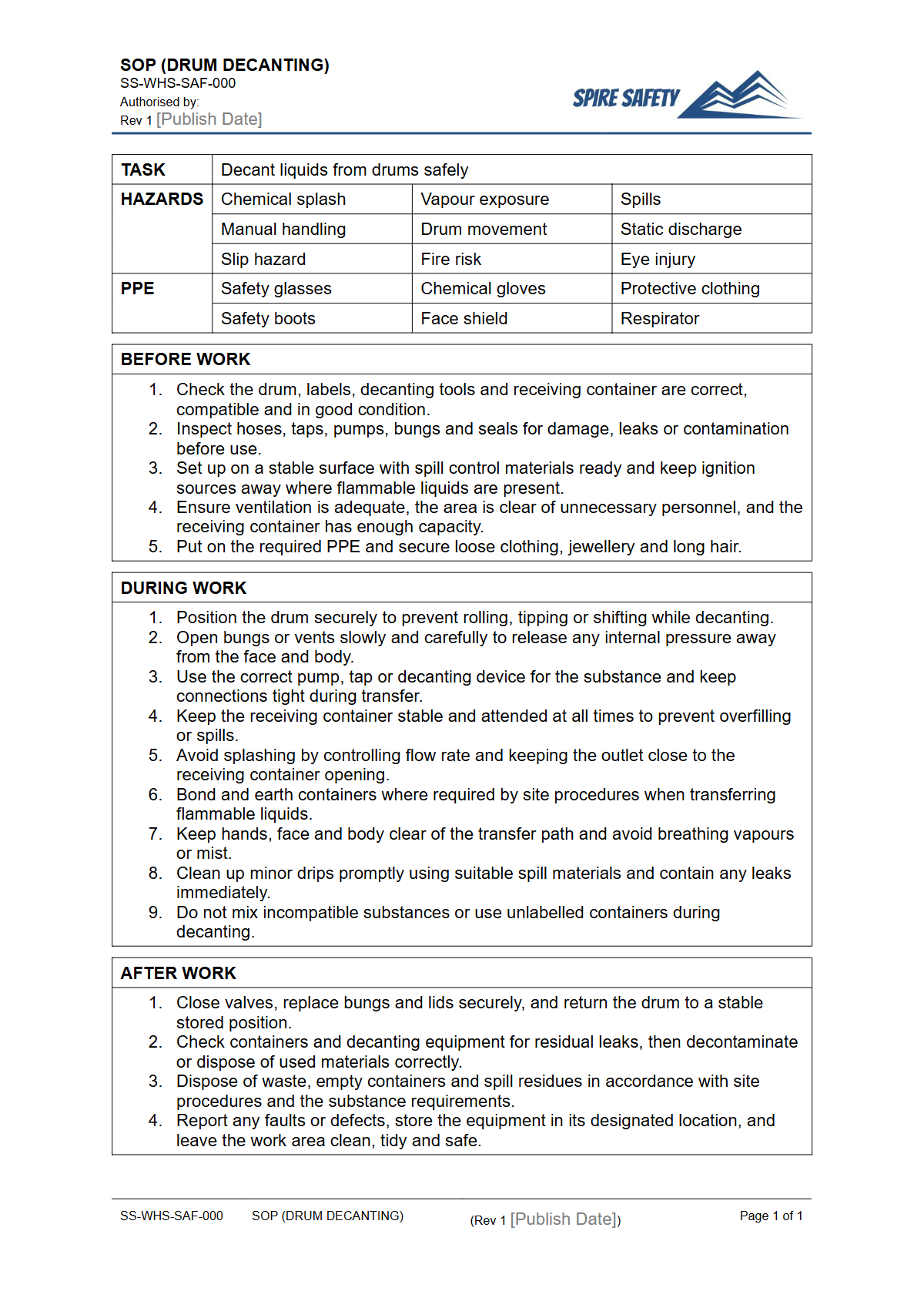
Download our free Safe Operating Procedure (Drum Decanting) Template to formalise safe work steps for transferring liquids from drums.
Free Safe Operating Procedure (Drum Decanting) Template
DOCX • 126 KB + PDF
Updated Oct 2026
No signup required
Purpose of the Free Safe Operating Procedure (Drum Decanting) Template
This Safe Operating Procedure (SOP) template provides a structured framework for documenting the safe decanting of substances from drums and large containers. Decanting, the process of carefully pouring a liquid from one container to another, presents numerous risks, including chemical spills, hazardous manual tasks, exposure to fumes, and potential fire or explosion.
Using this free Safe Operating Procedure (Drum Decanting) Template helps your organisation methodically identify these hazards and establish clear, step-by-step controls to ensure the task is performed safely and consistently by all workers.
The document is designed to be a key component of your broader safety framework, outlining prerequisite training, required Personal Protective Equipment (PPE), pre-operational checks, the decanting sequence, and post-task clean-up and emergency procedures. Formalising these steps helps standardise safe work practices, supports worker training, and demonstrates a commitment to meeting health and safety obligations.
This structured approach is fundamental to building robust WHS management systems that proactively manage risk.
Video walkthrough
How to use the Free Safe Operating Procedure (Drum Decanting) Template
This document serves as a comprehensive starting point, aligned with Australian WHS principles. To make it effective for your workplace, you must customise it with site-specific information.
Follow these steps to adapt the template:
- Conduct a Risk Assessment: Before customising the SOP, perform a thorough risk assessment for the specific drum decanting tasks at your site. Identify all potential hazards, such as the chemical properties of the substance, the weight and stability of the drum, the equipment used (pumps, cradles, funnels), and the work environment (ventilation, ignition sources).
- Insert Specific Details: Replace the generic placeholder text with details relevant to your operations. This includes specifying the exact types of drums, the chemical names and their Safety Data Sheets (SDS), the specific PPE required (e.g., nitrile gloves, chemical splash goggles, vapour respirator), and the model of any equipment used.
- Consult Your Workers: Under WHS law, consultation is mandatory. Involve the workers who actually perform the decanting task. Their direct experience is invaluable for identifying practical risks and effective controls that might otherwise be missed.
- Add Emergency Information: Detail your site-specific emergency procedures. Include the location of spill kits, safety showers, eyewash stations, and fire extinguishers. List emergency contact numbers and the procedure for reporting an incident.
Important: This template is a guide only. We have provided a solid foundation, but you are responsible for ensuring the final document accurately reflects the specific risks and control measures applicable to your workplace and the substances being handled.
When to use a Drum Decanting SOP
A Safe Operating Procedure for drum decanting should be developed and used whenever workers are required to transfer liquids from large containers (e.g., 20L, 60L, or 205L drums) to smaller ones. It is particularly critical in situations involving hazardous chemicals, flammable liquids, or substances that pose a health risk through inhalation or skin contact.
The SOP should be a primary reference document for worker induction, task-specific training, and refresher courses. It should also be readily available at the point of work for quick reference. Periodically reviewing the SOP is also essential, especially after an incident, when new chemicals or equipment are introduced, or as part of routine WHS compliance auditing.
Who should use this Safe Operating Procedure
This SOP is intended for use by several groups within an organisation:
- Workers and Operators: Individuals who physically perform the decanting task must be trained on and follow the procedures outlined in the finalised SOP to ensure their own safety and that of their colleagues.
- Supervisors and Managers: Team leaders and managers are responsible for ensuring workers are trained, competent, and adhere to the SOP. They use the document to supervise work, conduct safety observations, and investigate any deviations from the procedure.
- WHS Professionals and Safety Officers: Health and Safety advisors use the template to develop and implement standardised procedures. They also use it as a tool for risk assessments, incident investigations, and training program development.
- Persons Conducting a Business or Undertaking (PCBUs): Business owners and senior leaders have the primary duty of care. Implementing robust SOPs like this one is a key way they can demonstrate due diligence in providing a safe system of work. For related tasks involving mechanical aids, consider using our FREE Telehandler SOP (Safe Operating Procedure) Template to manage plant risks when positioning heavy drums.
In some scenarios, decanting might be part of a larger automated or semi-automated process. If a powered pump is used, it may be necessary to also develop procedures for the equipment powering it, which could involve referencing a specific Free Air Compressor SOP (Safe Operating Procedure) Template. For more documentation to support your safety system, you can browse our complete free WHS resources library.
Common mistakes
Common mistakes to avoid
- Using incorrect or damaged PPE (e.g., using latex gloves for a solvent that degrades them).
- Poor ventilation, leading to the build-up of hazardous or flammable vapours.
- Attempting to manually lift or tilt full or heavy drums without mechanical assistance.
- Not having a spill kit or emergency equipment immediately available and ready for use.
Legal references
Legal considerations
The following legal requirements may be relevant to this type of work.
- Work Health and Safety Act (Harmonised) — Provides the primary duties for protecting workers and other people from work health and safety risks.
- Work Health and Safety Regulations (Harmonised) — Sets out requirements supporting the management of workplace hazards and risks.
The following codes may be relevant to this type of work.
- Managing WHS Risks Code of Practice — Provides practical guidance on identifying hazards, assessing risks and applying effective controls.
- Work Health and Safety Consultation, Cooperation and Coordination Code of Practice — Provides practical guidance on consulting workers and coordinating with other duty holders.
- Managing the Work Environment and Facilities Code of Practice — Provides practical guidance on safe work environments, workplace facilities and related controls.
Did you know
Manual Task Risks
According to Safe Work Australia, manual handling injuries account for a significant portion of all serious workers' compensation claims. A single 205-litre drum of liquid can weigh over 200kg, making mechanical aids essential for safe handling.
Chemical Exposure
Many workplace chemicals can be absorbed through the skin or inhaled as vapour without any immediate noticeable effect. Chronic exposure to even low levels of some solvents and chemicals can lead to serious long-term health issues, highlighting the need for correct PPE and ventilation.
FAQ
Frequently asked questions
01What is the difference between an SOP and a SWMS for drum decanting?
02Does this drum decanting SOP cover manual handling risks?
03How often should a Safe Operating Procedure for drum decanting be reviewed?
04Where should the Safety Data Sheet (SDS) be kept during decanting?
Share this resource
Free Safe Operating Procedure (Drum Decanting) Template
Browse Categories
How To Use It
- 1Download and open in Word or PDF.
- 2Replace the placeholders with your business details.
- 3Get it reviewed by a WHS specialist before rollout.
Need it customised?
Our WHS consultants can adapt this template to your site, run a gap analysis, or audit what you already have in place.
Book a Free Consultation WHS consulting servicesor call 1300 156 382
Related templates
- Free Safe Operating Procedure (Drum Handler) Template
- Free Safe Operating Procedure (Drum Lifter) Template
- Free Safe Operating Procedure (Drum Pump) Template
- Free Safe Operating Procedure (Drum Sander) Template
- Free Safe Operating Procedure (Drum Transfer Pump) Template
- Free Safe Operating Procedure (Dry Cleaning Machine) Template