
Free Safe Operating Procedure (Drone Takeoff and Landing) Template
Document the safe operation of Remotely Piloted Aircraft (RPA) with our structured template. Download this customisable Safe Operating Procedure to get started.
Free Safe Operating Procedure (Drone Takeoff and Landing) Template
DOCX • 126 KB + PDF
Updated Oct 2026
No signup required
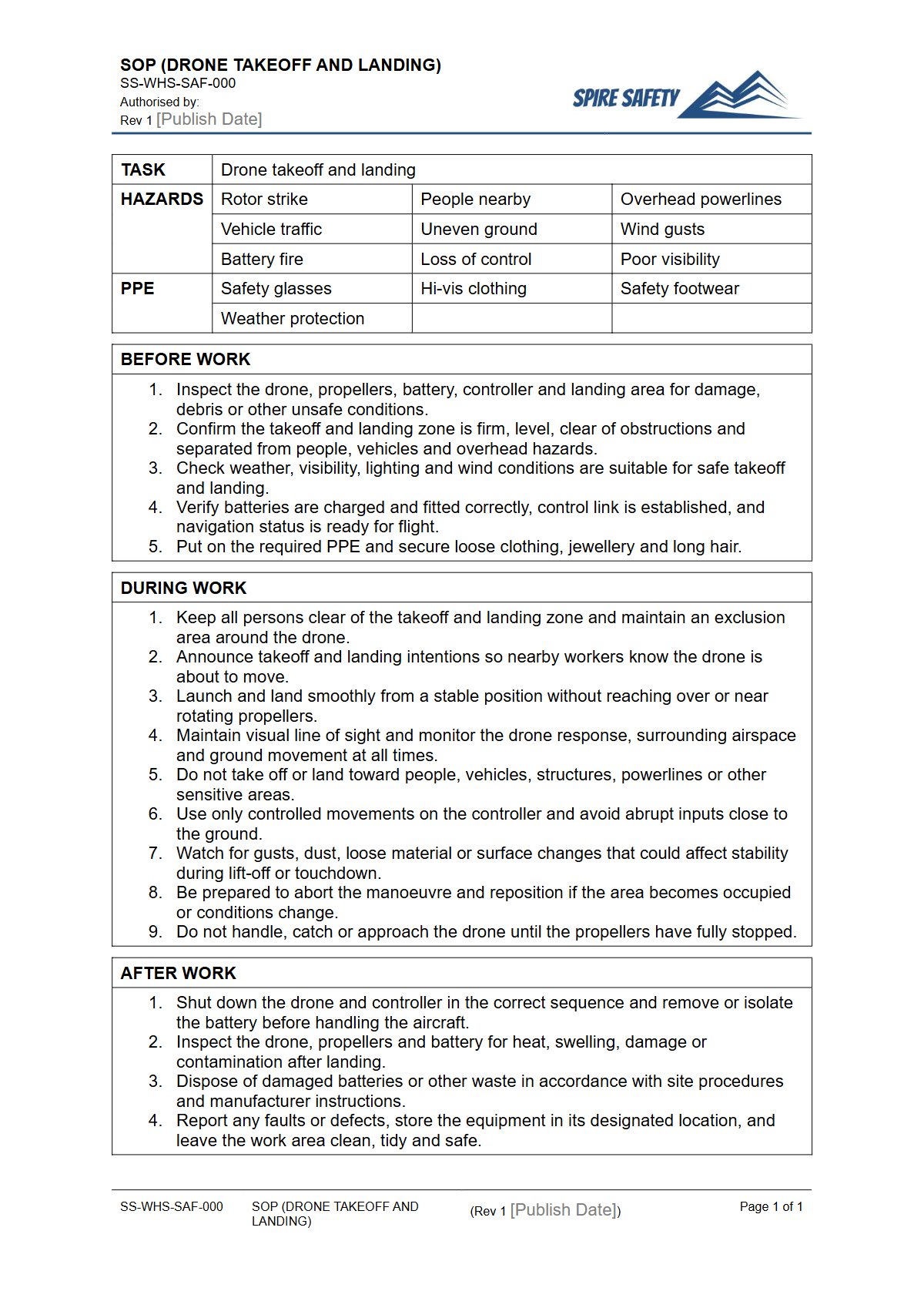
Purpose of the Free Safe Operating Procedure (Drone Takeoff and Landing) Template
Operating a Remotely Piloted Aircraft (RPA), commonly known as a drone, introduces significant workplace hazards. A formal, documented procedure is essential for managing these risks effectively.
This Free Safe Operating Procedure (Drone Takeoff and Landing) Template provides a structured starting point for organisations to define and communicate the required steps for safe drone operations. The primary purpose of this Safe Operating Procedure is to minimise risks such as loss of control, collisions with people or property, and equipment failure during the critical takeoff and landing phases.
By implementing a clear SOP, you establish a consistent, repeatable process that all certified operators must follow. This helps fulfil your duty of care as a Person Conducting a Business or Undertaking (PCBU) by providing a safe system of work.
A well-developed SOP is a critical component of broader WHS management systems, demonstrating a proactive approach to safety and operational discipline. It serves as a key training tool for new pilots and a reference document for experienced operators, ensuring everyone understands the expected safety standards and emergency responses.
Video walkthrough
How to use the Free Safe Operating Procedure (Drone Takeoff and Landing) Template
This template is designed as a foundational document. It must be adapted to reflect the specific circumstances of your workplace, the drone models in use, and the types of environments you operate in.
Download the DOCX file and begin by filling in the details of your organisation and the specific tasks the drone will perform. Review each section and add, remove, or modify steps to align with your operational realities and risk assessment findings.
Key customisation steps include:
- Specifying the make and model of the drone(s) covered by the procedure.
- Detailing the pre-flight inspection checklist specific to your equipment.
- Defining the criteria for a safe takeoff and landing zone (e.g., size, clearance from obstacles, public access control).
- Outlining communication protocols between the pilot and any observers or ground crew.
- Integrating site-specific emergency procedures for events like battery failure, loss of signal, or unexpected weather changes.
Note: We have created this template as a guide based on common Australian WHS practices. You must customise it to suit the unique risks, equipment, and environment of your business to ensure it is effective and relevant.
Regular WHS compliance auditing can help verify that your documented procedures are being implemented correctly in practice.
When to use this Safe Operating Procedure
A Safe Operating Procedure for drone takeoff and landing should be used and referred to before and during every flight operation. It is not a document to be filed away; it is an active tool for managing risk.
It is particularly crucial during the planning phase of any project involving drone use, helping to identify potential hazards and establish controls before the drone even leaves the case. The SOP should be a mandatory part of pilot induction and training, ensuring a baseline level of operational safety is understood from day one.
Furthermore, the SOP must be reviewed and consulted after any incident or near-miss to identify procedural gaps that may have contributed to the event. For complex worksites that utilise various types of machinery, this document integrates with other procedural controls, such as a FREE Telehandler SOP Template, to create a comprehensive safety framework.
Who should use it
This Safe Operating Procedure is intended for use by multiple roles within an organisation. WHS Managers and Supervisors should use it to develop, implement, and review the safety standards for drone operations.
They are responsible for ensuring the procedure is available, understood, and followed by all relevant personnel. Remotely Piloted Aircraft (RPA) Operators are the primary users of the SOP, following its steps during pre-flight, takeoff, landing, and post-flight activities.
Project managers and site supervisors who oversee work involving drones should also be familiar with the SOP to ensure flight operations are integrated safely with other site activities. The document helps them understand the requirements for establishing safe exclusion zones and managing ground-level risks.
Having documented procedures for all equipment, from drones to workshop tools like those covered in a FREE Circular Saw SOP Template, fosters a consistent safety culture. You can find more templates like this in our complete free WHS resources library.
Common mistakes
Common mistakes to avoid
- Failing to conduct a thorough pre-flight site assessment for new hazards.
- Neglecting to check and monitor weather conditions before and during the flight.
- Operating without clear communication protocols between the pilot and ground personnel.
- Using a generic SOP without customising it for the specific drone model and location.
Legal references
Legal considerations
The following legal requirements may be relevant to this type of work.
- Work Health and Safety Act (Harmonised) — Provides the primary duties for protecting workers and other people from work health and safety risks.
- Work Health and Safety Regulations (Harmonised) — Sets out requirements supporting the management of workplace hazards and risks.
The following codes may be relevant to this type of work.
- Managing WHS Risks Code of Practice — Provides practical guidance on identifying hazards, assessing risks and applying effective controls.
- Work Health and Safety Consultation, Cooperation and Coordination Code of Practice — Provides practical guidance on consulting workers and coordinating with other duty holders.
- Managing the Work Environment and Facilities Code of Practice — Provides practical guidance on safe work environments, workplace facilities and related controls.
Did you know
Drone Adoption
In Australia, the construction and agriculture industries are two of the largest adopters of commercial drone technology, using them for surveying, asset inspection, and monitoring.
FAQ
Frequently asked questions
01Is a Safe Operating Procedure for drones legally required in Australia?
02What should be included in a drone takeoff and landing procedure?
03Does this template cover CASA regulations?
04How often should our drone SOP be reviewed?
Share this resource
Free Safe Operating Procedure (Drone Takeoff and Landing) Template
Browse Categories
How To Use It
- 1Download and open in Word or PDF.
- 2Replace the placeholders with your business details.
- 3Get it reviewed by a WHS specialist before rollout.
Need it customised?
Our WHS consultants can adapt this template to your site, run a gap analysis, or audit what you already have in place.
Book a Free Consultation WHS consulting servicesor call 1300 156 382
Related templates
- Free Safe Operating Procedure (Drop Saw Mitre Saw Operation) Template
- Free Safe Operating Procedure (Drum Decanting) Template
- Free Safe Operating Procedure (Drum Handler) Template
- Free Safe Operating Procedure (Drum Lifter) Template
- Free Safe Operating Procedure (Drum Pump) Template
- Free Safe Operating Procedure (Drum Sander) Template