
Free Safe Operating Procedure (Driver Vehicle Handover) Template
Formalise your vehicle handover process with our structured Safe Operating Procedure. Download our free Driver Vehicle Handover SOP template to improve safety.
Free Safe Operating Procedure (Driver Vehicle Handover) Template
DOCX • 126 KB + PDF
Updated Oct 2026
No signup required
Purpose of the Free Safe Operating Procedure (Driver Vehicle Handover) Template
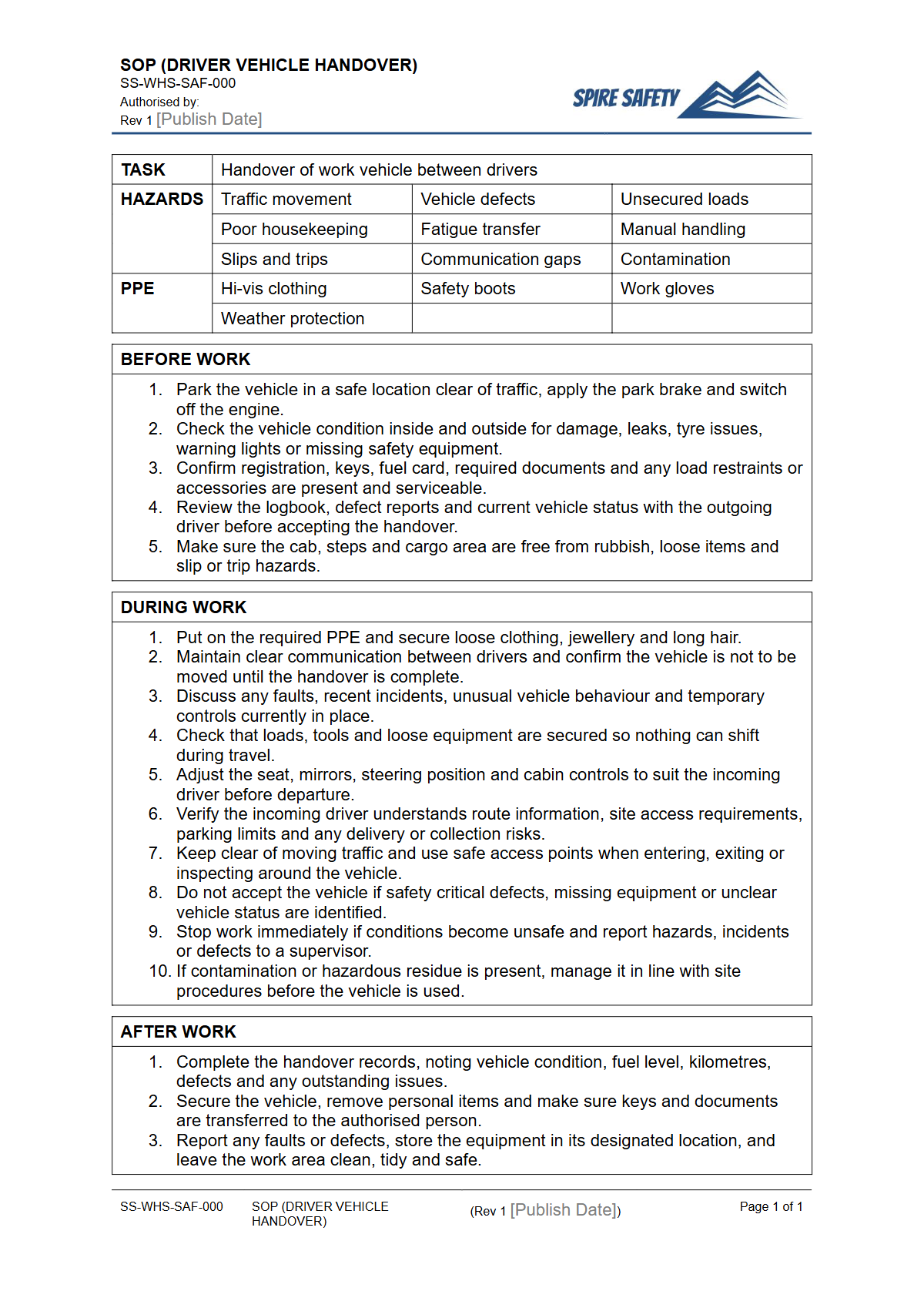
Transferring control of a company vehicle or mobile plant between operators is a critical control point for workplace safety. This Free Safe Operating Procedure (Driver Vehicle Handover) Template provides a structured framework to manage this process effectively.
It helps formalise the steps for inspection, communication, and responsibility transfer, ensuring that every operator is aware of the vehicle's condition before they begin their work. Using a standardised procedure helps identify defects, damage, or cleanliness issues early, preventing potential incidents and costly repairs.
It also creates a clear, auditable record of vehicle condition and operator accountability, which is a key component of a robust safety management system.
Implementing this SOP helps an organisation fulfil its primary duty of care by providing a safe system of work. It ensures that vehicles are maintained in a safe condition and that operators are not exposed to unnecessary risks from faulty equipment.
This process is fundamental to managing mobile plant hazards across various industries, from logistics and construction to agriculture and mining. Developing and embedding these procedures can be a complex task, and forms one part of building comprehensive WHS management systems.
Video walkthrough
How to use the Free Safe Operating Procedure (Driver Vehicle Handover) Template
This template is provided in both DOCX and PDF formats to suit your needs. The DOCX version is fully editable, allowing you to adapt it to the specific requirements of your workplace.
To use it effectively, download the file and begin customising the content to reflect your organisation's fleet, operational context, and risk profile. This includes adding specific vehicle types, listing common checkpoints relevant to your equipment, and assigning responsibilities to specific roles like 'Operator' or 'Supervisor'.
You should integrate your own company branding, site-specific emergency procedures, and contact details for reporting faults. The checklist component of the SOP prompts a physical inspection, similar to the pre-start checks outlined in our FREE Grader SOP Template, ensuring defects are caught before they become a hazard.
Once customised, the procedure must be communicated to all relevant workers, with training provided to ensure they understand their obligations.
Important: This document is a template and must be customised to suit the specific vehicles, tasks, and hazards present in your workplace. Its effectiveness is entirely dependent on its correct adaptation and implementation.
We are not liable for any incidents that may arise from the use of this document.
When to use it
The Driver Vehicle Handover SOP should be used every time operational control of a workplace vehicle or piece of mobile plant is transferred from one person to another. This applies to a wide range of scenarios, including shift changes where one driver relieves another, when a vehicle is returned to a shared pool, or when an operator takes a vehicle for the first time that day.
It is equally important after a vehicle has undergone maintenance or repair to verify it is safe to return to service.
Consistent application of this procedure is crucial for managing risk, whether it's a light vehicle, a forklift, or heavy machinery like the equipment covered in our FREE Dozer SOP Template. By making the handover a formal, documented process, you eliminate ambiguity and ensure a consistent safety standard is maintained across all operations, regardless of who is operating the vehicle.
Who should use it
This procedure is designed for use by multiple roles within an organisation. Primarily, vehicle operators and drivers are the ones who will complete the checklist during the physical handover.
Supervisors and managers are responsible for implementing the procedure, ensuring workers are trained on its use, and reviewing the completed records to identify trends in vehicle faults or operator behaviour. Fleet managers can use the data from these handovers to schedule maintenance and track the lifecycle of assets.
WHS advisors and personnel should also be familiar with this SOP as it forms a critical part of the overall risk management plan for plant and equipment. This applies to operators of all types of workplace vehicles, from delivery vans to specialised plant like that detailed in the FREE Telehandler SOP Template. Regularly reviewing the effectiveness of this procedure is a key part of maintaining safety standards, which can be verified through a formal WHS compliance audit.
Integrating clear procedures like this one into daily operations strengthens your safety culture by demonstrating a commitment to proactive risk management. You can find more templates to support your business in our free WHS resources library, covering a wide range of equipment and high-risk tasks.
Common mistakes
Common mistakes to avoid
- Assuming a verbal handover is sufficient without written records.
- Failing to customise the generic checklist for specific vehicle types and risks.
- Not clearly assigning responsibility for rectifying and closing out reported defects.
- Forgetting to train workers on how to properly follow the handover procedure.
Legal references
Legal considerations
The following legal requirements may be relevant to this type of work.
- Work Health and Safety Act (Harmonised) — Provides the primary duties for protecting workers and other people from work health and safety risks.
- Work Health and Safety Regulations (Harmonised) — Sets out requirements supporting the management of workplace hazards and risks.
The following codes may be relevant to this type of work.
- Managing WHS Risks Code of Practice — Provides practical guidance on identifying hazards, assessing risks and applying effective controls.
- Work Health and Safety Consultation, Cooperation and Coordination Code of Practice — Provides practical guidance on consulting workers and coordinating with other duty holders.
- Managing the Work Environment and Facilities Code of Practice — Provides practical guidance on safe work environments, workplace facilities and related controls.
Did you know
A Preventable Problem
A significant portion of vehicle-related incidents can be traced back to mechanical failures or missing safety equipment that a thorough pre-start or handover check could have identified.
High-Risk Industry
In Australia, the transport, postal, and warehousing industry consistently has one of the highest rates of work-related fatalities, with a large number of these incidents involving vehicles.
FAQ
Frequently asked questions
01What should be included in a driver vehicle handover checklist?
02Why is a formal vehicle handover SOP important for WHS?
03How often should vehicle handover procedures be reviewed?
04Does this template cover heavy vehicles and mobile plant?
Share this resource
Free Safe Operating Procedure (Driver Vehicle Handover) Template
Browse Categories
How To Use It
- 1Download and open in Word or PDF.
- 2Replace the placeholders with your business details.
- 3Get it reviewed by a WHS specialist before rollout.
Need it customised?
Our WHS consultants can adapt this template to your site, run a gap analysis, or audit what you already have in place.
Book a Free Consultation WHS consulting servicesor call 1300 156 382
Related templates
- Free Safe Operating Procedure (Drone Ground Handling) Template
- Free Safe Operating Procedure (Drone Takeoff and Landing) Template
- Free Safe Operating Procedure (Drop Saw Mitre Saw Operation) Template
- Free Safe Operating Procedure (Drum Decanting) Template
- Free Safe Operating Procedure (Drum Handler) Template
- Free Safe Operating Procedure (Drum Lifter) Template